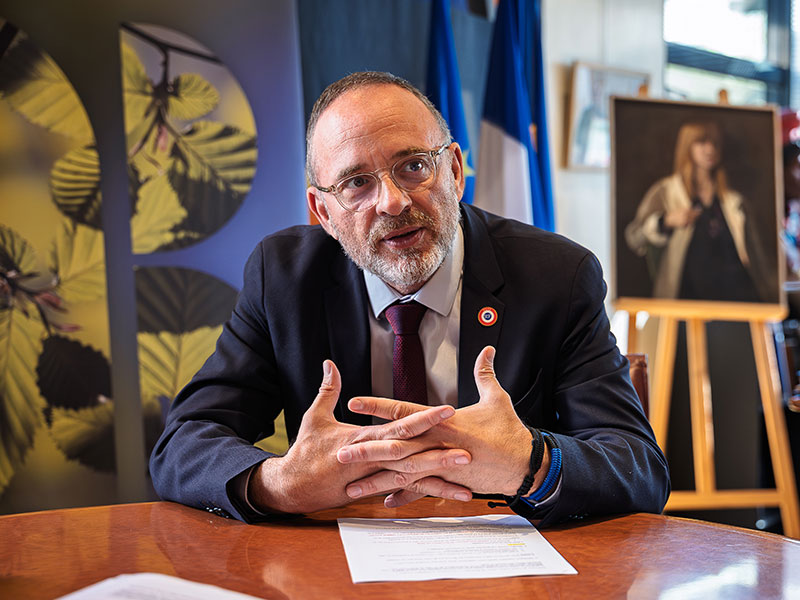
Re-elected mayor of Bourges in 2026, lawyer Yann Galut, a man of the left and former deputy for Cher, carried the colors of his city to the pediments of the European Capitals of Culture.
Bourges as European Capital of Culture, is it a default choice compared to metropolises?
No way. The jury made a strong political choice by favoring a city on a human scale. Since the health crisis, we have observed a real need for proximity and Bourges shows that culture can exist elsewhere than in metropolises. Other cities of similar size, such as Matera in Italy, Évora in Portugal or Mons in Belgium, have already been chosen. Culture is an engine of development everywhere, whatever the size of the territory.
Difficult to attract an international audience without a direct TGV, right?
In reality, our strength lies in praising slowness. Rather than being isolated, the idea is to invite Europeans to use soft mobility such as night trains, whose journeys become cultural thanks to the artistic journeys on board. The program goes beyond the city with the “Soleil ligérien” project, an artistic stroll through the Centre-Val de Loire region. We are adapting to new travel patterns, because although 70% of the public will undoubtedly be French, we are also targeting an international clientele ready to settle down for stays of four to six days, two hours from Paris and three from Lyon.
Concretely, what role does your partnership with SNCF play?
SNCF is a premium sponsor and a key partner. Special trains will connect major cities to Berry with “3-day packs” offers including access to the opening ceremony, exhibitions and events.
Packs that will include both train travel and a three-day pass…
No doubt, but for the moment nothing is certain, because we are in the process of building the offer with the SNCF. But there will also be very concrete offers with additional trains offered from Paris.
And regarding the operating budget, has it now been established?
Yes, around 40 million euros. It was stabilized with the confirmation of the participation of the State, our first financier, against 46 million euros of initial forecast. The new arbitrations induced by the financial crisis have reduced the State’s contribution to 10 million euros instead of the 12 million euros planned and several partner funding has been reduced or eliminated, notably that of neighboring departments. We resized the project.
What exactly does “resize” mean?
This only concerns artistic programming…
Not heritage then…
No for heritage renovations, we will be ready.
Exactly, where are we today with the 100 million planned investments?
We are rather between 50 and 60 million euros, an envelope intended for the renovation of cultural buildings and the transformation of key infrastructures such as the station. The renovation of the Hôtel-Dieu, renamed the Mélina Mercouri Center and which will house the European City of Artists, has increased from 4 to 6 million euros. The Halle aux Blés, which will host international exhibitions, is being renovated for 4 to 5 million euros. This decline is explained by the withdrawal of the project concerning the old cultural center.
Was the renovation of the old cultural center abandoned?
Yes, the vagaries of political change. The new president of the agglomeration, Richard Boudet, elected at the beginning of April, decided to withdraw from the project carried out by his predecessor, Irène Félix, because he considers it too costly. The renovation, estimated at 35 million euros, was also based on the provision of public resources, civil servants and spaces, which the new elected official deemed unsustainable. He preferred to stop the project to start from scratch without yet specifying his intentions.
And what about patronage in all this?
He too was rejected. Initially established at 6 million euros, it was adjusted to 5 million euros. Two years before the event, we have already secured 1.2 million euros, but including the financing currently being signed, we have raised 40% of this objective.
By scaling down the project, don’t you lose the “wow” effect?
I am not responsible for the state’s debt or budget cuts, our role is to adapt. The “wow” effect is not due to the means, but to the ambition to make a territory of 100,000 inhabitants the cultural center of Europe for a year. It’s already exceptional. It will come above all from the profusion and creativity, renowned artists, shows, exhibitions, strolls and concerts throughout the city. The Printemps de Bourges will also take on an unprecedented scale.
The attendance objectives therefore remain the same…
Bourges welcomes around one million visitors per year and we are targeting between two and three million in 2028. We know how to manage significant peaks, in particular thanks to the Printemps de Bourges which brings together up to 50,000 people. The accommodation offer is being strengthened with four new hotels including a Radisson, an increase in guest rooms and 800 Airbnb rentals.
But Bourges, pillar of armaments, is this compatible with the peace values of the European label?
There is no contradiction. Europe realized that it had to build its own defense to no longer depend solely on the United States. Having a strong industry means giving yourself the means to resist aggression and protect peace. So the peace values of the European label are also identified with European defense.
In this context, are arms company groups like MBDA or Nexter involved in sponsorship?
Not at the moment, but we are in discussions with them. The idea is to directly involve their employees in the adventure, which would be a strong symbol of territorial integration.
Finally, Mediapart spoke of internal tensions and management considered too vertical in 2025. Where is the situation today?
These tensions came from a report that we ourselves had commissioned and were largely linked to budgetary uncertainties which blocked our commitments to artists and teams. Since then, the situation has calmed down and work has resumed, notably with the appointment of Jean-François Chougnet as executive president of the Bourges 2028 association last September.
Resize, instructions for use
Programming. “ Due to the drop in operating budgets now between 35 and 38 million euros (a figure lower than that put forward by Mayor NDA), we will resize artistic projects with reductions of 10 to 15% depending on their typology”explains Pascal Keizer, general commissioner of the Bourges 2028 association. He further specifies that “this budget per inhabitant still remains three times higher than that of Marseille”. But what exactly does it mean “resize” ? For Frédéric Hocquard, general delegate of the association, these are concrete adjustments. “The five or six green stations initially planned will be reduced to three, and the seven or eight Loire Suns, imagined by David Moinard, are around five today”he confides. The Carasso foundation, involved in this latest project, will also provide funding of 400,000 euros. For the two responsible, the effect “wow” will remain intact. They cite in particular the opening weekend designed on the scale of the entire urban area, as well as L’Internationale des rivières by Camille de Toledo and “Ligerian sun”.