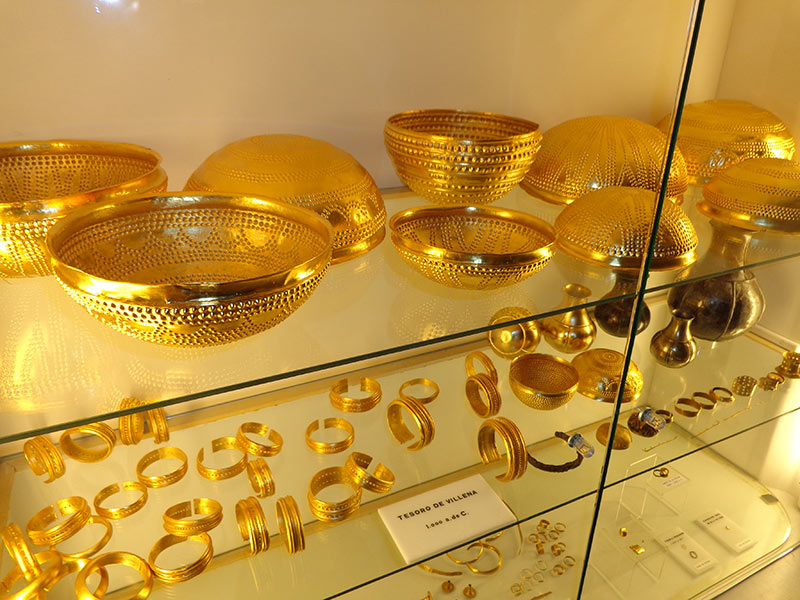
A new European museum has been the target of a spectacular theft of gold objects. On the night of August 26 to 27, burglars broke into the Villena Museum (MUVI), in the Valencian Community, and took away most of the famous Villena Treasure, one of the most important sets of Bronze Age goldwork in Europe.
Discovered in 1963, the treasure is made up of 59 objects corresponding to 66 elements, for a total weight close to 10 kg, including around 9 kg of gold. It notably includes eleven containers, twenty-eight bracelets, three bottles and various pieces of jewelry in gold, silver, iron and amber. The thieves did not, however, take the entire set: the three silver containers, a bracelet and a large part of the elements making up the “Bastón del Reyezuelo” escaped the theft.
The criminals entered the museum around 5:20 a.m. A first alarm sounded at 5:16 a.m. in a sports complex located approximately two kilometers away. Investigators are seeking to establish whether this intrusion constituted a diversion intended to ward off law enforcement. At 5:23 a.m., the museum alarm was triggered; when the first officers arrived a few minutes later, the perpetrators had already left the scene. A witness reported two vehicles traveling at high speed on the A-31 motorway towards Madrid.
The operation would have only lasted about four minutes. The burglars tried unsuccessfully to force a rear door, before entering the building through a window. They then managed to perforate the high security glazing protecting the Treasury. The numerous images recorded by the museum’s interior and exterior cameras are now used by the Civil Guard. Initial information reported several individuals and several vehicles.
The speed of the burglary immediately raised the question of the security of the MUVI, inaugurated in its current premises in 2024. Management has since detailed a nevertheless substantial system: five alarm systems constituting several protection perimeters, night vision cameras and a treasure room designed as an armored room of some 75 m². Its walls and ceiling are reinforced with steel plates and the window was protected by high security glazing. The equipment is subject to quarterly checks, the last of which was carried out on August 3, three weeks before the flight. The security system is approved at level 3 and two audits preceded the opening of the museum.
Theft is not limited to archaeological pieces. Three of the four historic crowns of the Virgin of Virtues, patroness of Villena kept at the museum have also disappeared. Two are gold crowns made in 1948 for the Virgin and Child from jewelry donated by residents of Villena. The third, called the Piñero crown, is a silver piece dated 1713. A fourth crown, smaller in size and intended for the child Jesus, remained in the museum: the thieves seem to have dropped it during their flight.
The Tesorillo de Cabezo Redondo, another exceptional archaeological ensemble preserved at the MUVI, was, however, not taken away. Discovered a few months before the Villena Treasure, in the spring of 1963, on a neighboring site, it brings together 35 gold pieces weighing 147 grams: a tiara, three bracelets, three spirals, thirteen rings, ten conical pendants, two strips, a necklace pearl, a fragment of a bracelet decorated with points and a fragment of an ingot.
The heritage importance of the Villena Treasure makes any financial estimate largely theoretical. Its reference value for insurance would reach 5 million euros, while the value of the metal alone would be around a million euros. The main risk is precisely that the pieces will be melted: their extremely recognizable nature makes their marketing as archaeological objects particularly difficult.
The burglary opened a controversy over responsibilities. On August 29, the Association for the Defense of the Rule of Law and the Fight against Corruption filed a complaint targeting Villena Mayor Fulgencio Cerdán and other municipal officials. She asks the courts to determine whether the absence of human supervision during closing hours can constitute a breach of the obligation to protect heritage property.
The Villena Treasure was unearthed in December 1963 after the accidental discovery, a few weeks earlier, of a gold bracelet in the rubble by the worker Francisco García Arnedo. Alerted by a jeweler to whom the piece had been presented, archaeologist José María Soler undertook research which led to the discovery of the deposit. Classified as an Asset of Cultural Interest in 2005, the ensemble is generally linked to the end of the Bronze Age, with recent studies proposing a chronology around the 14th-13th centuries BC.