Burgos,
Painting and photography are the focus of the three new exhibitions hosted by the Caja de Burgos Art Center until next January. Two of them feature young painters; the third, a more than established photographer.
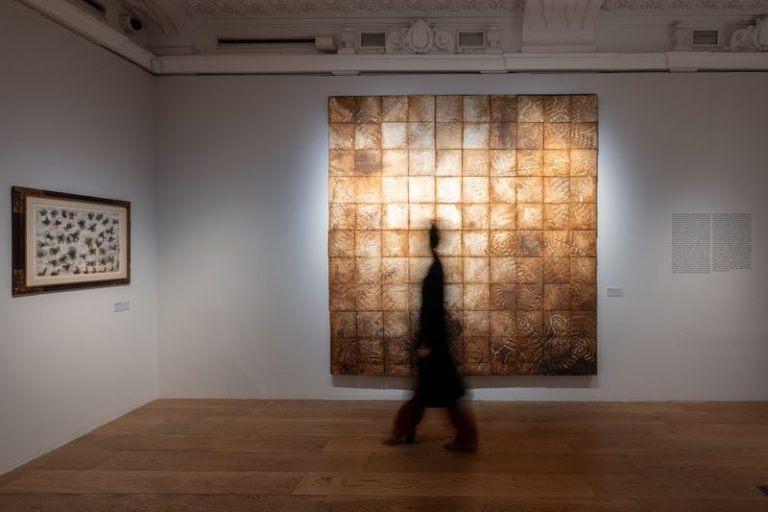
The proposal by Alain Urrutia, from Bilbao in 1981, is called “Regard sur le regard”. The basis of his painting has been the everyday environment: this artist has a photographic archive under construction that is fed by his own images and others obtained from the press, the Internet or television, representing collective memory. He selects them by feeling attracted to them consciously or unconsciously, and does not transfer them through mechanical or digital procedures to his paintings, but rather uses them as a means of constructing his works and as a tool to put his ideas in order.
We can say that his compositions are the result of new readings of already existing images and a process of fragmentation, reconstruction and elimination of the stories that those original photos addressed. This procedure is carried out through games of shadows, the use of layers of black and white that create multiple grays, the mastery of concealment and reframing techniques to highlight details, generate tension and mystery or give the pieces an evanescent atmosphere, which we could relate to the literature of Alessandro Baricco and his resort to permanent doubt when narrating.
In many of his works we found apparent blurred faces, but not anonymous ones: we could not consider them mere portraits, they had their past, and for this reason, and because they were unrecognizable to us, they allowed us an only intuitive identification. This is not the case of the pieces that Urrutia is now showing us in Burgos: they are half a dozen diptychs that partially contain faces from the History of Art, archaeological, sculptural and pictorial icons whose eyes are directed at the viewer, engaging in an exchange of glances.
These compositions, practically unpublished given that they have only been seen for a few days in a Berlin industrial warehouse, also stand out for their large format, which has nothing circumstantial: their scale determines a particular relationship of the public with them, one linked to submission and subordination to the emblems of our heritage.

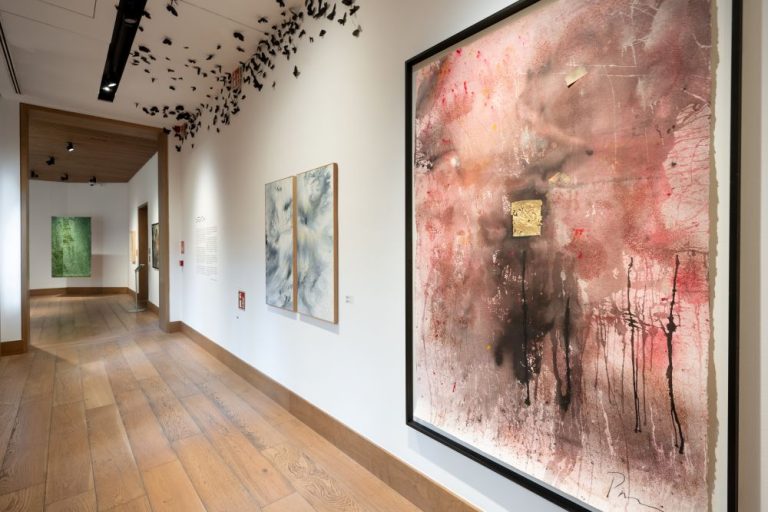
Urrutia shares a generation with the Madrid-born Virginia Rivas, who has made color the protagonist of her paintings, in conjunction with gesture and light. Its exhibition at the CAB is titled “The Color of Noise” and is based on the accepted chromatic identification of the sound spectrum, on the analogies between visible and audible waves. According to the most common theories, a uniform noise power can be identified with the target; The rest of the tones are linked to bass sounds and low frequencies.
The exhibition consists of five autonomous installations, but related to each other, in the colors white, pink, gray, green and brown. Contemplating the space of the CAB from each of them, indicated by a translucent column, we will see that our perception of the whole is transformed and that the analogies between these tonalities and the sound textures gain weight. If we think about it, in fact, sometimes we use the same terms to refer to the palette and what we hear: coloration, tonality, spectrum…
In Rivas’s research, the spectrographies of noises (sea waves for pink; rain for green, electronic interference for gray; static signals for white and natural agents for brown – rather red -) have given rise to specific colors, created by the artist, who has focused on the use of noise in sound therapies used to alleviate problems with sleep, concentration, anxiety and tinnitus (the ailment consisting of hearing internal whistling). Rivas remembers, in that sense, that the blue and violet noisesbecause they are very sharp, they are not used for that medical purpose.
The instruments of his studies (notes, notes, slides, electronic configurations, tests, color palettes and paint mixtures created for each noise) can also be seen in the CAB, in a specific room.


Finally, Cristóbal Hara, National Photography Prize winner in 2022, worked until the eighties in black and white and since then in color, diluting the barriers between the image-document and fiction and incorporating multiple references to painting, literature and popular culture.
His exhibition in Burgos is called “Principiante”, it has been co-produced with the Juan March Foundation, and consists of a selection of his images dated between the sixties and the eighties, some not presented until now: Hara has reviewed his negatives and first prints for the occasion, he has printed and edited new prints.
They belong to the series Soldier in Spain, Children of Cuenca and Spanish photographs and they anticipate the originality of the frames of his color production, in which, often, the fundamental motif seemed to be located at the extremes.
In his snapshots, the theoretically anecdotal becomes a symptom; the rarity, in typism. He often paraphrases Ortega y Gasset: Only the fantastic can be exact.


Alain Urrutia. “Regard sur le regard”
Virginia Rivas. “The color of noise”
Christopher Hara. “Beginner”
CAJA DE BURGOS ART CENTER. CAB
C/ Saldaña, s/n
Burgos
From October 3, 2025 to January 18, 2026