While the streets of Messina were in jubilation on the occasion of the traditional Vara procession, celebrating the Assumption of the Virgin on August 15, major works by Antonello di Messina were stolen from the city’s regional museum (MuMe).
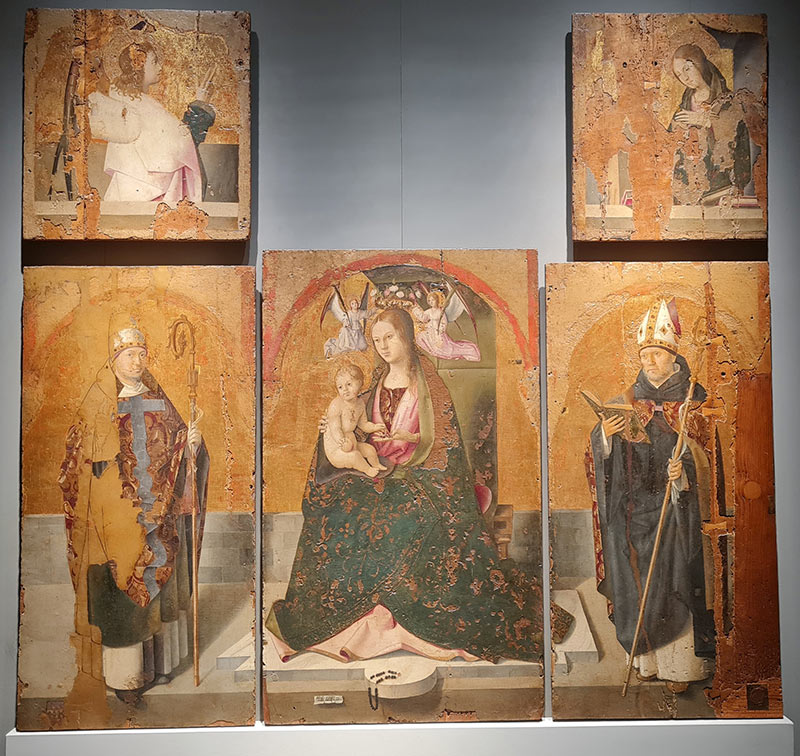
The burglary, which occurred around 9 p.m., took place in less than 3 minutes. After forcing a side door, two individuals ran without hesitation towards the rooms where the coveted works were located: the polyptych of Saint Gregory, of which the criminals were only able to take three panels out of five, and a small painting representing a Madonna accompanied by a Franciscan monk in adoration on the front and a Christ in Pietà on the back. The total sum of these works, “priceless” according to the museum teams, was valued according to an expert between 70 and 80 million euros.
Antonello of Messina (1430-1479), Madonna accompanied by a Franciscan monk in adoration (front) and Christ in Pietà (back).
© Regional Museum of Accascina Messina (MuMe)
Not excluding the possibility of a mafia operation, the Messina public prosecutor’s office mandated the Comando Carabinieri Tutela Patrimonio Culturale (TPC), a special unit dedicated to the fight against illegal trafficking of cultural property, to assist the national police in charge of the investigation. Unsaleable on the art market due to their uniqueness which makes them very recognizable, works of art of this type are likely to circulate on criminal networks. The speed of the operation also led investigators to suspect internal complicity: the four MuMe guards on duty the evening of the theft were questioned by the police.
In their flight, the perpetrators of the burglary abandoned the two panels of the upper register of the Saint-Grégoire altarpiece, which were then recovered by the police. They compose a framing Annunciation depicting the archangel Gabriel on the left, and the Virgin announced on the right. But the three temperas of the central register, representing Gregory I, the Virgin and Child, and Benedict of Nursia have disappeared. Originally, a sixth panel completed the polyptych painted in 1473 which was probably to represent the deposition of Christ, but it has been lost for several centuries.
The entire altarpiece, which adorned the monastery of Santa Maria Extra Moenia in Messina, is the only major work by Antonello still preserved in his hometown. The loss is all the heavier as Antonello’s work is widely dispersed in the country and elsewhere. Museum director Marisa Mercurio described works having “considerable importance for our identity”. A few months ago, during the spectacular purchase of theEcce Homo by the Italian state, entrusted to the Abruzzo Museum in L’Aquila, the autonomous Sicilian government had requested that the painting be allocated to a museum on the island and thus return to its land of origin.
This new theft seems to confirm the vulnerability of Italian museums. Target of a major burglary last March, the Magnani Rocca Foundation had three paintings by Matisse, Cézanne and Renoir stolen, for a total value estimated at around 9 million euros. Bitter coincidence, the Italian police were delighted to have found these works the day before the August 15 heist.