Paris. “Abakans”? There was a need for a new term in the history of art to designate the forms invented by the Polish visual artist Magdalena Abakanowicz (1930-2017). That this name is derived from his surname is not insignificant: the “Abakans” alone embody the essence of his artistic approach.
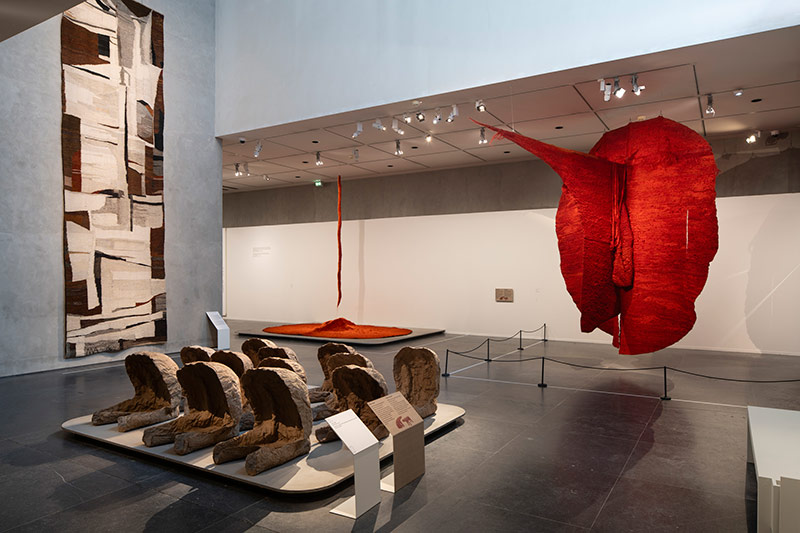
These hybrids between weaving and sculpture, these enveloping layers of fabric, both heavy and flexible, are suspended from the ceiling and descend almost to the floor [voir ill.]. In places they leave openings which can suggest, according to the commissioners, “the flesh peeled from wood, the fur of an animal, the curved lips of a woman”. For the artist, these are above all places to shelter (Black outfit1975). The spectator, for his part, wonders when faced with these forms, which are both absorbing and disturbing: cocoons or floating sea monsters? Whether welcoming or aggressive, these works allow Abakanowicz to question the ambiguous and shifting links between the intimate sphere and the surrounding space.
Magdalena Abakanowicz, a rare artist to achieve international recognition behind the Iron Curtain, began with painting. She then chooses fiber – living and malleable – as the texture and support for her works. This use of weaving challenges the traditional hierarchy established by art history, which has long relegated this discipline to the domain of craftsmanship. Despite the valorization of the decorative arts and the importance that Matisse or Paul Klee gave to tapestry, it is above all the image produced on the surface of the textile which remains determining.
View of the exhibition “Magdalena Abakanowicz, the fabric of existence” at the Bourdelle Museum.
© Nicolas Borel
Invited in 1962 to the first International Tapestry Biennial in Lausanne, Switzerland, Abakanowicz created Composition of white shapesa monumental canvas in vertical format – more than 6 m high – which caused scandal. However, the work, covered with geometric shapes inherited from the tradition of Polish constructivism, still retains a two-dimensional appearance. Gradually, however, the works gain in relief, when the regular and tightly controlled aspect of the weaving frees itself from repetitive harmony to give way to overflow and incompleteness (Shells1973). The emphasis on relief and thickness, but above all the radical gesture by which the weaving detaches itself from the wall to unfold in space, leads to the sculpture-installations that constitute the “Abakans”.
Does the artist then feel the need to continue her reflection on the body in a more explicit way? The strange headless creatures, lined up in rows, these crowds frozen as if petrified, or even the famous “Back Figures”, make up an army of similar but never identical beings. Should we see in it the reflection of an existence marked by war as well as by the communist regime? Abakanowicz does not comment. The fact remains that these strange, archaic animals, locked in a heavy silence (Standing Mutants1992-1994), just like the “War Games” series (1982), menacing assemblages of wood and steel, deliver a not very reassuring vision of humanity.