
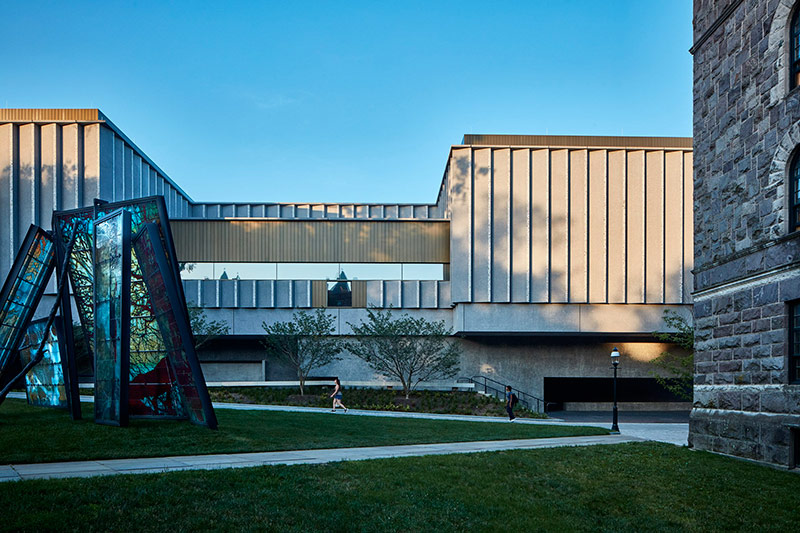
New Jersey (United States). The campus of Princeton University invites you to stroll, with its stylish building Gothic Revival to another imbued with modernism. Ralph Adams Cram, Robert Venturi (1863-1942) and Frank Gehry (1929-2025), are the great builders of this university founded in 1746. Since then, it has continued to expand or transform. Along the paths, the visitor crosses an open-air museum retracing the history of American architecture. Latest opus inaugurated at the end of 2025, after five years of work, the Princeton University Art Museum (PUAM) continues this eclectic score in neo-brutalist mode. Its concrete blocks, with their austere geometry, seem to levitate above a few parasols and a landscaped garden level.
The museum, whose cost was estimated at $300 million ($260 million), was designed by David Adjaye (born 1966), the critically acclaimed British-Ghanaian architect to whom, among other things, the new Studio Museum in Harlem is due. However, a dark side appears in 2023 during the construction of the Princeton building. The Financial Timess reveals that the talented David Adjaye is accused, by three of his collaborators, “sexual exploitation, harassment and creation of a hostile work environment within his office”. The facts are denied by Adjaye who withdraws. Cooper Robertson, the architectural firm in charge of the site, is finalizing the museum.
From the outside, the buildings that make up the complex are opaque, only the folds of the concrete, which have become moldings, punctuate the facade. In a faithful interpretation of Brutalism, few windows are visible. However, you just have to enter the interior of the place to discover numerous pierced bays providing light to the exhibition rooms and perspectives on the campus. Small spaces equipped with wooden benches, profiled between walls and ceiling, are also dedicated to contemplating the surroundings.
A new arrangement of collections in dialogue
Spread over 13,378 m², the museum doubles the surface area of the old one. The 117,000 objects in the collection, which cover 5,000 years of history, are linked together. An approach that meets the vision of James Steward, the director for sixteen years, whose mantra is: “ Placing all our collections on an equal footing, so that they can dialogue with each other in a more dynamic way.” Thus, if the nine pavilions are spread over three levels, the main part of the collection is displayed on only one. The different ensembles form a journey through the history of art. The rest of the building is allocated to the library and classrooms, transforming the whole into an art and archeology department.
The interior spaces distance themselves from the rigor of Bauhaus. They are heated by the addition of materials. Oak parquet flooring, a set of spruce beams that intersect in boxes, agglomerated concrete panels on the walls of an exhibition room, walls covered in lichen green or bluish gray paint creating an unexpected intimacy… far from the “white cube” spirit.
In the center the famous bronze sculpture by Rodin, The Age of Brass (1877), in a new room at the Princeton University Art Museum.
© Richard Barnes / Princeton
The place has multiple entrances, it is crossed by campus paths, open to all. The general public can therefore mingle with students and teachers. The visit is organized like a lesson. The scenography serves the exercise of dialogue, it brings classic works into contact with other, very current ones. The visitor evaluates the existing narrative, questions the assimilated discourses. From the clash of times arises a questioning.
The passageway which dominates the central atrium serves as a guide to the visit. It shows associations of works which can be confusing but challenge. For example, a portrait of George Washington created by Charles Willson Peale (1741-1827) which is one of the museum’s 25 works depicting the first president of the United States, an indisputable national hero. Next to this painting, on the same picture rail, a work by the artist Titus Kaphar (born in 1976), a copy of a portrait of the fifth president of the University (from 1761 to 1766), Samuel Finley. From his mouth extend strips of torn canvas symbolizing the shreds of a notice published in 1766 in the local newspaper, announcing the sale of six slaves on the University campus, during the succession of Samuel Finley. The association of the two works questions the political ambiguity of the founder of the United States.
A post-Alfred Barr museology
The living art projected in the collections could be a misused legacy of Alfred Barr. A former university graduate (1922), he revolutionized museology. It was on campus that he formalized his vision for MoMA, of which he was the designer and first director, in 1929, at the age of 27. He left reflections on the dialogues, influences, interactions between artistic movements. If he fixed the reading, we can assume that the museology chosen today by James Steward, the connections between a medieval Spanish recumbent figure and a work by Christian Boltanski, between a Blue Marilyn by Warhol and a Florentine Madonna from the 14th century, share the same desire to analyze exchanges between artists. The vision of the museum which transcends time could be described as post-Barrian.
In addition to the collections, high-quality temporary exhibitions are multiplying here and there: notably “Willem de Kooning: The Breakthrough Years, 1945–50” which examines the early works marking the expressionist inflection of the American and “Photography as a Way of Life”, a magnificent panorama of images by photographers Minor White, Aaron Siskind and Harry Callahan who had a theoretical influence in the 20th century. These exhibitions also nourish the encyclopedic desire of the PUAM which, more than a museum of masterpieces, asserts itself as a university museum at work.


