
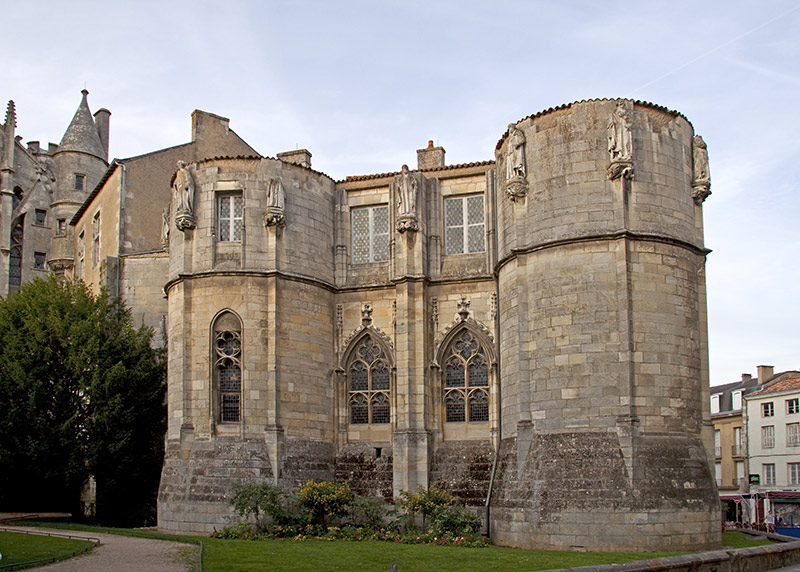
On July 2, 2025, the city of Poitiers presented the main lines of its project to rehabilitate the Palais de Poitiers. In reflection since 2019, the date of the move of the courthouse towards new premises, the town hall has formalized the works which will transform the building into a cultural complex of 6,000 m² spread over 350 pieces. The works should start in 2026 and end, for the first phase, in 2029. Phases two and three are planned from 2030, without precision on their completion calendar.
The preparations were started in 2023 with archaeological surveys and structural analyzes aimed at assessing the scale of the site. In 2024, cleaning and depollution operations (including asbestos removal) were carried out until 2025. At the same time, archaeological excavations were carried out in the ancient ramparts.
The room of lost steps at the Palais de Poitiers.
The first phase of the project provides in particular for the abolition of so -called “parasites” constructions in order to facilitate the bypass of the palace. Inside, several fittings are planned: a café-restaurant hotel entrusted to Neris Group-Roebling Capital, a space for associations, a large living room, a conference room, a reception board, an Aula (old Salle des Pas lost), as well as offices and technical spaces. From 2029, a partial reopening of the site is scheduled during phases 2 and 3, which will notably concern the Maubergeon tower, intended to accommodate the architecture and heritage interpretation center (CIAP), the body of the house, a black box (performance hall), the restoration of the Square Jeanne d’Arc, the Grand Patio, as well as the requalification of Place Lepetit.
The cost of the project is estimated at around 60 million euros. Funding of 42.5 million is provided by the Grand Poitiers, the Nouvelle-Aquitaine region and the State. The support of the Sorégies Foundation, as a patron and project leader, was also announced. The objective is to revitalize the city center through the creation of a public and cultural space with free access. The project includes the development of a visit route, the modernization of the patio with a belvedere, exhibition spaces, as well as the renovation of interior traffic. The figure of Aliénor d’Aquitaine was chosen as a common thread of the route.
The work will be carried out by the architects Marc Iseppi and Natacha Frilat of the November workshop, who notably participated in the retraining of the Centquatre in Paris. Their approach, mixing conservation of historical buildings and contemporary interventions, was designed to remain reversible and integrate an ecological axis.
The Palais de Poitiers dates back to the Carolingian era, in the ninth century. It quickly became a power center for the counts of Poitiers and the Dukes of Aquitaine from the 10th century. In the 12th century, Guillaume IX, Duke of Aquitaine, had the Maubergeon tower built there. Aliénor d’Aquitaine, known for having been a queen of France and England, then hired works there and made the Aula erect there. The building hosted the Poitiers courthouse from 1418 to 2019.
The archaeological component is central to this project, in particular with the installation of the CIAP, which will benefit from the data and discoveries from the site. A research program, in progress since 2020, is carried out with the Center for Higher Studies of Medieval Civilization (CESCM) and the University of Poitiers-CNRS. It aims to document the thousand years of history of the palace through investigations carried out throughout the site. The objective is to return to the inhabitants the knowledge of their heritage.


