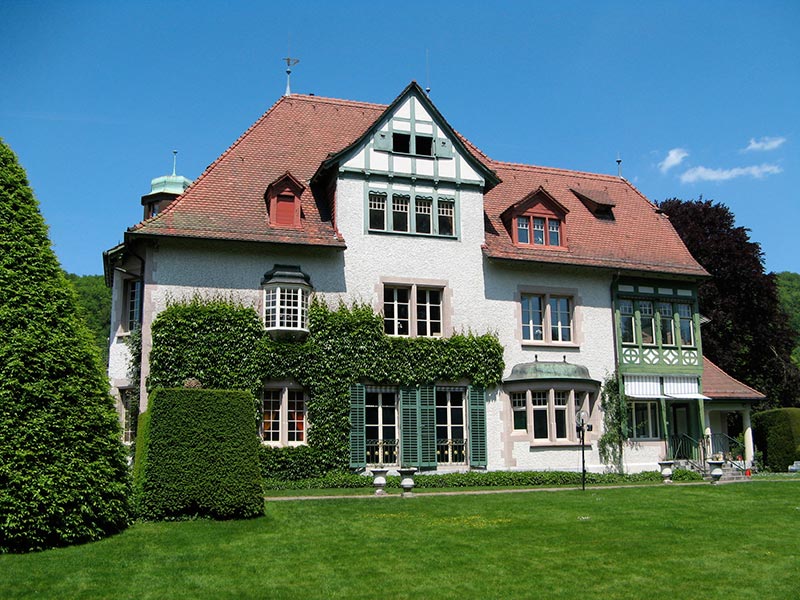
After two years of work, the Langmatt Museum in Baden, Switzerland, has reopened its doors to the public. This major renovation made it possible to completely restore the listed Art Nouveau villa, more than 125 years old, whose state of deterioration required urgent structural intervention.
The Langmatt Foundation, which manages the museum, was facing a financial crisis threatening its long-term viability. The city of Baden and the canton of Aargau agreed to co-finance the work, with the city providing 10 million Swiss francs (11 million euros), while the cantonal public authorities and other third parties supplemented the financing. The total cost of the renovation was 19.8 million Swiss francs (21 million euros). Project management was entrusted to Villa Langmatt AG, and construction to the architectural firm Ernst Niklaus Fausch Partner AG.
To finance its endowment fund and guarantee the future of the museum, the foundation sold three masterpieces by Paul Cézanne at Christie’s in New York in November 2023: Fruits and jar of ginger (1894-1895), Four apples and a knife (1885) and The sea at L’Estaque (1878-1879). The sale brought in a total of 40.32 million Swiss francs (44 million euros). On his own, Fruits and jar of ginger was sold for $33.5 million (€29.5 million). This decision caused a lively controversy in museum circles, with critics denouncing the sale of “jewels from the collection” to finance the operation of the museum, a practice deemed contrary to museum ethics.
The renovation covered the 2,630 m² and 75 rooms of the villa, from the basement to the roof. The work included the reconstruction of floors, walls and ceilings in several spaces. The sanitation system was renewed and the facade partially restored. The museum has also been equipped with fire protection devices, an elevator and new technical equipment. Access has been adapted for people with reduced mobility. A multifunctional glass pavilion was also added. The historic park and the entrance area have finally been renovated.
The construction site held a few surprises, including the discovery of hidden wallpaper and a secret door still accompanied by its key. These findings led the teams to modify the site plans. The aim was to preserve the historic character of the villa while meeting the requirements of a contemporary museum in terms of conservation, security, accessibility and functionality.
During the construction period, the Browns’ impressionist works left Baden for the first time in their history to circulate between the Fondation de l’Hermitage in Lausanne, the Wallraf-Richartz-Museum & Fondation Corboud in Cologne and the Österreichische Galerie Belvedere in Vienna.
Villa Langmatt was born from the initiative of the industrial couple Sidney William Brown (1865–1941) and Jenny Brown-Sulzer (1871–1968), who began their collection during their honeymoon in Paris in 1896 with the purchase of a painting by Eugène Boudin. Created between 1900 and 1933, the collection includes 22 works by Renoir, to which are added paintings by Monet, Sisley, Pissarro, Cézanne, Gauguin, Degas, Cassatt, Bonnard, Redon, Van Gogh, Courbet and Fantin-Latour. It also includes French furniture from the 18th and 19th centuries, sculptures, drawings, textiles, silverware, porcelain and Chinese ceramics. When the last occupant, John A. Brown, died in 1987, the villa and its collections passed by will to the city of Baden, which founded the Langmatt Sidney and Jenny Brown Foundation before opening the museum to the public in 1990.