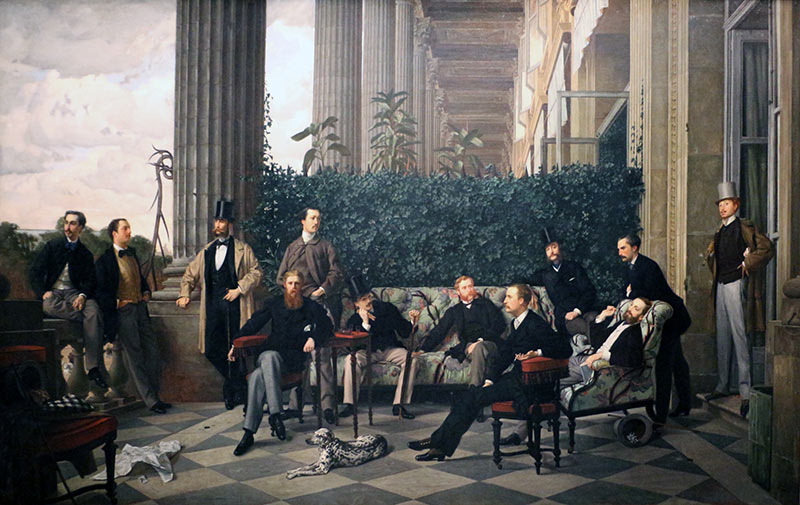
Paris, 1866. The twelve founders of the Cercle de la rue Royale commissioned a group portrait (see ill.) from the painter James Tissot (1836-1902). Mostly around thirty years old, these young men, most of whom come from aristocratic families, represent an imperial world which is experiencing its last days. Tissot delivers here his masterpiece where, while remaining faithful to the Ingresque lesson, he frees himself from French tradition by situating this group portrait outside in the manner of conversation pieces British. This imposing painting is quickly installed in one of the lounges of this men’s club before being offered to one of them by drawing lots. Baron Rodolphe Hottinguer, seated on the right on the sofa, wins the Royale Street Circle.
Wishing to part with the painting, one of Baron Hottinguer’s descendants requested an export certificate from the Ministry of Culture on January 25, 1995, but was refused. In order to preserve cultural heritage on national soil, the legislator has entrusted the Ministry of Culture with special administrative police power over the control of cultural property. As such, it has set up a mechanism through the request for an export certificate for cultural property which makes it possible to identify works of major interest for the national heritage by temporarily classifying them as national treasures (articles L. 111-1 et seq. of the Heritage Code). If the good is concerned, it will have to obtain a “passport” to leave France under penalty of constituting an illegal export. In the event of refusal, the property is classified as a national treasure and the State has thirty months (at the time three years) to make a purchase offer to the owner. After this period, the administration can no longer refuse the issuance of said passport.
An automatic classification to block export
On March 3, 1998, Mr. Hottinguer reformulated the same request and the issuance of the certificate should therefore have been automatic. However, by a decision of March 30, 1998, the Minister of Culture placed the painting pending classification as a historic monument, as authorized by the law of December 31, 1913 relating to historic monuments, and therefore suspended the procedure for issuing the export certificate (today articles L. 622-4 and L. 622-5 of the Heritage Code). By a decree of September 3, 1998, the painting was classified: it can no longer leave the territory. Particularly upset, Mr. Hottinguer sues the French State, because he considers that this classification authority arrived far too late to prevent the export of the painting. The question is simple: can the legislation on historic monuments make up for the shortcomings in the legislation relating to the export of cultural property?
On June 30, 1999, the Paris administrative court responded in the negative and granted Mr. Hottinguer’s request. The Ministry of Culture appeals. On June 27, 2000, the Paris administrative court of appeal rejected the owner’s claim, because the four-month period running from the new request “ has neither the purpose nor the effect of prohibiting the administration, after the expiration of the three-year period, from proceeding with a classification measure or pending classification of the property and from refusing, in view of this measure, a second export certificate.. The owner does not budge and appeals to the Court of Cassation. The Council of State confirmed this vision on June 21, 2002. Mr. Hottinguer was definitively rejected.
Heritage preservation versus the rights of collectors
This interpretation of the texts may be surprising but it has undeniable practical virtues for the Ministry of Culture to safeguard perhaps in an abusive manner – or at the very least artificial – the movable heritage on the national territory when requesting an export certificate. The Council of State also refused to recognize, in 2018, a misuse of procedure on the part of the Ministry of Culture, regarding the classification of the Portrait of the Countess du Cayla by Baron François Gérard, and even considered that the issuance of an export certificate for a cultural good does not prevent the administration from changing its mind to classify or register a painting a posteriori! Would this mean that the State, which cannot separate the wheat from the patrimonial chaff during passport control, could improperly maintain an asset on the territory ad vitam aeternam, or in the name of the general interest, to the great detriment of the legal security of collectors? While in matters of public archives, the State abstains from any claim once it has been able to control the nature of the documents when requesting a certificate, it may be surprising that the Ministry of Culture can automatically classify goods for which it had admitted the free circulation or for which it had not made any offer to purchase following a rejection of a certificate. The articulation therefore poses a challenge to the security of the art market.
Thanks to the “Hottinguer” ruling, it is now well accepted that legislation relating to historic monuments can take over; the State will always have the possibility of countering the dispersal, without the agreement of the owner, by automatically classifying a painting, even if this measure involves paying compensatory compensation to the owner who suffers harm due to the application of an easement, as the “Walter” case showed in 1996 (see JDA no. 665). However, through a clever subterfuge linked to several purchase offers made by the State, the Court of Cassation refused any compensation to Mr. Hottinguer on March 8, 2005. Six years will be necessary for the Musée d’Orsay to buy, for 4 million euros, the painting by James Tissot thanks to the profits generated by the exhibition “Manet, inventor of Modernism”.