
Lyon (Rhone). The results of Grégory Doucet’s mandate reveal a strong imprint left on town planning, education… But what about culture? When the leader of Europe Écologie Les Verts (EELV) took the helm of the Lyon municipality in 2020, he defended a cultural policy articulated around four main principles: creation, emancipation, transition, cooperation. Behind these few key words, it is the desire to make culture accessible to all that is proclaimed. And in fact, the choice is affirmed to favor support for existing structures, rather than pursuing a resolutely ambitious cultural policy.
The budget of museums and libraries protected
Throughout its mandate, the ecologist Town Hall has reinforced Lyon’s generous cultural budget.“In operation, culture is our second budget item after education. And excluding payroll, it is the first, explains Audrey Hénocque, first deputy mayor responsible for finances, culture and major events. This culture budget, including subsidies and payroll, increased by almost 20% between 2020 and 2025.” In relative terms, its share has remained stable since this increase is proportional to that of the overall budget. In 2023, the City allocated 152 million euros to culture in its initial budget, or 14.8% of its total budget. In 2025, this figure reaches 171 million euros, again the equivalent of 14.8% of the budget. Enough to ensure the functioning of the City’s rich cultural network which includes a national opera, an auditorium, a House of Dance, theaters, its share of museums and libraries, festivals and biennials which actively participate in its influence…
Thus, the City has secured the large budget allocated to its sixteen libraries (€27 million in 2025), its six museums (€20 million), as well as that allocated to existing events, while it produces the emblematic Festival of Lights (2 million spectators) and the more local festival “Entre Rhône et Saône” (40,000 spectators), launched during this mandate (see ill.). Added to this is the financial support provided to the major biennials of contemporary art and dance, whose competence had been transferred to the Metropolis (1.5 million euros paid each year). As one of the main areas highlighted, support for artistic education has been consolidated. The City, which contributes to the budget of the National School of Fine Arts of Lyon (€6.6 million) and the Regional Conservatory (€7.5 million), also obtained the “100% EAC” label (artistic and cultural education) in 2024, which guarantees a cultural path for all young people in the region, from kindergarten to CM2.
Show during the 2025 edition of the Entre Rhône et Saône festival.
© Muriel Chaulet / City of Lyon
This budget, although it was reinforced, was not however exempt from rebalancing, the municipality having had to deal with the significant budget cuts in the Auvergne-Rhône-Alpes region decided by its president, Laurent Wauquiez (Les Républicains). The reframing of the subsidy to the Opera, reduced by 500,000 euros out of a total amount of 17 million euros, notably earned it salvos from a right that was very critical of environmentalist priorities. “Choices were made but, in reality, the subsidy paid to the Opera ultimately increased with the funding of the staff,” defends Audrey Hénocque, who clearly states her priorities: “Our first major principle is support for creation. » This resulted in the vote in 2020 for a “Covid-19” fund with 4 million euros to help the entire sector after the pandemic, then the increase in the Cultural Intervention Fund, an increase that the municipality estimates at more than 2 million euros under this mandate. “This allowed us to support artists, small companies and in particular our eight “Discovery Scenes” (in the field of live performance). This support for emergence is something we are very keen on. »
The opposition denounces a “lack of vision”
“In Green political thought, culture is not a determining element. They actually tried to maintain budgets despite budgetary difficulties, but they managed without vision. retorts Georges Képénékian, former mayor of Lyon (2017-2018) and independent candidate for municipal elections. The one who is part of the centrist movement had also held, for almost ten years, the position of deputy mayor in charge of culture and major events under Gérard Collomb. “If you just maintain the budget without moving forward, without creating, it’s a waste”he judges, pointing out the delay in the construction of the “Ateliers de la danse” ((see ill.), delivery postponed to 2027) as well as the lack of progress on the ambitious project to extend the Part-Dieu library, a project valued at 140 million euros that Grégory Doucet places at the heart of his future program, as he seeks a second term.
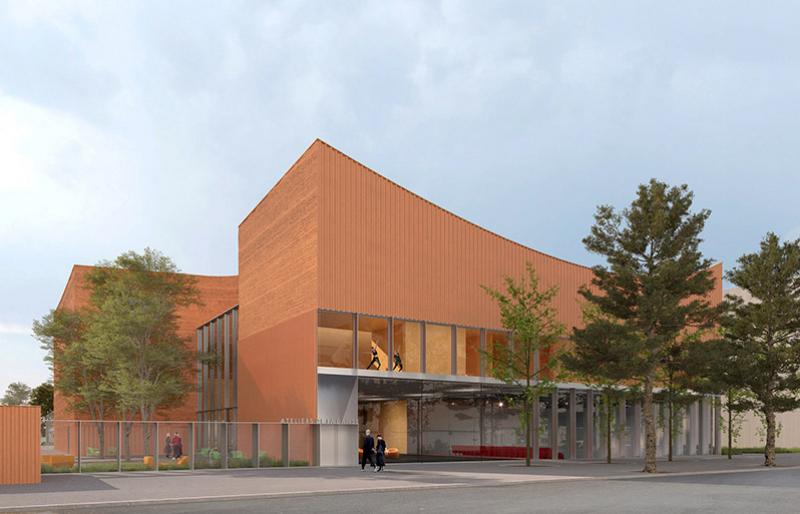
Architect’s view of the future Ateliers de la Danse, delivery of which has been postponed until 2027.
© Dominique Coulon & associates
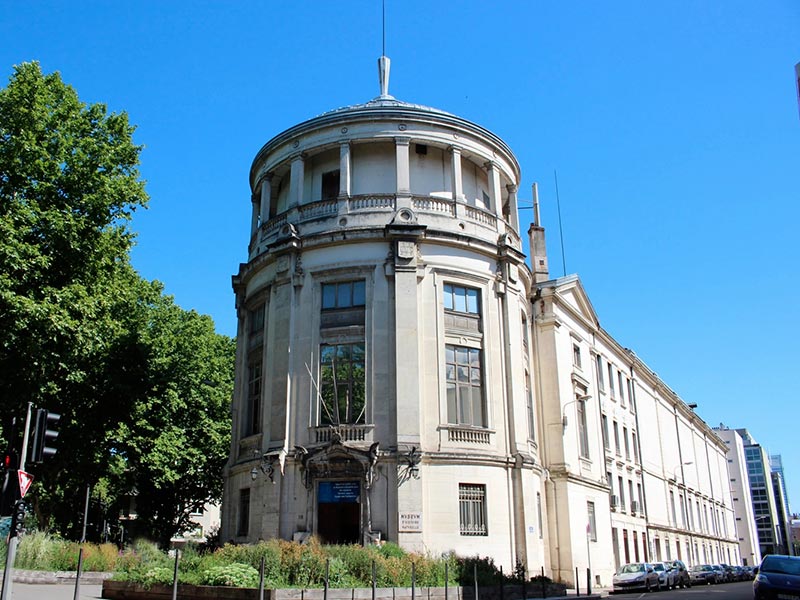
But one of the main subjects of friction concerns the Guimet Museum, the former natural history museum closed in 2009. The opposition deplores the lack of exploitation of the place which, pending heavy work costing more than 40 million euros, remained empty except during the 16th Contemporary Art Biennial in 2022, then on the occasion of the “Obey” exhibition in 2023. If the future of the museum becomes clearer slightly, now that the City has retained three scenarios for its rehabilitation, the file will also have revealed tensions within the municipality itself. Because in Lyon, the management of culture has not been done without a hitch. A tension which materialized in the stormy departure of the former deputy for culture, Nathalie Perrin-Gilbert, dismissed by Grégory Doucet in 2024. At issue: disagreements on the future of the Guimet museum, but also around the management of the Lyon Conservatory after the former deputy denounced operating anomalies.
These few projects in the pipeline do not prevent the municipality from boasting one of the multi-year investment programs “the largest ever” in terms of cultural action with “361 projects committed thanks to a budget of 144 million euros” since 2020. If Grégory Doucet’s mandate was not marked by large-scale projects, more modest projects were undertaken to strengthen the accessibility of sites and improve their energy performance. Among the most significant operations, include the rehabilitation of the New Generation Theater (€4.6 million including €3 million by the City), the ongoing construction of the Ateliers de la danse on the Kennedy block (for which the City has injected €10 million in 2025), the redevelopment (planned until 2027, for €6.3 million with state aid) of the Subsistances site, a place of production and distribution in live performance and visual arts, or the restoration of the Printing Museum since last summer (funded to the tune of €5.4 million). And, among the projects on track, the modernization of the Villa Gillet, international house of contemporary writing (€4.3 million), should begin in April. According to Audrey Hénocque, “There are already a lot of cultural places in Lyon, so under this mandate we focused more on strengthening existing places. In Lyon, there was a delay in the maintenance of buildings in general, but particularly in the cultural sector.”


