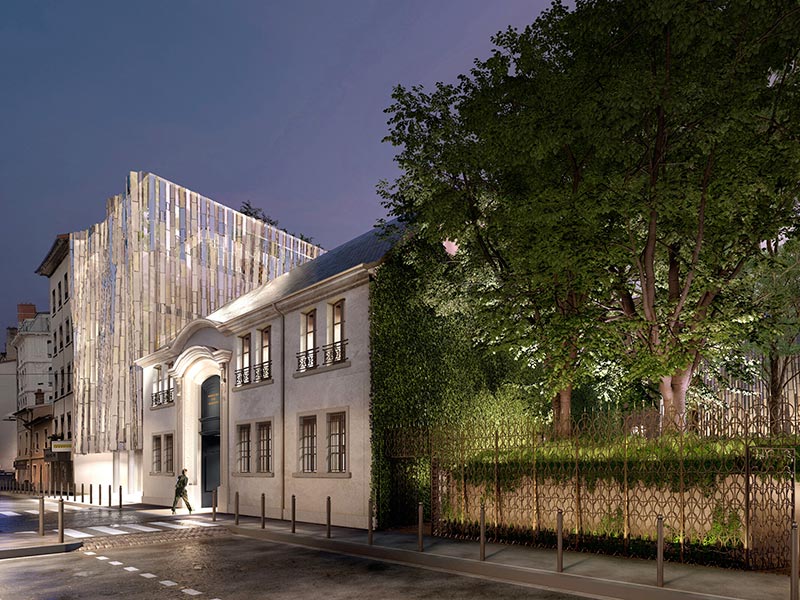
Lyon (Rhone). A timetable that is still unclear, a budget that remains to be clarified: in Lyon, the renovation of the Museum of Fabrics and Decorative Arts is marking time. However, when Laurent Wauquiez, then president (Les Républicains) of the Auvergne-Rhône-Alpes region, purchased the site seven years ago, the stated ambition was strong: to offer it a real renaissance. On the program: an extension commensurate with the richness of the collections, built on the site of buildings without much heritage value located within the site. But to date, the Museum of Fabrics has been closed for four years without the building permit having been filed. The planned budget has only fluctuated: first planning on 50 million euros then on 60 million, the Region finally came forward with only 32 million euros, while waiting to establish a new, more precise estimate.
A revised and accepted project
At the same time, the demolition of the buildings, which had been postponed until the end of 2025, has still not taken place. According to information from the weekly There Lyon Tribunethe mayor of Lyon, Grégory Doucet (Les Écologues), would have sent, last February, a letter to the Region “to request information on the reasons for the lack of progress on the renovation project”, not without recalling that the City issued a demolition permit from January 2024. A request which, for the moment, has remained without a concrete response. Contacted, Fabrice Pannekoucke, the president (LR) of the regional council, ensures that “the Region will not fail to continue to keep the City of Lyon, the Metropolis of Lyon and all partners and local residents informed as the project progresses.”
The stagnation of the project finds its origin precisely in this tension between regional ambitions, municipal expectations and concerns of local residents. In 2021, the Region is financing the exterior restoration of one of the two private mansions on the site, the Lacroix-Laval hotel, before immediately unveiling the project designed by architect Rudy Ricciotti. A project whose imposing volumes aroused opposition from both local residents and the City, the latter deeming it incompatible with the local town planning charter. In January 2023, a second version is presented, with delivery now planned for 2028-2029. Reduction in the level of extensions, reduction in surface area of 1,300 square meters made possible by the outsourcing of reserves and the restoration workshop… The new project, with a total surface area of 5,500 m², is not canceled this time. If the volume is revised, the layout remains the same: the permanent exhibition will be deployed within the Lacroix-Laval hotel and the temporary exhibitions in the Hôtel de Villeroy and the “Hotel Neuf”, which will be built to connect the two buildings and house modular spaces.
To what cause can we attribute this delay in the presentation of definitive content? And to what extent will the project be reviewed in the light of budgetary constraints? The regional presidency expresses itself succinctly, affirming that “the objective of building a modern, intelligible museum integrated into its environment has never changed despite the technical, heritage and regulatory constraints which require moving forward methodically and in conjunction with local residents, who contribute strongly to the project within the framework of regular dialogue forums”.
Restoration of collections
It is difficult, despite everything, to speak of a project at a standstill given the important work carried out on the collections. “We have just completed the new scientific and cultural project, which was voted on by elected officials. We are working on the itinerary of the collections, the selection of works which will be presented by rotation in the Lacroix-Laval hotel, based on a deadline of 2030″, explains Aziza Gril-Mariotte, director of the Fabric Museum. While waiting for the reopening, reserves and workshops have been moved to a temporary site located near Saint-Étienne. For more than three years, the teams have been carefully examining the collections: proofing, counting, reconditioning, in-depth restoration, etc. “The Region is financing this collections project in a very significant way”indicates Aziza Gril-Mariotte, specifying that the community “working to acquire land to develop a definitive conservation and research center”. And as for the restoration, the work is deployed on two fronts. On the one hand, that of pieces from the former Museum of Decorative Arts, treated with care in the workshops of specialized restorers. On the other, that of the museum’s impressive textile collection, one of the largest in the world with its 800,000 pieces from the four corners of the world. Costumes, tapestries and even accessories which, patiently, await their return to the forefront.