Metz. How can we renew the public’s view of the work of François Morellet (1926-2016), surprise the expectations of those who think they know this representative of geometric abstraction, precursor of minimalism? The question guided the reflection of Michel Gauthier, curator of the contemporary collection of the Center Pompidou – National Museum of Modern Art, curator of this exhibition which brings together around a hundred works, almost half of which come from public collections (the rest coming from the estate and the Kamel Mennour gallery). It is a sentence that Morellet would have uttered in 1987, which ultimately gave its guiding principle to the clash: “I am the monstrous son of Mondrian and Picabia. »
Between rigor and unreason
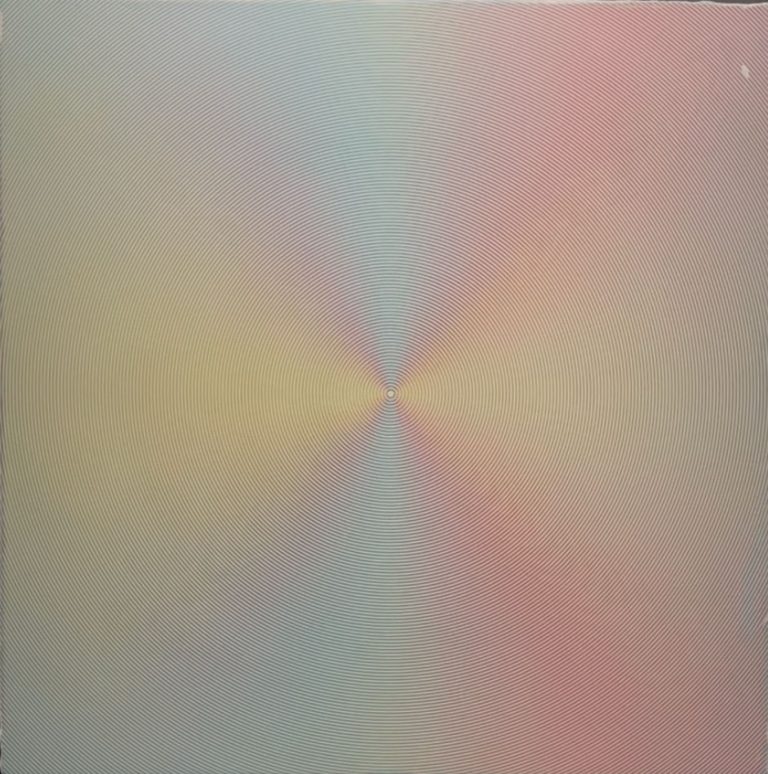
Starting from the principle that Mondrian embodies the “rule” and Picabia the “unreason”, Michel Gauthier therefore proposes a route split in two, which meets in the middle, in the left hemisphere versus right hemisphere mode. To this dual bias, more playful than scientific, the commissioner added a rather disconcerting preamble to capture attention. The tour begins with some of the first figurative canvases of the self-taught painter, “before Morellet became Morellet”. This introduction is short enough to remain entertaining and we can, if we are cooperative, detect, in such a Harlequin coat or in such another still life, the beginnings of a rigor “mondrianesque” illustrated by the rest of the route, which also follows a chronological progression. The first abstract paintings, after the conversion to concrete art, are thus presented, on the “Reason” side, then the systematic paintings – we would have liked a more explicit mention, in the room, of this moment when chance comes to cancel subjectivity. Object paintings and paintings in space follow. The refined scenography perfectly serves this exploration of the two conceptual and aesthetic poles, ingeniously separated by the dashes of More or less (2011) in subliminal transition.
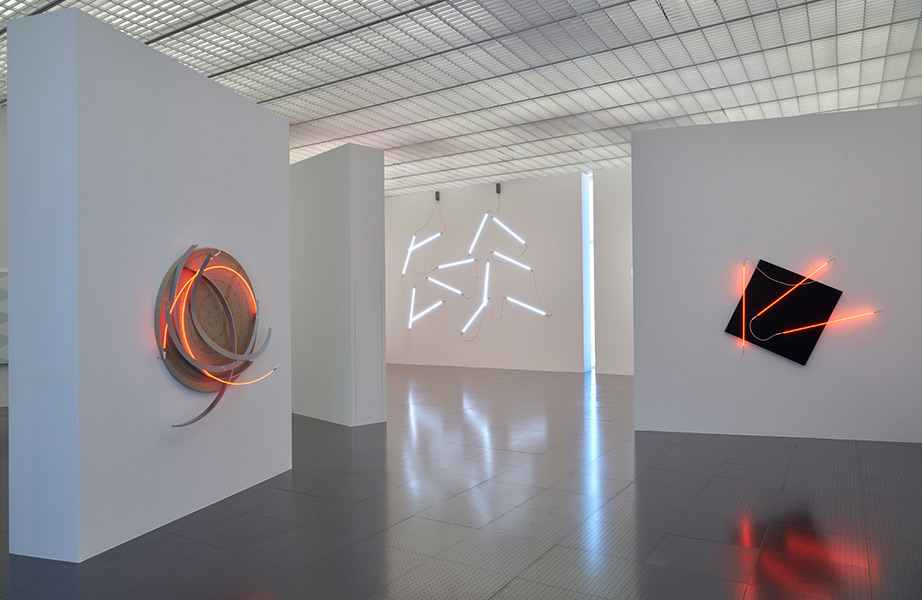
The second part gives pride of place to the baroque temptation of Morellet, his side Whimsical brut (1996). It is the one which includes works in neon, expression of a form of fantasy that some critics considered in its time “vulgar” as if Morellet, by using light, had betrayed a classic dogma. The whole ignores the more facetious dimension of the work – which was further highlighted, in 2021, by the exhibition organized at the Center Pompidou, reflecting a major donation to the museum. Finally, at the end of the gallery, a vertical loophole gives a glimpse of the installation 4 frames 30° – 60° – 120° -150° starting from a corner of the wall. Intervals: wall height (1977-2026) created for the occasion on the facade of the SNCF technicentre in Metz. This example of a “architectural disintegration”that is to say a work which is not at all thought of according to a precise place, “clearly distances Morellet from modernism”, underlines Michel Gauthier. This is the final point of this exhibition, which kicks off a nationwide program celebrating the centenary of the artist’s birth.