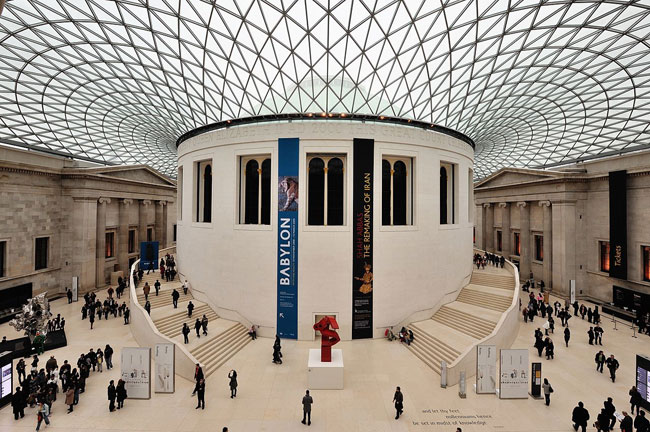
The British Museum has quietly changed several panels in its Ancient Near East galleries by removing the term “Palestine”. This decision follows a letter from the pro-Israeli association UK Lawyers for Israel (UKLFI) addressed to museum director Nicholas Cullinan, warning of the use of this term for very ancient periods. The association maintains that qualifying the entire region as “Palestine” over several millennia “erased historical changes and created a false sense of continuity.” According to UKLFI, this terminology obscures the kingdoms of Israel and Judah from the first millennium BC. AD
Several cartels dedicated to ancient Egypt and the Phoenician navigators, which until then designated the eastern coast of the Mediterranean as “Palestine” and described certain peoples of “Palestinian ancestry”, have been updated. The museum has thus replaced “Palestine” with “Canaan” when it comes to the ancient Levant. Until now, a carte on the Hyksos period (around 1650-1550 BC) described these invaders from the Nile delta as “of Palestinian origin”. The mention was replaced by “of Canaanite origin”.
The British Museum indicates that it will continue this update gradually as part of its major rearrangement project. The museum specifies that it will continue to use, on its contemporary maps, the terminology used by the UN (Gaza, West Bank, Israel, Jordan). The term “Palestinian” will henceforth only be used as a cultural or ethnographic designation, when the context lends itself to it.
The museum assures that this revision is based on visitor comments and surveys, and not on political pressure. In his response to UKLFI, he specifies that he has undertaken “selective revisions” old panels in order to be more historically accurate. UKLFI, for its part, welcomed the change, emphasizing the educational role of museums and deeming it essential that their descriptions accurately reflect the state of the historical record.
The removal of the word “Palestine” immediately sparked criticism in the Arab press and among supporters of the Palestinian cause, who see it as a symbolic erasure. The term indeed arouses strong emotions because it is not neutral. By rejecting its use, some see it as an alignment with the Israeli political narrative.
In June 2025, 250 employees signed an internal petition asking the British Museum to cut its ties with Israeli cultural institutions, in protest against the war in Gaza. They denounced a “marginalization of the Palestinian narrative”. This gesture followed an exhibition celebrating the creation of the State of Israel, accused of having ignored the Nakba of 1948 and contributed, according to some employees, to a form of “pro-Israeli propaganda” during the conflict in the Middle East.