Bayonne (Pyrénées-Atlantiques). “With this exhibition, it was obviously not a question of exhausting the theme of mythologies, that would be impossible”point blank announcement Barthélemy Etchegoyen Glama, director of the Bonnat-Helleu Museum. For the museum’s first temporary exhibition, which reopened last November, the chosen theme is as abundant as it is widely explored, but approached from a well-considered angle. “We wanted to offer visitors a journey through the world of these great stories, these powerful images that nourish our imagination. So a rapprochement between works which belong to centuries, to cultures, to extremely different civilizations but which, once brought together, have a lot to say. »
Weaving myths
Exit therefore any form of chronological or geographical division. The bias is rather to mix the myths to better highlight their similarities and highlight their resonances. And to establish this dialogue, the scenography proves to be decisive. Nearly a hundred works, ranging from Prehistory to the 20th century, are displayed in a single room whose structure has been designed like a kaleidoscope. If this labyrinthine route can be confusing, it fully participates in this desire to offer a journey which does not impose any direction of visit, except a division by numbered chapters which the visitor is free to follow or not. Above all, this device encourages the play of gazes: the works echo each other, embrace each other at a single glance, and are reflected in mirrors. Enough to highlight sometimes unexpected correspondences.
Myths of Pharaonic Egypt, ancient Greece, traditions of the Near and Middle East, beliefs of Mexico, Oceania and even Africa… Far from being forced, these connections find their full coherence in common themes which tell the great cosmogonic stories. The creation of the world is thus read in an Egyptian stele representing the god Amon, who is said to have laid the cosmic egg, as in a Sumerian tablet which relates the birth of vegetation through the coupling of Heaven and Earth. Other figures take on a universal dimension, like the serpent, which we find both in the form of Quetzalcoatl, a powerful Aztec divinity, and in that of the great serpent Yurlungur in Aboriginal mythology.
Exceptional loans
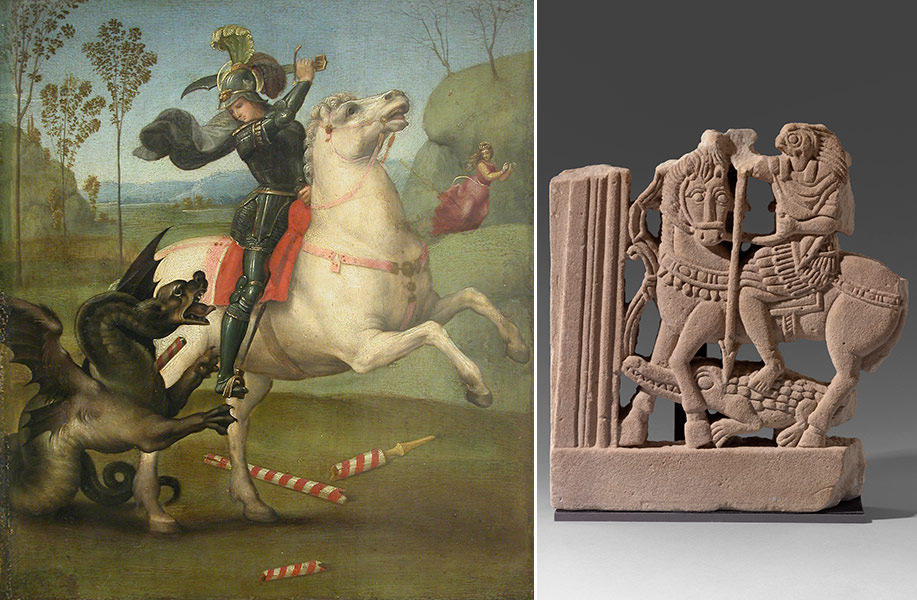
To enrich this mythological panorama, the Bonnat-Helleu Museum benefited from the loan of forty works kept at the Louvre Museum, as part of the partnership which unites the two institutions – the Basque museum being the most important depository of the Louvre on French territory. Among the masterpieces presented, the Saint George by Raphael (around 1503-1505) (see ill.), usually hung on the walls of the Grande Galerie, here integrates the section of “Dragon Slayers”, where it dialogues with Syrian representations of the saint dating from the 17th century and a Horseman Horus (see ill.) from Sudan (around 200-399 AD). A cutting-edge selection enriched by a large number of pieces from the Musée du quai Branly from Africa, Asia and Oceania, including a Japanese Kagura mask (20th century) and an impressive crocodile emblem from Papua New Guinea (20th century).
Among its assets, the exhibition makes these great stories resonate with Basque and Gascon legends. “The challenge was to ensure that this local mythology was represented at all levels of discourse. However, Aquitaine mythology is still much less known than Egyptian or Mesopotamian mythology.underlines the director. A challenge taken up collectively with Benjamin Caule, specialist in protohistory in Gascony and the Basque Country, and curators François Bridey and Dominique de Font-Réaulx from the Louvre Museum, all curators of the exhibition. The local is naturally intertwined with the universal: the figure of the bear-man (Hartza), long present in Pyrenean carnivals, thus finds its place among the multiple hybrid creatures that populate the myths. As for the lamina mask (made in 2026), a goose-woman also from Basque mythology, it reminds us that a myth can be read and listened to, but also looked at.
Finally, the exhibition goes beyond the simple story to question the birth of these myths and their transmission. Homerian texts, practices and rites, told stories that the “collectors” of the 19th century recorded in writing…: these narratives have continued to be transmitted and reinvented. A photograph of the famous wrestler El Santo, a true contemporary myth, or even a lightsaber from Star Wars slipped among thousand-year-old javelins and spearheads, are all revealing winks.