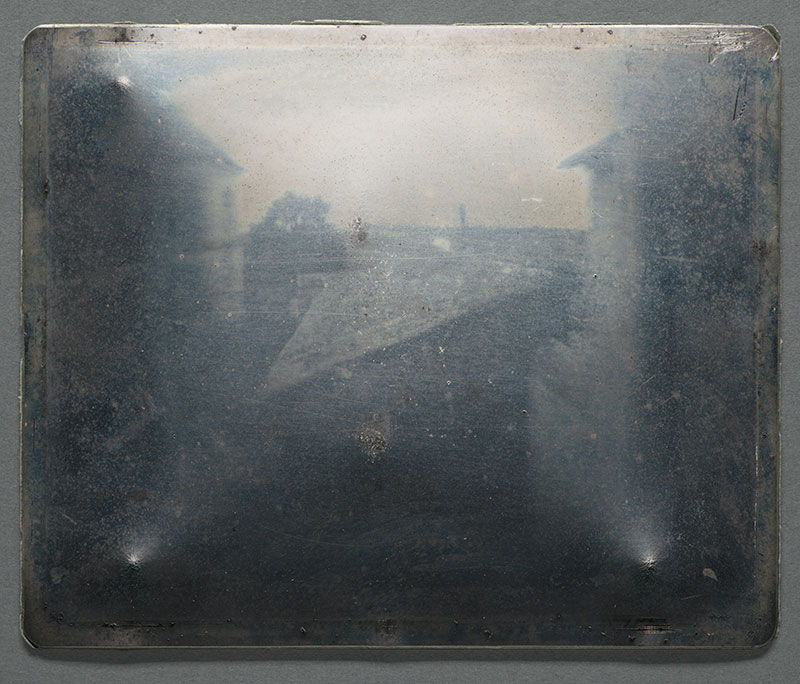
France. No commemoration of the invention of photography will have offered so many exhibitions, publications and conferences. Until September 30, 2027 and beyond, more than 1,000 projects have been labeled by the scientific committee set up by the Ministry of Culture to celebrate the two hundredth anniversary of the oldest photographic image that has reached us, the Fat’s point of view (1827), by Nicéphore Niépce [lire l’encadré et voir ill.]. Beyond the number and territorial coverage of the event, whether French, overseas or international, one of the particularities of the program is the highlighting of a multitude of public collections. The mobilization of municipal and departmental archives, libraries, media libraries, museums and other public institutions is all the more remarkable as the labeling of the projects is not accompanied by any specific funding from the Ministry of Culture.
This is because the celebration of the event gives all these structures the opportunity to launch original exhibitions. In Bar-le-Duc (Meuse), the Departmental Archives retrace the history of the territory through the exhibition “The Archives come out of clichés”; in Marseille, the municipal archives will reveal next year, from May 30, the diversity of their funds in “Portraits: Photographic History in Marseille”. In Metz (Moselle), the city’s libraries-media libraries are teaming up with the Musée de la Cour d’or to offer “Metz under the eye of photographers” from March 6, 2027, while La Conserverie de Nancy (Meurthe-et-Moselle), a place dedicated to the collection and rescue of family photographs, is offering the “Presents” exhibition at Galerie Poirel until November 22.
Unsuspected funds
Unsuspected collections are also emerging on the national level such as those of the National Audiovisual Institute (INA), the subject of the “Watching TV” exhibition scheduled until November 15 as part of the Rendez-vous de l’histoire de Blois (Loir-et-Cher). Next year, the Écrins National Park will unveil its archives for the first time at the Brune Tower in Embrun (Hautes-Alpes). As part of this promotion of public collections, museums are programming a photography exhibition for the first time, such as the Musée du Temps in Besançon (Doubs) with “The Footprint of Time. Photographing people and cities in the 19th century.”
So many exhibitions which do justice to the policy of conservation of photographic heritage carried out throughout the territory in complete discretion and often without means. In parallel with these events, many municipalities are launching photo collections. The town of Tarnos in the Landes is thus starting a collection of documents and testimonies linked to social movements and the first general holidays by the Popular Front.
Another great first: the Media Library of Heritage and Photography, is joining forces with the Grand Palais-RMN photographic agency, to offer eleven free turnkey exhibitions to communities, libraries, tourist offices and French Institutes. Among these, the one planned for the end of September at the Roubion tourist office in the Alpes-Maritimes, on the theme of rural areas.
Return to France from the “Point du vue du Gras”
The suspense lasted until the end. Five days before the press conference unveiling the program for the Bicentenary of Photography, on September 3, the exceptional loan of the Fat’s point of view (1827) by Nicéphore Niépce (1765-1833), preserved by the Harry Ransom Center at the University of Texas at Austin following its acquisition in 1962 from the collection brought together by Alison and Helmut Gernsheim, a couple of researchers and historians who were behind the discovery of this heliogravure in February 1952 in England. From March 20, 2027, the Nicéphore-Niépce Museum in Chalon-sur-Saône (Saône-et-Loire) will present it for the first time in France as part of the exhibition “The Footprint of Hélios. 1826-1827, Niépce invented photography. Until now, the work had only been the subject of two exhibitions in Europe: the first in Lucerne in Switzerland in 1952, the second in Mannheim in 2012. An agreement is in progress between the Ministry of Culture and the municipal museum for sharing the costs of transport, insurance and the conditions of its presentation, costs of an undisclosed amount.