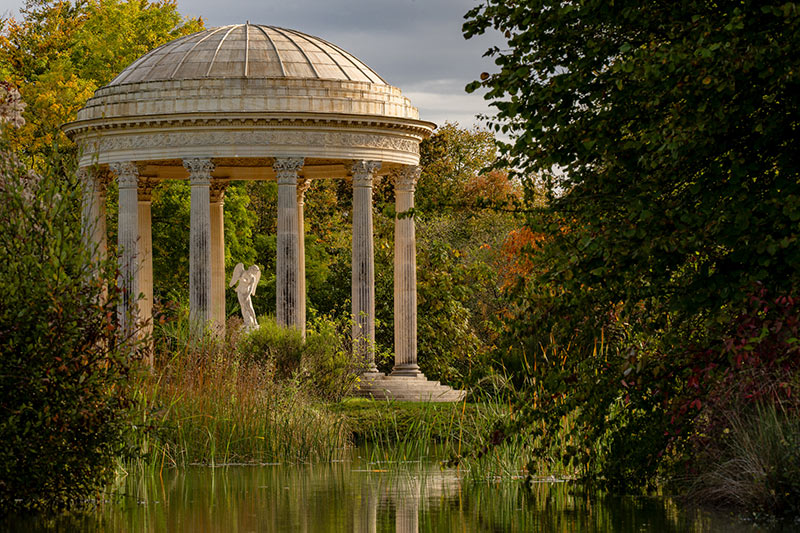
Versailles (Yvelines). Rectilinear paths, geometric patterns of groves and imposing fountains were until the beginning of the 18th century the striking features of French gardens. From 1750, the royal family and aristocrats adopted a style from England, where the garden must embody “a return to the state of nature, but a composed nature”specifies curator Élisabeth Maisonnier (chief heritage curator, National Museum of the Châteaux of Versailles and Trianon).
The Queen’s Hamlet.
© Palace of Versailles / T. Garnier
The first part of the exhibition presents the plant and architectural elements which structure an English garden, or rather “ an Anglo-Chinese garden because there is a dimension of oriental exoticism in these gardens », Explains the commissioner. A large model shows the ideal model of a garden with waterways, Chinese and neo-antique bridges (Palladian style), “factories” (architectural elements) in the shape of a pyramid, mosque or pagoda. Around this model, tables and drawings illustrate the diffusion in the graphic arts of the fashion for English gardens (Gainsborough), as well as works on gardens written by English scientists. At the same time, another way of seeing the world emerges: aristocrats and artists rediscover Antiquity during their Grand Tour in the Mediterranean, with visits to Roman and Greek archaeological sites. An Anglo-Chinese garden should thus make it possible to “travel a world in miniature”according to Élisabeth Maisonnier, who points out a note of “kitsch”, reflecting the taste of the time for exoticism. A section of the exhibition shows the influence of Rousseau on this fashion, through his work The Social Contract which redefines the relationship between man and nature: if gardens remain intended for man’s gaze, he is no longer the master of nature. The Ermenonville estate where he lived for a few months illustrates the putting into practice of this philosophy.
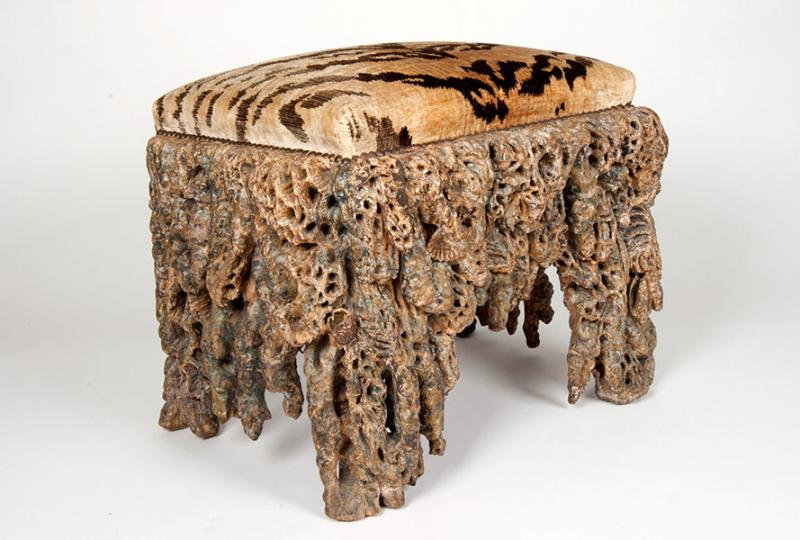
Stool made for a cave, circa 1775-1780.
© The Bowes Museum, County Martine Beck-Coppola
Furniture, fashion and portraits
After this didactic part, the exhibition addresses the art of living in the garden at Versailles and in the aristocracy, since this type of garden “remained reserved for the aristocracy and elites in the 18the century “. In addition to outdoor furniture (table, folding seat and parasol), the second half of the 18th century saw the birth of new festivals in the Trianon area (1774 to 1780 for the works), within the framework of the Menus Plaisirs, the archives of which were used for the exhibition. Several portraits painted by Élisabeth Vigée Le Brun (1755-1842) show the influence of this fashion on the aristocracy and on Marie-Antoinette, who posed in “English” white cotton outfit and straw hat, a scandal in the eyes of the Court. The Queen makes the Trianon gardens “a life-size theater set”according to the commissioner, with illuminations, shows and nighttime parties. The exhibition closes with three exceptional paintings by Fragonard which synthesize, in pastel tones, the art of living under the Ancien Régime, before the Revolution destroyed most of the Anglo-Chinese gardens.
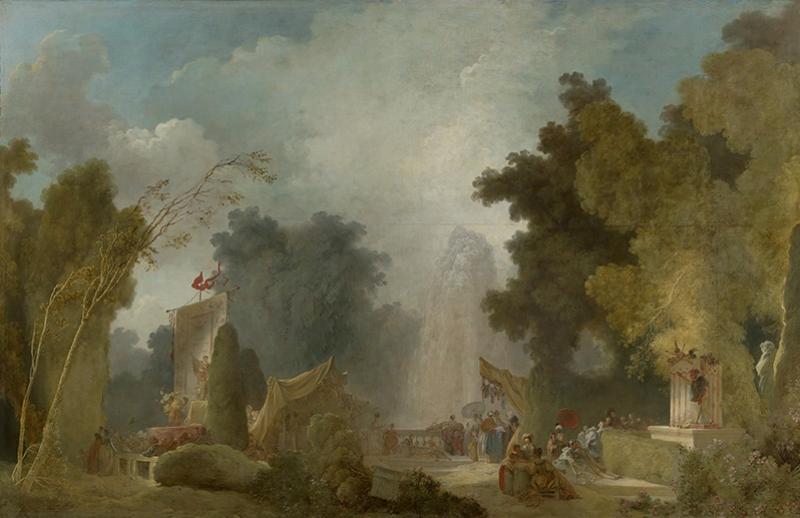
Jean-Honoré Fragonard (1732-1806), Party in Saint-Cloudc.1775-1780, 216 x 335 cm, oil on canvas.
© Banque de France