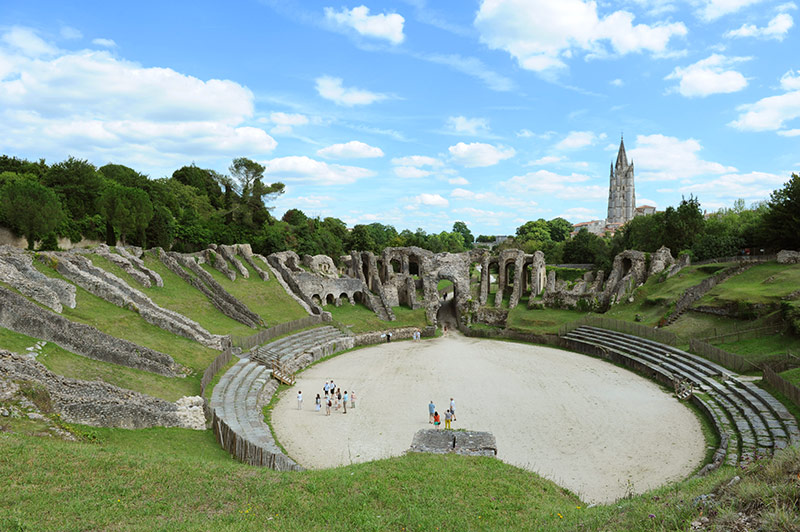
Saintes (Charente-Maritime). It is one of the oldest in Roman Gaul, perhaps even the first. The amphitheater of Saintes, two thousand years old, has regained its splendor of yesteryear. Its two monumental doors were restored and consolidated after several years of work, necessary for the preservation of this particularly well -preserved site.
In 2018, an archaeological diagnosis had pointed out the alarming state of the vestiges, in particular the degradation of the two doors. The amphitheater had not benefited from a restoration campaign for almost a century, some punctual maintenance operations apart. “” One of the objectives of this diagnosis was to see how the building had been transformed during the restoration campaigns that have taken place since the end of the XIXe century, explains the architect Elsa Ricaud (Sunmetron agency), in charge of project management. We realized that 25 % of masonry was still in their ancient state, which is not bad at all for such an old building! »» The site was therefore divided into several phases, organized in order of priority. Launched in 2022, the operation first focused on the door of the living (East side), more degraded, before the door of the dead (west side), inaugurated last April. Doors whose evocative name – attributed to the 19th century only – denotes their importance in the staging, the ostentation of the fights of gladiators which took place in these places. Then will take place a third phase to clean up the site, the final point of this project at 4.7 million euros, carried by the City and subsidized by the State, the New Aquitaine Region, the Department and the Heritage Foundation.
The complete turn of the arenas now possible
These interventions made it possible to consolidate the vaults, restore the facings and secure the access of the amphitheater, which the visitor can now go around. “Throughout the site, we had a truly exceptional archaeological follow -up, underlines Elsa Ricaud. We have reused original techniques, and no pocket (obviously temporary, editor’s note) has not been done in ancient masonry. »» From 2022 to 2024, the door of the living, with very weakened vaults, was thus restored according to a roccal technique, which imitates the ruin effect. The existing arcs have been reinforced by returning the missing segments and integrating steel reinforcements. In parallel, the restoration of the door of the dead had to be launched earlier than expected, because of progressive sagging, at the risk of collapse, of the ground of earth that fills it. After securing the site, the bottom of the door was then consolidated by a retaining wall.
“Each site has its share of complications. Here it is water. We have had several flood periods, which sometimes interrupted the work for several months ”, Adds Elsa Ricaud. The amphitheater of Saintes has the particularity of having been built in the hollow of a valley, which makes it particularly vulnerable to floods. Hence the need for a third sanitation phase, which will start in a few months and should end in 2026. The ground will then be disbursed to get closer to the ancient level, and a rainwater evacuation system will be installed. At the time already, the site had a central sewer. “We realized that this sewer was enlarged at the end of IIIe century “, Reports Karine Robin, head of the departmental archeology service, who led the excavations on the site with INRAP (National Institute for Preventive Archaeological Research). “It was almost acquired that the amphitheater was no longer used for shows during this period, but this discovery shows us the opposite. »»
The installation of scaffolding will have enabled archaeologists to explore so far inaccessible areas, giving rise to other discoveries. Thus from the discovery of the foundations of a Gallo-Roman bridge under the door of the dead, a vestige of an old axis which linked Saintes to Bordeaux. “And we now have a much better understanding of the way we were circulating in the monument”, specifies Karine Robin. The ingenious staircase system was designed so that the different social classes never meet, with ninety different ways to access its place. A project that has therefore made it possible to preserve the amphitheater, but also to learn a little more about its history.
The amphitheater of Saintes
History. Begun around 25 and completed in the 1940s after J.-C., the amphitheater is one of the rare vestiges of the ancient city of Mediolanum, then capital of Roman Aquitaine. Nestled in the hollow of a natural valley, it could accommodate up to 15,000 spectators, all of the inhabitants of the city. The imposing building, 126 m long and 102 m wide, then included 35 stands. Place of gathering and celebration of power, it regularly hosted violent shows: animal hunts (Venationes) In the morning, public executions on the meridian break and gladiator fights (munera) in the afternoon. After the 3rd century, the amphitheater was relegated beyond the ramparts and served, among other things, as a stone career in the Middle Ages. It was gradually recovered in the 20th century, classified as a historic monument in 1840 before being bought by the city in 1860.