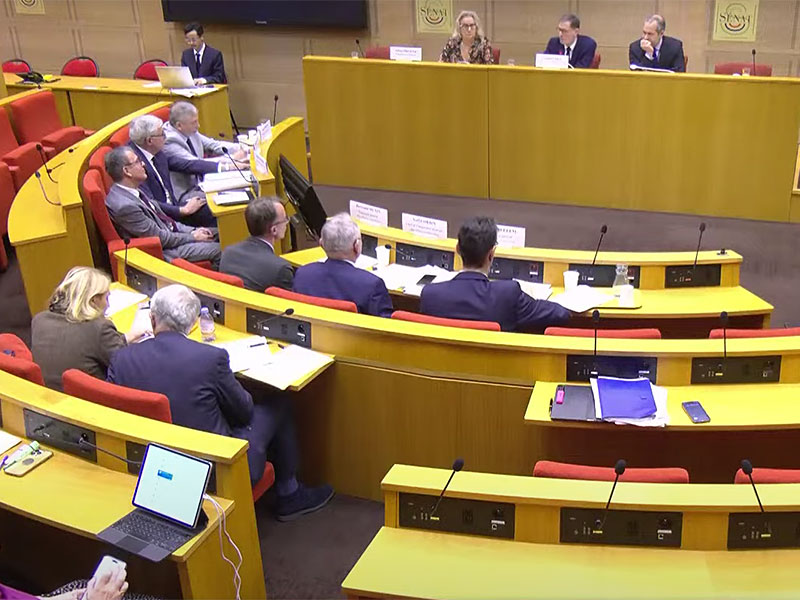
The hearing of the two responsible for the administrative investigation ordered by Rachida Dati the day after the burglary of the Louvre – Noël Corbin (Head of the General Inspectorate of Cultural Affairs, IGAC) and Pascal Mignerey (head of the delegation for the inspection of research and innovation of the general directorate of heritage and architecture of the Ministry of Culture) – before the Senate Culture Committee, Wednesday December 11, made it possible to establish that the burglary of the Louvre is not a chance incident.
From the introduction, the president of the commission, Laurent Lafon, set the tone: “The conclusions of this investigation are very severe and in a certain way implacable, contrary to the elements put forward before our commission by the president director of the Louvre; it points to the general failure of the museum and its supervisory authority in taking into account safety issues. »
The investigation highlighted a chronic underestimation of risk, which has become a lasting part of the establishment’s governance. Noël Corbin indicated that “the risk of theft was underestimated” over a long period.
Noël Corbin during his hearing by the Senate.
© Public Senate
This lack of vigilance finds its source in a conflict of priorities where the “culture of welcome has taken precedence over that of safety”. The report established that this orientation led to a structural lack of resources and political will. The Security Master Plan, initiated in 2017 to modernize the systems, illustrates this inertia: it was “constantly pushed back”its operational launch now being postponed until 2026.
The investigation naturally focused on the failures that enabled the intrusion, explicitly targeting the museum environment. Perimeter video surveillance, an essential link in this protection, proved to be ineffective. The equipment is considered obsolete and the Security PC is under-equipped. The experts explained that there was indeed a camera which filmed the installation of the nacelle but that it provided images of “poor quality” without the possibility of zooming.
The hearing is not very clear on the subject but we understand that the agents were not watching the images live, that they viewed them with a delay, without being able to easily interpret them. The head of IGAC estimated that “within 30 seconds, the agents or police could have prevented the thieves from escaping”.
The report highlights the fragmentation of responsibilities: the security department is confused with the reception and surveillance department, which has diluted security expertise. This situation slowed down the establishment of a single, dedicated authority. Senator Lafon recalled that the creation of a security manager position, recommended in 2017, remained blocked.
Based on reading the report, Laurent Lafon underlines “that these security flaws had all been identified by several previous works with largely consistent results. Annexed to the report are in particular an audit by the National Institute for Advanced Studies in the Security of Justice carried out in 2017 as well as an audit carried out by the jeweler Van Cleef & Arpels in 2019, an audit which focused more specifically on the Apollon gallery as part of technical skills sponsorship. »
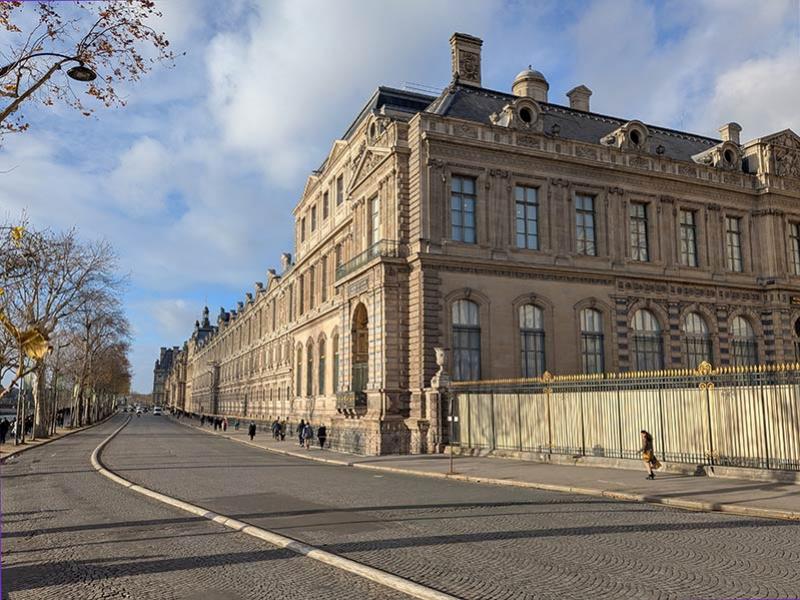
The Quai François Mitterrand and, on the 1st floor of the Louvre, the balcony of the Galerie d’Apollon where the jewels stolen on October 19, 2025 were exhibited.
© Photo Ludovic Sanejouand for LeJournaldesArts.fr