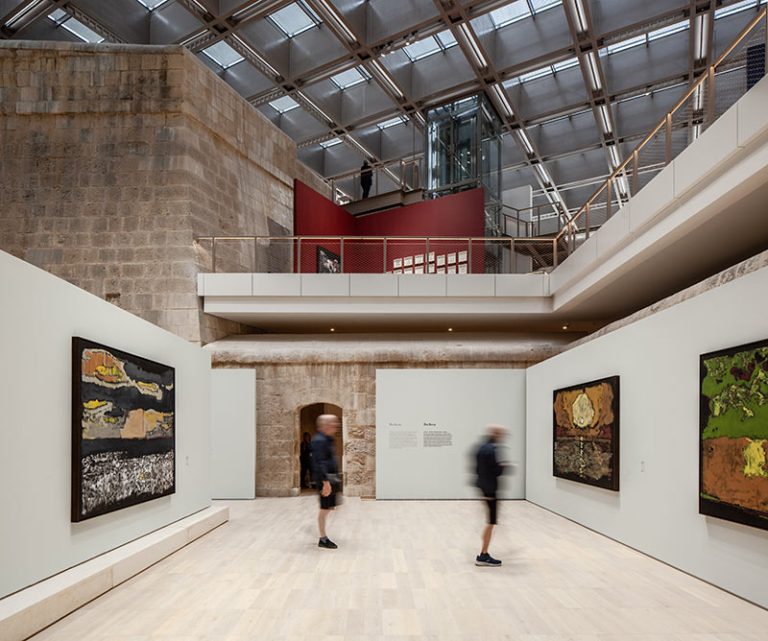
One of the so-called red rooms of the New Uffizi, number 61, is dedicated to the Tuscan Jacopo Pontormo (1494-1557), a very important artist of the 16th century and student of Andrea del Sarto, who worked mainly in Florence and who contributed decisively to laying the foundations of Mannerism. Pontormo – originally Jacopo Carucci – was a friend of Rosso Fiorentino, another disciple of Del Sarto, and would be a teacher and almost a father to Bronzino, like him a star among the painters of the first half of that century.
Due to his introverted and complex personality, he was considered a complicated artist, and he did not fear insults with brushes either: his production was daring and innovative and responded to his own principles. Pontormo studied the greats, from the aforementioned Andrea del Sarto to Michelangelo and Leonardo, but he reworked the canons of the 15th century to articulate an original language, hence, in the past, his art was considered excessive and strange; Giorgio Vasari spread it as such, because of its “anticlassicism.”
His works – the Uffizi houses one of its most notable collections – are characterized by the original use of bright tones and by the detailed study of the human figure, based on Buonarrotti but also on Dürer and Lucas van Leyden, who had a significant influence on this Tuscan author born in the town that today gives him his name. That room 61 treasures its large canvas of the Dinner at Emmausthe representation of the crucial moment of Jesus’ revelation to his disciples, which due to its compositional expertise and palette would influence Caravaggio and Velázquez. Also The Expulsion of Adam and Evewhich masterfully captures the remorse and suffering of both after their punishment; The Nativity of Saint Johnmade using a convex mirror, to deform the real figures; and portraits of Cosimo the Elder, Maria Salviati or Saint Anthony the Abbot.
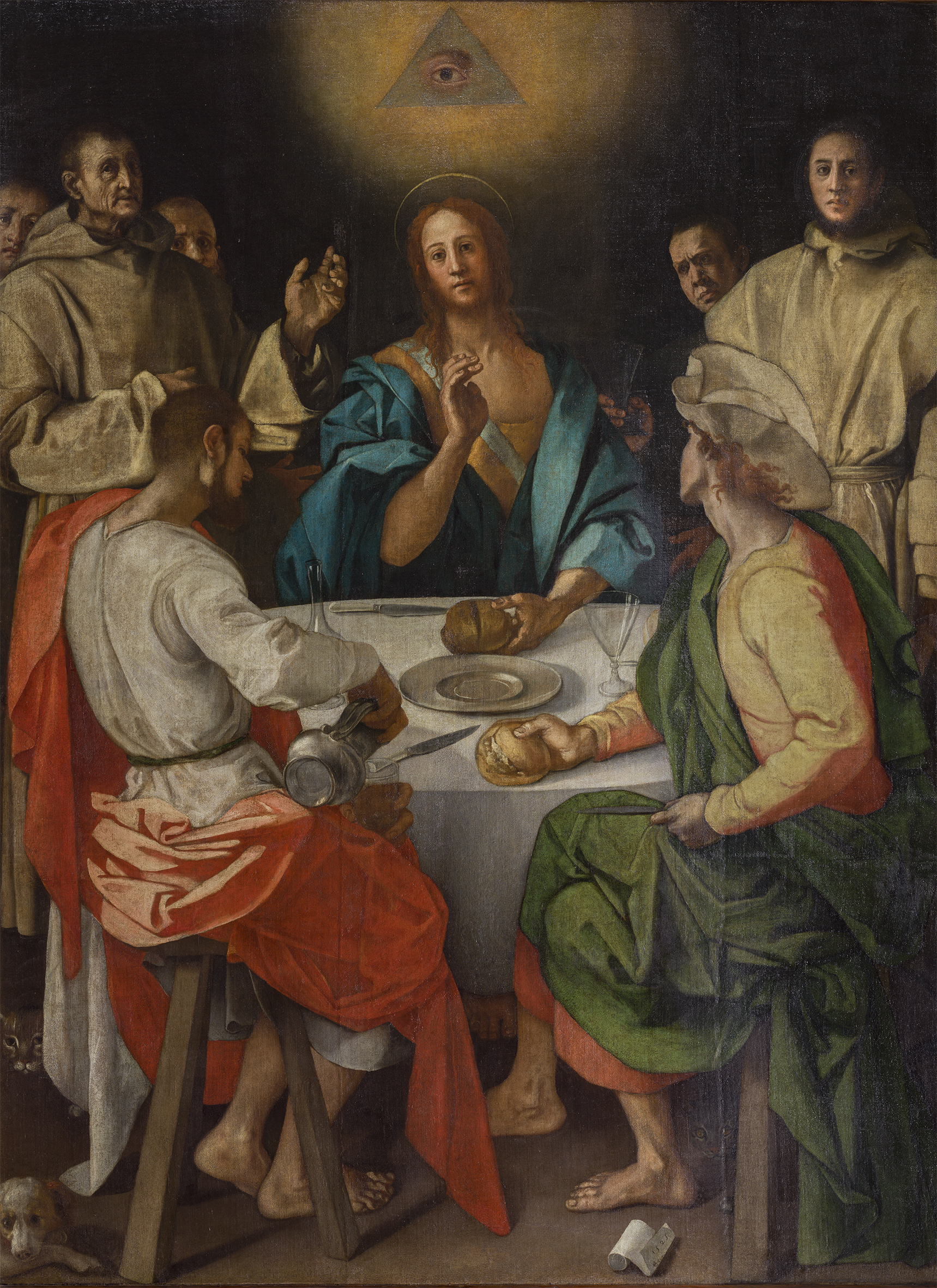
Pontormo. Dinner in Emmaus1525. Uffizi Gallery
Not too far from the Uffizi, in the church of Santa Felicitas, a spiraling whirlwind of intertwined bodies and languid gazes awaits us that seems to question the laws of perspective. We refer to The deposition of Christone of the masterpieces of mannerism in Florence itself: Pontormo eliminates the context of this scene to give preeminence to the expression of feelings. The lines of the set are virtuous – he was a very good draftsman, as we saw a few years ago at the Mapfre Foundation – and they meander in all directions, giving rise to arabesques and continuities, surprises and clearer areas. Theirs is a spiritual scene, but also nervous; he seems to yearn for transcendence, but does not fear artifice.
It has traditionally been interpreted as a Descentbut we usually refer to it as Deposition to these images when the cross does not appear: this moment would correspond to the burial, rather, although we do not see a tomb or a slab. When several figures come together in an attitude of crying, this group could also be considered as Lament: the moment in which the body of Christ is torn from his Mother to be taken to the tomb, with movements as inharmonious as that of the angel holding, in the foreground, the legs of Jesus.
Like other of his contemporaries, Pontormo was highly aware of the relevance of his painting and valued theoretical speculation. This may have been the reason why, decades later (between 1554 and 1556, a prolific period for him), he kept a personal diary in which he gave great importance to his practices, but also to his daily life. So much so that he described what he ate, his schedules and expenses, sharing lines with the progress of his work in the frescoes of the church of San Lorenzo, also in Florence.
We will understand these diaries better if we think that the term mannerused by Vasari to refer to his contemporaries who had their own style, did not refer only to artistic qualities, but also to human manners; that is, to self-control, culture and refinement: sprezzatura (the precarious grace without affectation).
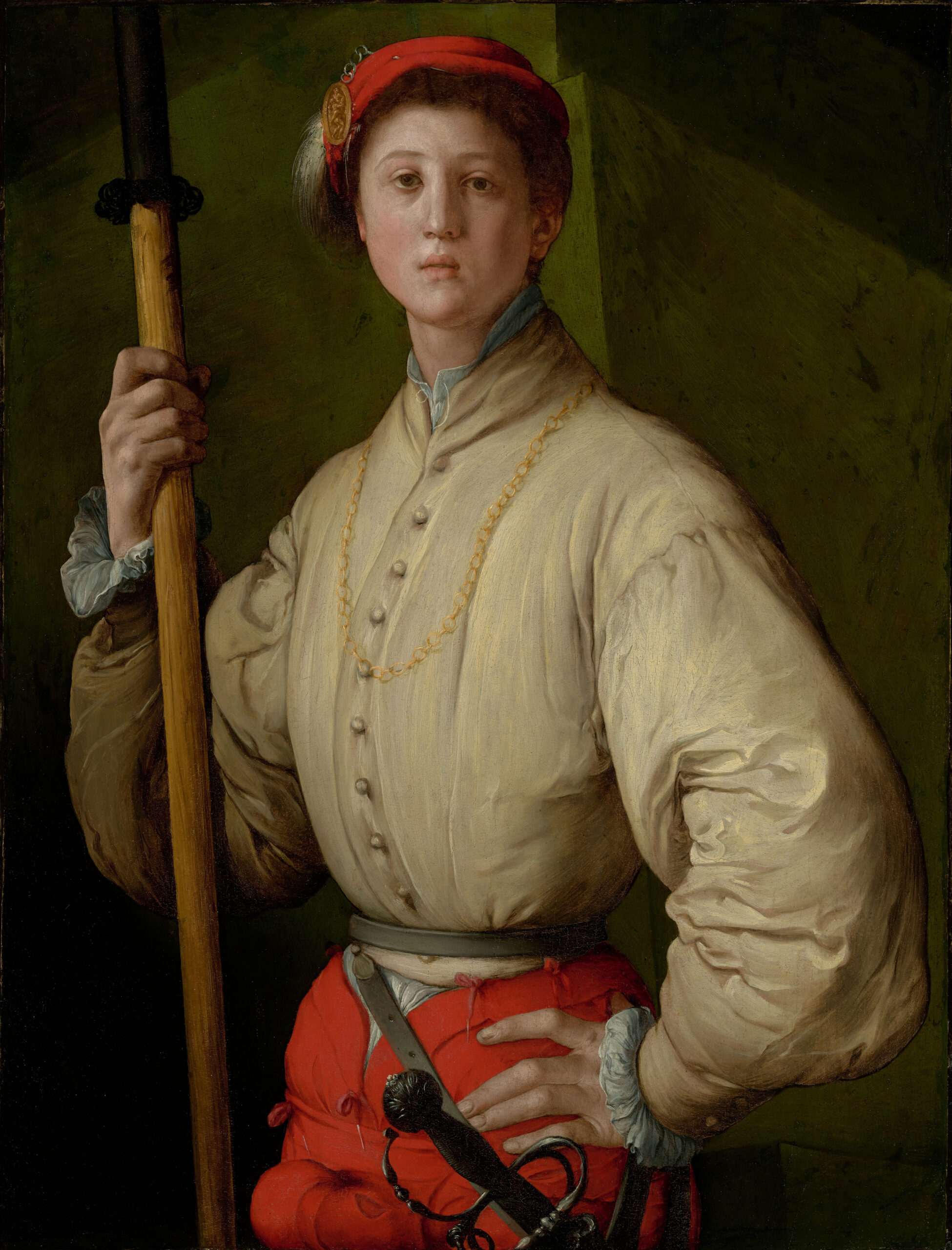
Pontormo. Ritratto di Alabardiere (Francesco Guardi?)circa 1529 – 1530. The J. Paul Getty Museum, Los Angeles
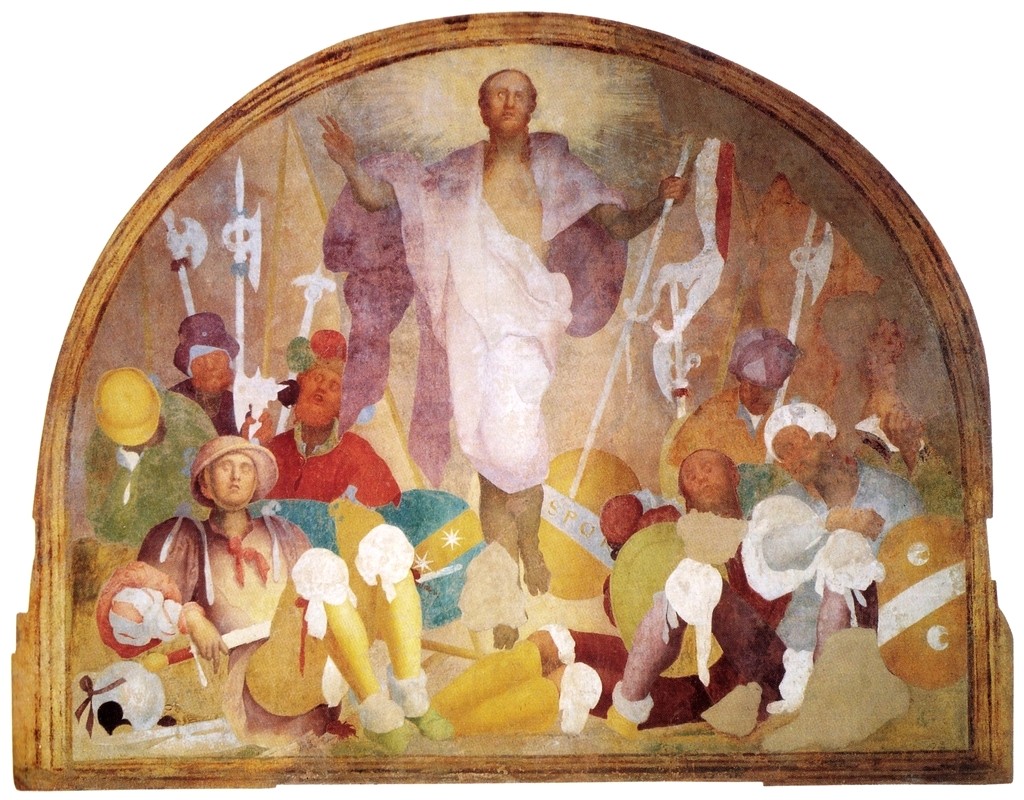
Pontormo. Resurrection1523 – 1525. San Lorenzo al Galluzzo
Out of necessity, the Uffizi will collaborate this autumn with the Scuderie del Quirinale in Rome in what will be the first major exhibition dedicated – in Italy and elsewhere – to Jacopo Pontormo. It can be seen from October 9 to February 7. It will be curated by Cristina Acidini, a leading expert on 16th century Florence, and we know that it will bring together her fundamental paintings and a selection of works on paper structured chronologically, but with thematic episodes. In addition to the Uffizi, some of the main European and American museums will lend pieces and there will be no shortage of the landmark work that we have recently had the opportunity to admire at the Prado: The Visitationfrom the church of San Michele Arcangelo in Carmignano.
This painting constitutes an absolutely original interpretation of that biblical chapter: we see four female figures, monumental in their dimensions and elongated, located in an ambiguous space, as those of this artist used to be. The arrangement of the figures has been related to Dürer’s engraving Four naked women (1497), while the gesture of the embrace between the Virgin and Isabel refers to the dextrarum iunctio, the symbol of union used in Roman reliefs and also used by Raphael in his Visitation of the Prado.
The presence of the two figures in the second plane and the small characters that animate the urban background—two men talking, a donkey leaning out in a corner and a woman in a window—make this space an architectural decoration linked to the representations of the ideal citywhich this time functions as a scenographic curtain that emphasizes the sensation of suspension and movement: mannerist dynamism. The palette of this fabric, which offers us unusual nuances and translucent layers, is key to the composition and the sensation of weightlessness that surrounds the figures has its counterpoint in the sculptural weight of the fabrics, whose folds seem to have been carved in stone and allow a glimpse of the soft contrapposto of the bodies.
The lighting, meanwhile, affects a certain pictorial relief character of the work, which has been interpreted as a reference to the Renaissance debate on the paragone, in which it is known that Pontormo was actively involved.
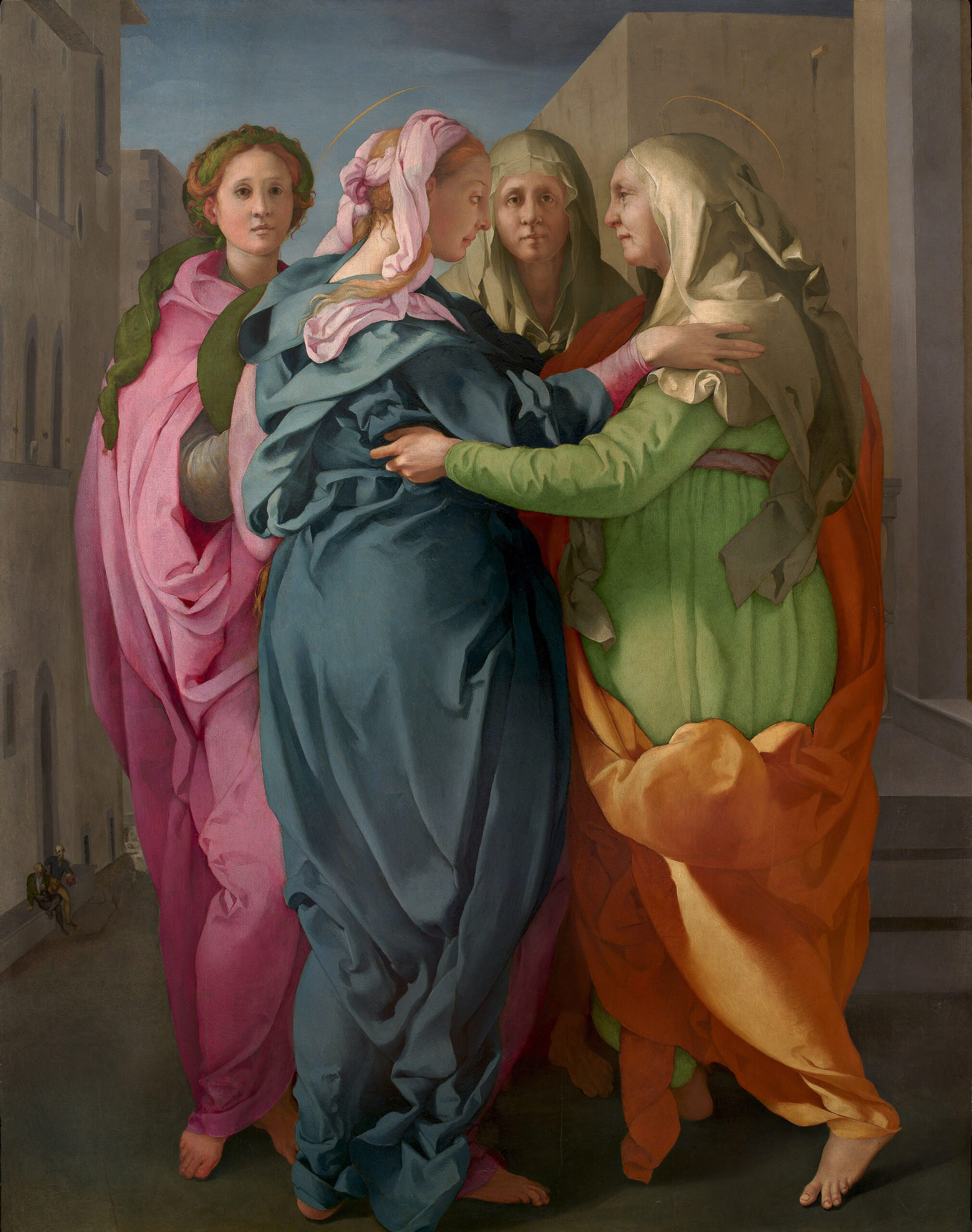
Pontormo. Visitation1528 – 1532. San Michele Arcangelo di Carmignano
Pontormo
SCUDERIE DEL QUIRINALE
Via XXIV Maggio, 16
Rome
From October 9, 2026 to February 7, 2027