While the Court of Cassation refused, on September 23, 2026, to return to the heirs of the collector Simon Bauer a painting by Camille Pissarro that the heirs considered stolen, for lack of proof of the identity of the work, the Paris judicial court has just granted, Thursday, November 5, 2026, the restitution request initiated by the heirs of Salomon Flavian against a London sale of Sotheby’s.
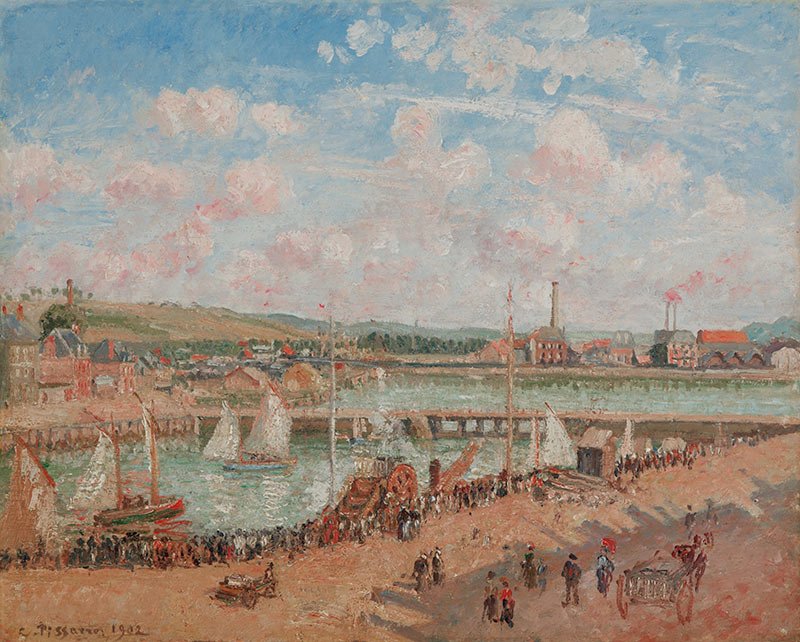
Painted in 1902 by Camille Pissarro, the canvas entitled The port of Dieppe Or Fishing dock and Duquesne basin, Dieppe, sunny afternoon was acquired in 1935 by the Franco-Romanian banker and art collector Salomon Flavian (1892-1955). In 1941 the assets in his coffers at the Westminster Foreign Bank were seized by the Nazi authorities and the painting could not be found at the Liberation. In 2024 the painting was sold at an auction by Sotheby’s in London for £1.2 million, after a settlement agreement was reached between some of Salomon Flavian’s heirs and the Mondex Corporation, a Toronto-based trading company working to search for looted cultural property.
Not approving this process which would have been against their interests, all the heirs of the banker had seized the Paris judicial court in order to declare the nullity of all successive sales of the painting on the basis of the order of April 21, 1945. In response, Sotheby’s and Mondex maintained that the Pissarro had been taken out of Flavian’s estate well before the start of hostilities, certainly in 1937 to be sold to Paul Rosenberg then to Edward The Bottom.
Gold “faced with the direct evidence provided by the applicants, supported by serious and consistent clues, (Sotheby’s and Mondex) who have undeniably undertaken numerous research, particularly in the Rosenberg archives and on the Parisian art market of the 1930s, provide no direct and convincing proof of the resale of the painting by Salomon Flavian before the war”. So that in application of the 1945 order the judges could only “to note the nullity of all successive sales of the painting by Camille Pissarro “The Port of Dieppe” (…) including the sale which took place in London on June 25, 2024”. The painting must therefore be returned to the heirs in whatever hands and wherever it is located – and a possible appeal is not suspensive.
To this end, the judge took care to order Sotheby’s to communicate, under penalty, the full identity of the 2024 buyer in order to obtain the material restitution of the work. It is true that the persistent silence of Sotheby’s, in the name of “business secrecy”, “prevents the rights holders of Salomon Flavian from asserting their right to restitution from the sub-purchaser of the disputed work, and contravenes the main objective of the order of April 21, 1945 of the restitution in kind of the stolen property to the victims or their beneficiaries”.
This judgment is particularly original on two procedural points. First of all, and despite a sale abroad, the judges excluded the jurisdiction of international law in favor of French law by qualifying the action as tort linked to the initial damaging act of the spoliation committed in Paris in 1941. Then the judges refused to apply the arbitration clause which excluded the jurisdiction of state courts in favor of the Court of Arbitration for Art in The Hague, provided for in the settlement agreement concluded between certain members of the family and Mondex, in considering that it could not be imposed on other third parties entitled to the contract, in the name of the protection of public order and the purpose of the 1945 ordinance.
It remains to be seen where this is hidden Port of Dieppe to be returned…