France. The outsourcing of public services in museums is a recent phenomenon across the sector. Several actors date the real starting point to the opening of the Musée du quai Branly, in 2006. A new museum, a national public establishment, the Quai Branly then made the choice to outsource all the functions which were not considered to be part of the core museum business. For a player in the sector, “it’s a liberalization that took place silently”. Silent, because the subject remains sensitive. Few institutions communicate willingly about this type of subcontracting. “They have shameful outsourcing”, summarizes the same actor. The discretion is due to the political and union nature of the subject. In 2014, Aurélie Filippetti, then Minister of Culture, finally decided, after a heated debate, to reinternalize the surveillance of the Picasso Museum when it reopened. More recently, three unions took several establishments to court. There is no doubt that the file is at the top of the pile of the leaders of the Center Pompidou, a large part of which will be retired by the time it reopens. However, we note that the public service delegation for the concession of restaurants or bookstores is more transparent.
The arrival of foundations increases the expected level of service
The scope of this market needs to be clarified. This is not about private security or room guards, but reception and orientation services in the spaces, queue management, access control, ticketing, group support, management of visit assistance tools, changing rooms, and, in certain cases, mediation. These services can be permanent or requested on an ad hoc basis, during an opening, a night or privatization of spaces.
This development is part of a broader movement of outsourcing of peripheral functions in museums. Either “anything that is not an office activity”slips a service provider. Behind the formula, we find a logic well known in other sectors: refocus internal teams on collections, scientific programming, management of works, administration, and entrust specialized operators with missions requiring a large number of staff and subject to atypical schedules.
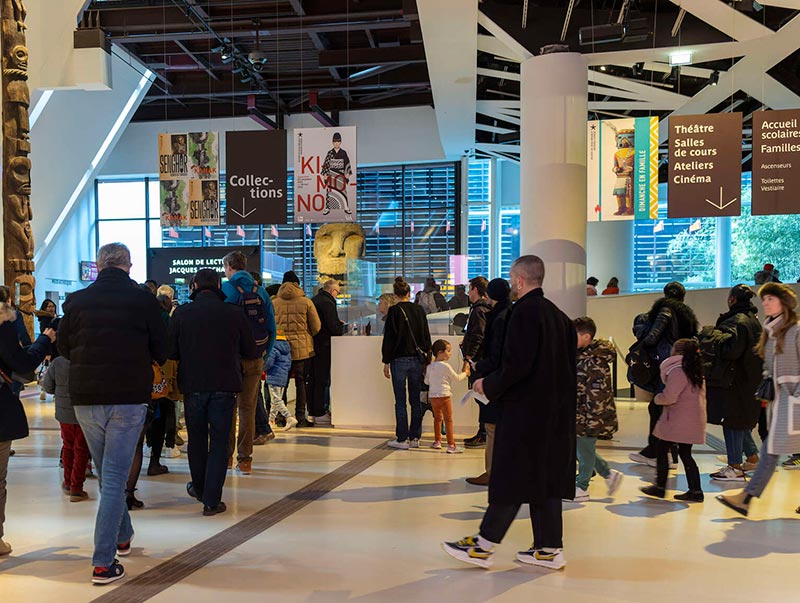
Quai Branly is a pioneer and laboratory. Angélique Delorme, its deputy general manager, indicates that there are “around 110 people under the multi-service contract on site every day, for a total volume of around 230 to 250 people including shifts”. The model then spread. For the general director, the competitive context has changed mentalities: “The market has changed with the arrival of agile private players like the Louis Vuitton Foundation or the Bourse de Commerce. To offer a quality service, agility is necessary on the public (sector) side too. As a member of the Council of State, I recall the three principles of public service: equality, continuity, but also adaptability. »
The French market for these cultural services is estimated, according to data collected by The Arts Journalaround 50 million euros in 2025. The host and hostess agency Marianne International thus claims 14 million euros of activity in culture. Pénélope announces 10 million. Armonia, ex-Musea, is around 9 to 10 million euros. City One would weigh around 4 million euros in this segment, the mediation and audience management company MagmaCultura 2 million, the guide-lecturer agencies Pont des Arts 3.4 million euros – according to its latest available figures –, and Des Mots et des Arts around 2 million euros. The market therefore remains modest on the scale of large companies, but its growth is now attracting well-capitalized and structured companies.
Contractual terms vary depending on the establishment. Some museums contract directly with a specialized operator. Others go through a facility manager (building or service manager). This is the case of the Musée du quai Branly, which awarded a multi-service contract to Engie, which then mobilizes service providers for all or part of the reception missions. Other institutions use Ugap (a public purchasing center) to secure their purchasing procedures. In all cases, the profitability of the contract depends on very concrete parameters: price of services, indexation clauses, coverage of replacements, schedule, event calendar, seasonality of attendance.
Schedules and events: meeting a need for elasticity
If outsourcing is progressing, it is first and foremost because it meets a need for elasticity. Museum opening hours are difficult to fit into the schedule of internal teams: evenings, weekends, public holidays, nights, peaks in attendance at certain exhibitions, late closings linked to public relations operations. Alain Chalon, director of Marianne International, summarizes the operational advantage sought by establishments: “It is infinitely simpler to call your service provider to ask for four more agents for an opening in eight days than to try to mobilize internal teams. »
The second driver is the rise in service standards. In establishments that welcome several hundred thousand, or even several million, visitors, reception is no longer an additional function. It becomes a component of the visiting experience, the fluidity of the route, the management of groups, foreign tourists (visitors from outside the European Union to the Louvre or Versailles) or evening visitors. “These are the human faces of the museum,” as one provider describes them. Training, supervising, evaluating and replacing these personnel requires expertise in recruitment and management. However, not all museums have the staff or the time to take on these tasks directly. Angélique Delorme thus asserts that “99% of visitors (from Quai Branly) are satisfied with the welcome ».
Using an external service provider appears more expensive than direct management, since the latter includes the costs of recruitment, training, supervision, absenteeism, and of course its margin in the invoice. But the gap would be reduced significantly if an establishment itself were to build an organization capable of carrying out the same tasks. It is also simpler for a museum management to manage a commercial contract involving fifty people than to manage fifty employment contracts. “Museums no longer have the know-how for thisobserves Alain Chalon. »
This development does not eliminate operating difficulties. She moves them. The main one concerns the day-to-day management of outsourced teams. The museum cannot exercise a direct hierarchical link without taking the risk of reclassifying the mission as an employment contract. In practice, establishments work through the operating managers or site managers of the service providers, to whom they transmit general instructions, planning adjustments or specific needs linked to an exhibition.
How to integrate outsourced teams into museum life?
The other question is that of the integration of these employees into the life of the institution. How can employees of a third-party company feel invested in a scientific and cultural project that is not that of their legal employer? How can we maintain service consistency when a growing part of the interface with visitors escapes the internal hierarchical chain? The Sud-Culture union believes that these practices “break work collectives or the coherence of museum policies”. Managements try to limit this border effect. At Quai Branly,“all agents wear the same badges and we invite them to general meetings to present our future activities”, indicates Angélique Delorme.
Attachment to place plays a significant role here. All the stakeholders interviewed underline the attractiveness of cultural establishments for employees. This environment promotes loyalty that is often absent in traditional tertiary reception. Some museums are also seeking to stabilize teams. At Quai Branly as at the Musée des Confluences (Lyon), employees of the previous service provider are taken over in the event of a change, even in the absence of strict legal obligation. According to Béatrice Schawann, director of general administration of the Musée des Confluences, “the majority of employees of the previous service provider remained and were taken over by the new service provider”.
Museums are also attentive to the conditions of execution. The specifications sometimes include objectives for workforce stability, training or balanced schedules. Béatrice Schawann specifies: “Our specifications ask the holder to commit to a maximum turnover rate of 30%, to limit the fragmentation of hours and to promote balance between employees’ personal and professional lives. » In a sector where the quality of reception depends on the continuity of teams, the turnover rate becomes an indicator almost as decisive as the price.
There remains the question of the employees themselves. Trade union organizations regularly denounce harsher working conditions than in the cultural civil service. The service providers argue, for their part, that the contracts are mostly permanent, with possibilities for internal development. Certain profiles, particularly students, find flexibility in these work organizations compatible with their personal constraints. “We ensure that our employees do not work more than every other weekend”explains Alain Chalon. He emphasizes the possibilities for progression: “Our employees benefit from vertical mobility, for example becoming a team leader,” recalling that the general director of Marianne is a former site manager. The gap with public jobs, however, remains real. For a comparable role, the remuneration of a service provider is not necessarily higher than that of a museum agent, while the advantages linked to leave and status remain more favorable in the civil service.
This market could double in ten years. The minimum level for outsourcing is around 80,000 visitors to whom the museum offers a full range of services. Progress can come from the entry of new museums into the model, or from the extension of the scope entrusted by establishments which already outsource certain services. It should be noted that external support has already been called upon when it comes to speeding up the construction of collections, which are at the heart of a museum’s missions. The next step will undoubtedly be the outsourcing of room surveillance agents.