Melle (Deux-Sèvres). A subtle art, as close as possible to the thrill of nature and heritage. This is how Jan Kopp, curator of the Biennale of the small town of Deux-Sèvres, envisaged the energy of this 11th edition which is deployed on 13 sites in the city. From the old court to the Romanesque churches, via the media library and the cinema, the German artist, who himself presented several works during the previous edition in 2024, composes a score of around fifty discreet touches,“invisible circulations and patient rustles” to use his words. An invitation to contemplation conceived with acuity, far from the tumult of major international contemporary art events.
The visual artist has chosen to present several ethereal works, composed from a palette reduced to black and white. Whether they dialogue with the elements or gradually reveal themselves to senses other than sight, these proposals testify to the pronounced interest of their authors in immateriality. In the courtroom of the former Melle court, located in the Hôtel de Ménoc, the Lithuanian artist Zilvinas Kempinas (born in 1969) exhibits a mobile designed in the purest tradition of kinetic art. Thanks to the action of a fan attached to the ceiling, the magnetic strip ofOasis (2009) deploys its moving contours above a white metal circle placed on the ground. The work, as sober as it is fleeting, is of great elegance and promises to leave a lasting impression on the retina. The attic of the Hôtel de Ménoc hosts an intervention in situ by French artist Laurie Dall’Ava (1982), entitled Chronoplast II (2026). Its line of earthenware biscuit plaques, which form an abstract and refined composition, is an olfactory landscape which reveals its plant scents as the visitor approaches it. Composed from syntheses of green organic pigments, the perfume crystallizes the “chlorophyll memory”according to the artist. Here too no big outbursts, just a tenuous intervention.
A stone’s throw from the old court, the Protestant temple of Melle is adorned with a sound mobile, composed by the Austrian-born visual artist Susanna Fritscher (1960) in collaboration with members of IRCAM. The white tubes equipped with sound membranes of Sonic Propellers (2017, [voir ill.]), attached to a rotating motor, move on the ceiling of the temple until it draws a horizontal circle in space. The serious sounds gradually give way to more acute and harmonious inflections: the sculpture is thus revealed to those who know how to listen.
Among other deeply poetic and timeless works, the video Stars, put out your lights (2026), produced by Marie Reinert (1971) with the students of an agricultural high school and broadcast in the nave of Saint-Pierre church. Taking up the aesthetics of Spider Castle (Akira Kurosawa, 1957), the artist composes a strange, phantasmagorical and contemplative object, in which adolescents made up of branches blend into a turbulent forest immersed in a thick fog of smoke. In the Jeanne-d’Arc room, Davide Balula (1978) displays his triad of sculptures entitled Puddles (2008) next to the now famous azure blue swimming pool designed by Céleste Boursier-Mougenot (1961). The three glass sculptures materialize the wave caused by a ricochet on a puddle.
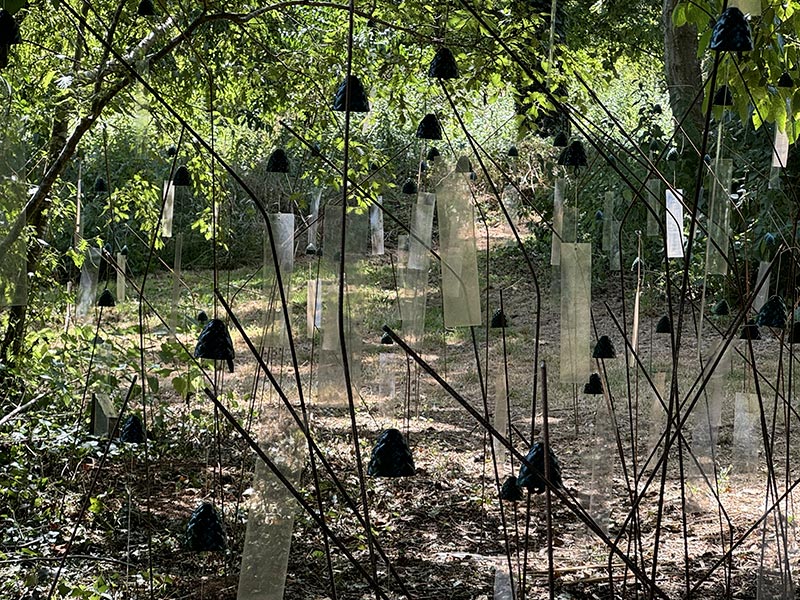
Jan Kopp also reactivated the magnificent installation Animitas (2014-2026) by Christian Boltanski (1944-2021) by adapting it to its green setting within the Maladrerie park. Here, there are 300 bells whispering their tinkles in the shade of a gigantic tree.
The richness of this biennial demonstrates the fact that Melle is a town which benefits from the unfailing commitment of a voluntary municipality: the event is financed to the tune of 100,000 euros by the town hall, or almost half of its budget. Note that the City also carries out many public commissions and acquires works during each edition of its Biennale, works which then remain for the most part in public space.