
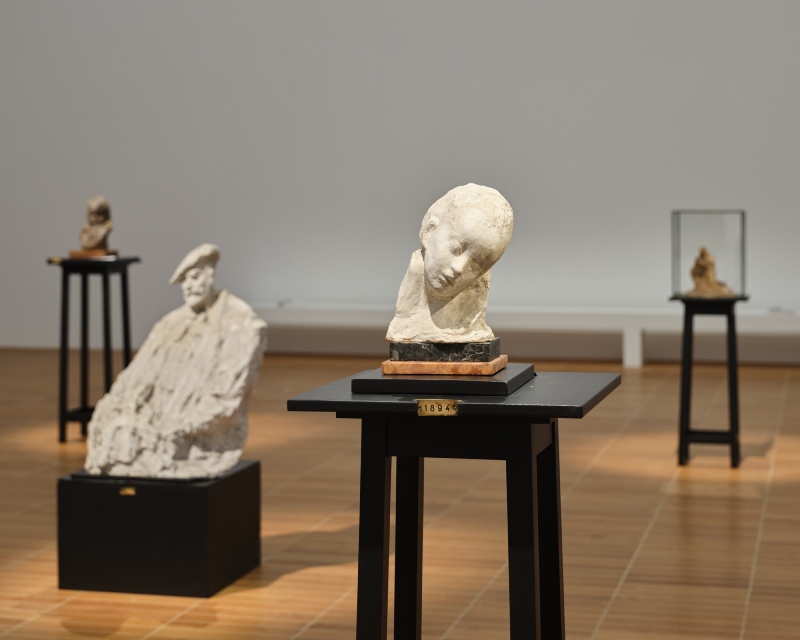
Basel (Switzerland). Under a somewhat worn title “Medardo Rosso, the invention of modern sculpture” – one day it would be necessary to identify all the artists who “invented” modernity -, hides a remarkable exhibition. The commissioners, Elena Filipovic and Heike Eipeldauer, conservatives at the Museum Modernen Kunst Stiftung Ludwig in Vienna, not only gathered a significant part of the sculpted and photographic work of Rosso (1858-1928), but also managed to orchestrate a convincing dialogue with a sixty artists of the past hundred years.
Perilous exercise, because such diversity could easily become visually confused, especially since the works, of various material natures, refer to different places and eras. Here, however, thanks to a rigorous selection of the work and a thoughtful provision, the assembly is remarkably constructed. Among the creators gathered at the museum-sculptors and painters-some are major figures of the avant-garde, such as Constantin Brâncusi, Louise Bourgeois or Jean Dubuffet. But the choice of artists is based above all on their proximity, visual or conceptual, with Rosso.
The use of photography
The route begins with a room where the sculptures are presented according to a staging privileged by the artist, placed on supports evoking stools of variable dimensions and protected by glass windows. The whole is accompanied by photographs made by Rosso himself-who, in his early days, was also a photographer. For him, as for Brâncusi, these shots make it possible to study the effects of light on the surfaces of works, often shaped in wax. The importance given to reflections on an almost translucent material explains why Rosso’s work is frequently qualified as an impressionist.
The different sections of the exhibition then analyze the fundamental principles of the sculptural practice of Rosso. Thus, the anti-monumental questions the classic statue, isolated in space and frozen in its verticality, aimed at timelessness. In Bookmaker (1894), the figure emerges from an informed mass and renounces pedestal, characteristic of traditional sculpture. Another notable aspect is the marked inclination of the character, which makes it possible to integrate the work into the surrounding space. This dynamic evokes as much Unique forms of continuity in space d’Umberto Boccioni (1913), that The horse (1914) by Raymond Duchamp-Villon or Prop by Richard Serra (1969), a metal hose tilted against a wall.
Introduction of narration
In Rosso, models are generally ordinary individuals, these “Hero of modern life” Dear to Baudelaire, which the artist rubbed shoulders on a daily basis. An already common approach at the end of the 19th century in painters and writers, but also rare in sculpture. One of the peculiarities of Rosso lies in the introduction of narration through sculptural groups, as Omnibus printing (Around 1889) – prefiguring Interior of an omnibus de Honoré Daumier (1864) – or The conversation (1889).
In the “Repetition and variation” section, Rosso applies the principle of seriality, illustrated in particular by The Jewish Child (1893). Sculptures or photographs: he offers different wax, bronze and plaster versions. Each version subtly differs from the previous one, although they all proceed from the same initial impression. This process will be shared by countless creators of modernity, starting with Monet. Andy Warhol or Sherrie Levine will push the exploration to her climax.
Finally, the main quality of Rosso lies in its ability to dissolve matter, making it malleable, fluid, sometimes brushing against it. He thus manages to introduce a feeling of palpable in the inert hardness of the sculpture. Born in Turin in 1858, installed in Paris between 1899 and 1920, Rosso was admired by Rodin and Apollinaire. But back in Italy, his work will be overshadowed by futurism. Little present in art history books, rarely exposed in France … In short, the trip to Basel is essential.


