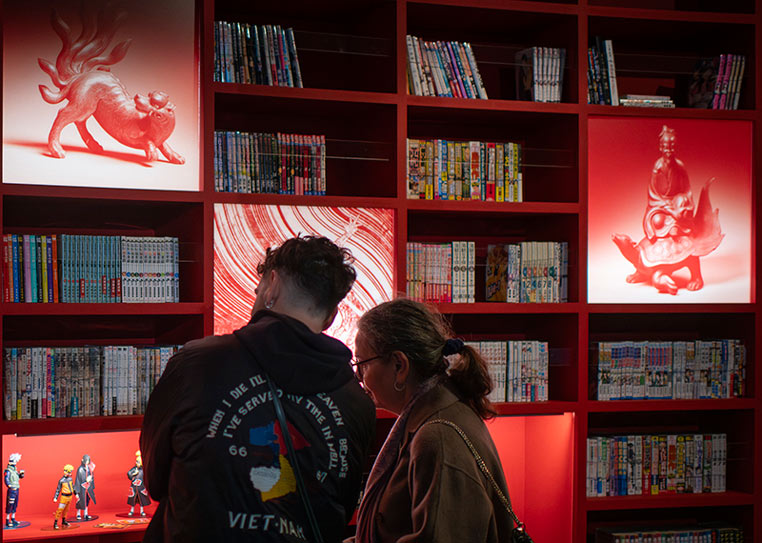
Paris. With 36 million volumes purchased in 2024, France is the largest consumer of manga after Japan and you can regularly admire original drawings from albums or celluloids of anime (Japanese cartoons) at the Maison de la culture du Japon, or at Japan Expo, for example. However, this is the first time that this genre has been rewarded with a major retrospective, pending the opening, hoped for in 2027, of the European Museum of Manga and Anime (Mema) in Colmar.
View of the exhibition “Manga, an art!” » at the Guimet Museum.
© Luc Boegly
The curators, Estelle Bauer and Didier Pasamonik, do not present the cultural context that the manga inherited, because the subject (humorous drawings, illustrated books, world of printing and publishing before the mid-19th century) was developed at the Guimet Museum in the exhibition “Before the manga” which ended at the end of January. However, they show more or less known connections, for example with the print (ukiyo-e) in the space devoted to Naruto (1999-2014) by Masashi Kishimoto. But the opening of the course certainly constitutes a revelation for a large part of the public: it was an Englishman, Charles Wirgman, and a Frenchman, Georges Bigot, who, from 1862 for Wirgman, adapted Western caricatures and press drawings to Japanese culture. At the beginning of the 20th century, the work of the man considered the founder of Japanese comics, Rakuten Kitazawa, bears witness to what he owes them.
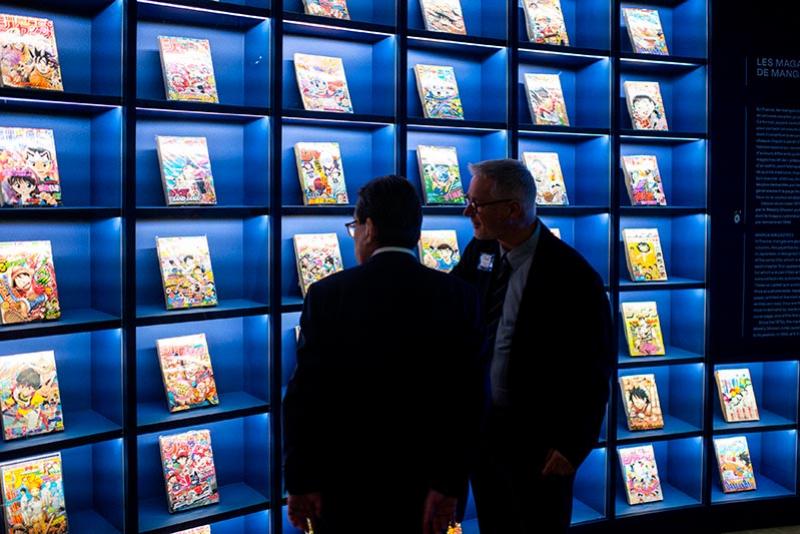
View of the exhibition “Manga, an art!” » at the Guimet Museum.
© Dmitry Kostyukov
The evolution of manga
The continuation of the manga story told up to One Piecedesigned since 1997 by Eiichiro Oda, is chrono-thematic and abundant. It shows the influence of kamishibaïs, boards for small street theaters operating from the late 1920s to the 1950s, and American cinema. At the same time, it focuses on the careers of famous authors (mangaka). It also reveals the numerous subdivisions of this literature, shonen (for boys), shojo (for girls), shonen itself comprising different genres: the gekiga (historical story), the stories of yokai, these supernatural beings who haunt the Japanese imagination, fantasy, works describing an apocalypse such Akira (1982-1990) by Katsushiro Otomo and those which address past or present social life. The autobiography Barefoot people (1973-1985) by Keiji Nakazawa documents the childhood of a survivor of the bombing of Hiroshima.
Several generations of French people grew up in this varied aesthetic environment and this mental universe conducive to imagination as well as reflection. Osamu Tezuka, for example, addressed gender identity with Princess Sapphire (1953-1956) – a theme taken up in shojo The Rose of Versailles (1972-1973) by Riyoko Ikeda – and the challenges posed by robots and artificial intelligence in Astro Boy (1952-1968). It is this wealth which, in October 2022, convinced deputies to reject the amendment aimed at excluding manga from the Culture Pass, confirming its integration and that of anime in our civilization.
View of the exhibition “Manga, an art!” » at the Guimet Museum.
© Dmitry Kostyukov