
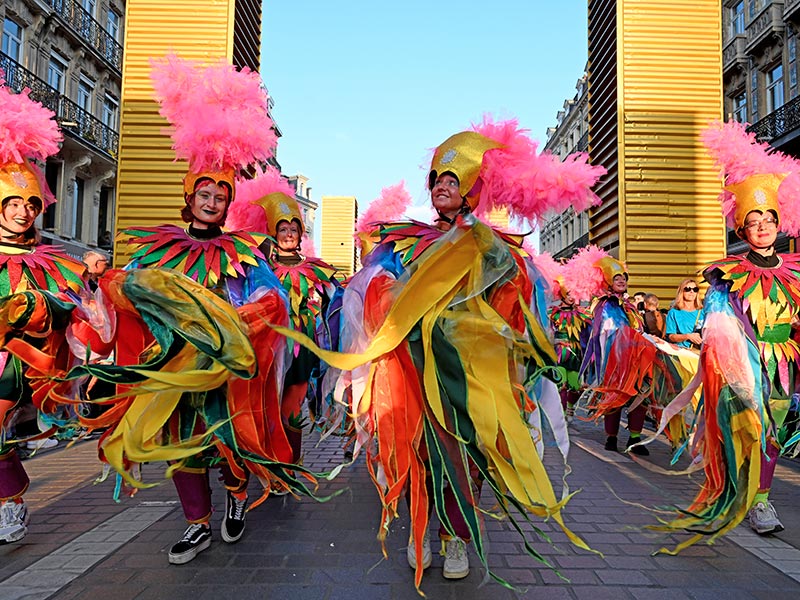
Lille (North). In Lille, culture is not just entertainment. It is the beating heart of political life. Even if Martine Aubry (mayor from March 2001 to March 2025) has often been criticized for her taste for pharaohism, all the municipal candidates are unanimous: it was she who brought culture into the streets of the capital of Flanders. The budgets speak for themselves. For 2026, that devoted to culture amounts to 72.9 million euros broken down as follows: 60.4 million euros for operations and 12.5 million euros for investment. Or around 310 euros per inhabitant. In comparison, the cities of Bordeaux, with 67 million euros, and Strasbourg, with 60 million euros, are almost poor relations.
However, the Lille cultural model is debated. In question, the “glitter culture”, which favors the spectacular to the detriment of in-depth work carried out with local actors. Symbol of this “showcase culture”, the triennial multidisciplinary event Lille3000, criticized from all sides. The current mayor, Arnaud Deslandes (member of the Socialist Party), successor and heir apparent to the resigning mayor, defends this legacy by insisting on its economic benefits estimated at around 53 million euros for the last edition, called “Fiesta”, which attracted 2 million visitors in 2025. The current majority is not budge. “We want to perpetuate Lille3000 but that doesn’t mean that we shouldn’t change the model,” tempers Marie-Pierre Bresson, culture assistant.
Opponents of Lille3000
The opposition, on the other hand, is on a roll. “An exhausted model where we are clearly at the end of a cycle”, denounces the Ecologist Stéphane Baly. Same thought for Lahouaria Addouche, head of the La France insoumise (LFI) list, who castigates “budgets focused on major “showcase” events and much less on neighborhoods”. Double standards? Whatever the case, everyone is preaching for the return of a local culture, much more everyday and anchored in the population. And if no candidate is kamikaze enough to reduce the budget, all propose to break it down differently.
Thus, Stéphane Baly intends to eliminate Lille3000 and use its budget of 2.6 million euros per year to create a permanent cultural forum whose contours are still very vague. Same desire but more concrete for Lahouaria Addouche who wants to create “multicultural neighborhood festivals throughout the year”. The candidates Violette Spillebout (Renaissance) and Louis Delmer (Les Républicains, LR), for their part, are not eliminating Lille3000 but are reshaping it. The first replaces the grand triennial parade with “an annual parade resulting from joint work between artists, schools and social centers”. Louis Delmer, for his part, undertook an audit of Lille3000 and redirected the budget towards the creation, in particular, of a major annual concert at a cost of between 40,000 and 50,000 euros.
A sign of the times and a need for identity in an anxiety-provoking environment, these new elections highlight heritage much more than the previous ones. Lille Town Hall has invested 85 million euros in six years for its preservation and in particular for major development works. This is the case for its flagship project worth 34 million euros, the transformation of the Natural History Museum, which is scheduled to open in 2028. “It is a lever for popular education and ecological awareness which will be reinforced by the creation of a large metropolitan media library whose budget will fluctuate around 30 million euros. »
The Grand Place of Lille.
World Heritage: relaunch the candidacy of the Vauban citadel
The Hospice-Comtesse chapel in Old Lille will also be restored in 2026, for an amount of 5.5 million euros. A response to the voices of the opposition who denounce the status of poor relation of heritage? Louis Delmer plans in any case to “double the heritage budget because the investment of funds for its rehabilitation is almost non-existent”. A critique argued by Violette Spillebout. “Martine Aubry did not mobilize institutional partners and patrons to safeguard heritage; for example, the Saint-Joseph chapel was destroyed while the population was very mobilized against this project”she points.
These positions are all the more virulent as none of the candidates have digested the abandonment by the former mayor of the inclusion of the Vauban citadel on the UNESCO World Heritage List. “We must relaunch this classification and above all restore the citadel by favoring the circular economy to seek funding from the Drac (regional directorate of Cultural Affairs Hauts-de-France) and Europe”, advances Stéphane Baly. The positions are all the more asserted as each candidate cherishes their own flagship project in terms of heritage. The Renaissance candidate dreams of creating, at the Le Tripostal art center, a European image laboratory by relying on current players and consolidating the budgets sprinkled today on isolated projects. Louis Delmer, for his part, wants to found a European city of contemporary arts, a sort of Lille-style Villa Medici which would welcome emerging artists from Eastern and Northern Europe. A residence installed in the current law school which he would move to the Saint-Sauveur wasteland. All for a budget estimated at around 5 million euros
Culture in the northern city has thus become an arena where two visions collide. On one side, the world city and its 2 million visitors, on the other, the promise of a return to the village held up by the opposition. This duel crystallizes a deep identity issue. This is the position taken by the Ecologists and LFI, consisting of placing the associative fabric at the heart of a more sober and “de-spectacularized” cultural transition. Lahouaria Addouche intends to establish an MJC in each district by redistributing the Lille3000 budget. This popular culture also involves the reappropriation of the city by its inhabitants. And in particular its history. A key theme which is reflected in the emblematic projects of several candidates. Violette Spillebout is therefore considering the creation of an architectural and heritage interpretation center, which would be installed in the current courthouse, for a budget of between 60 and 75 million euros. For Stéphane Baly, “the importance of knowing where we come from” is essential. And to answer this eternal question, he is planning the creation of a local history museum housed either in the Old Lille media library or at the Palais Rihour, currently the tourist office. Similar project for the LR with the creation of a museum of Lille history also located at the Palais Rihour for a budget of 6 million euros.
Return to the identity of Lille as a city of canals
Called both by Environmentalists and the current majority, the creation of an independent cinema also participates in this reappropriation. “We will house this cinema in the rooms of the Saint-Sauveur station with a subsidy budgeted at 40,000 euros in favor of the association which will be responsible for its operation”, observes Marie-Pierre Bresson.
Finally, the return to Lille’s identity involves its Flemish origins and its past as a city of canals. Thus, the 100 million euro project to restore water to Avenue du Peuple-Belge, a canal now transformed into green spaces, is almost unanimously supported by the candidates. In short, the battle of 2026 will not be that of an already record budget but that of identity. The people of Lille will have to choose between remaining spectators of a global metropolis or once again becoming actors in a city that is reclaiming its history.


