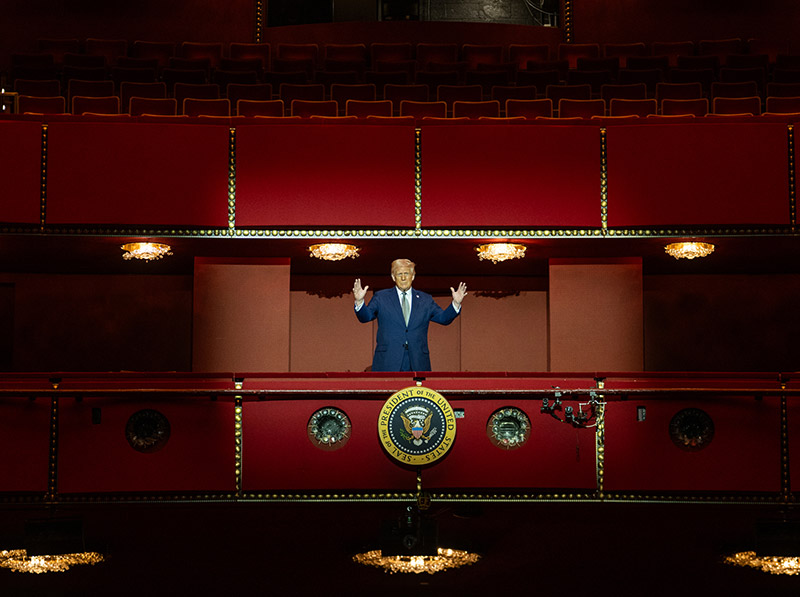
Donald Trump transformed the renovation of the Kennedy Center into a legal showdown. Tuesday, September 15, a few hours after a federal judge banned his name from being placed on the building for the second time, the American president warned that the work would not take place if this decision was not reversed. The board of directors, which he chairs and whose majority of members were appointed by him, had just approved the closure of the main building for a $257 million renovation that could last up to two years.
The dispute dates back to December 2025. The council then voted to rename the institution “The Donald J. Trump and John F. Kennedy Memorial Center for the Performing Arts” and installed the president’s name on the facade. Entered by Joyce Beatty, Ohio Democrat and member ex officio of the council, the federal justice invalidated this decision on May 29. Judge Christopher Cooper recalled that the name of the Kennedy Center is fixed by Congress and that the law makes it the only national memorial dedicated to John F. Kennedy in the capital. It also prohibits, with limited exceptions, the installation of new memorials or commemorative plaques in its public spaces. Donald Trump’s name was removed in June.
Donald Trump’s name inscribed on the Kennedy Center.
The council tried another route in August. By 20 votes to 3, he voted no longer formally for a name change, but for the addition on the facade of an inscription crediting Donald Trump with the restoration and renovation of the building, as well as the naming of the surroundings as “President Donald J. Trump Plaza”. For the administration, it was no longer a question of renaming the center but of recognizing the role of the president in financing the work, in the manner of a donor mention.
Christopher Cooper rejected this distinction on September 15. According to him, an inscription honoring Donald Trump on the facade or the naming of the square also constitute forms of memorialization subject to authorization from Congress. “Defendants cannot install memorials to President Trump, or anyone or anything else, at the Kennedy Center without Congressional approval.”he writes.
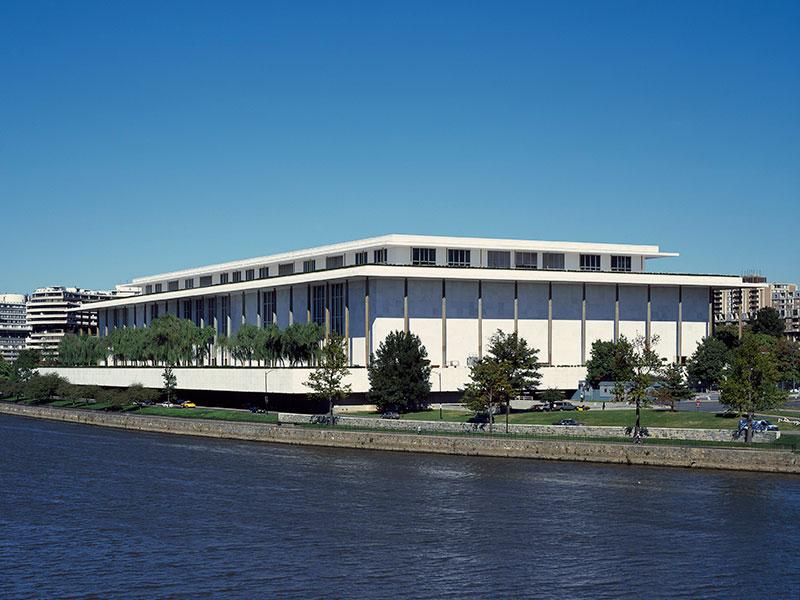
The Kennedy Center in Washington DC
The matter now takes on a financial dimension. In its filings, the Justice Department argued that preventing any mention of Donald Trump risked driving away donors, drying up private contributions and jeopardizing the renovation. The council is seeking in particular to raise private funds in addition to the $257 million already allocated by Congress.
After the judge’s decision, Donald Trump explicitly linked his support for the project to the outcome of the procedure. If the judgment remains unfavorable and is not overturned before the Supreme Court, “the reconstruction and renovation of the Kennedy Center will not take place”he wrote on Truth Social. This threat comes even though the council has just voted to close the building to begin work and the establishment reports a very degraded financial situation.