
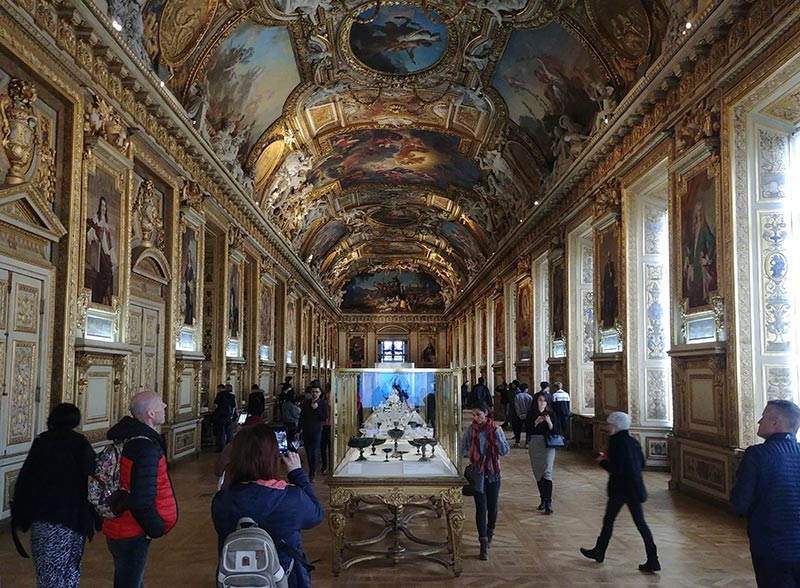
France. Five minutes. That’s how long it took on September 8 for the two masked and hooded burglars to break into the Renoir Museum in Cagnes-sur-Mer and leave with four paintings by the master. Two were found. There remains a loss of 9 million euros . A snub-shaped theft almost a year after the resounding burglary of the Louvre in the heart of Paris, during which eight jewels from the Crown of France were stolen. Far from being isolated sequences, France has witnessed a real trivialization of these burglaries for three years. Are our museums sieves? In any case, Jean Gazançon, CEO of Arte Generali is categorical. “I would never have insured the Apollo gallery of the Louvre, he blurted. Everyone knew that his security conditions were deplorable. » The gallery balcony had already been reported as “point of vulnerability” by a security audit in 2018 which, exploited by the thieves, revealed to the public the Louvre’s lack of insurance for its collections.“In France, the permanent collections of national museums are generally not insured, the State being its own insurer” recalls Daphné de Marolles, head of the Art and jewelry branch at AXA XL. Marion Habay, Fine Art Manager at Helvetia, summarizes this state guarantee regime in one sentence: “It is often said that objects from major museums are protected by their notoriety and therefore unsaleable, except… that we have had the opposite demonstration. »
This is again the case with the recent theft of the Renoirs. Then there is the question of buildings which cost the Louvre dearly but which again falls under the responsibility of the State, which remains its own insurer. The State guarantee for works, however, has its limits and falls into a special regime known as nail-to-nail, from the moment a work passes through the doors of a museum for a loan or a temporary exhibition. “ The most fragile stage in the life of a work is transport, not because of the risk of theft but of handling because it is at this moment that we experience the most damage.
underlines Mathilde Duthoit Michelet, art underwriter at QBE. Has this wave of thefts changed insurance conditions or just the way we view security?
Rates still low“Some insurers are starting to raise their rates a little but as long as this is not followed by the entire market, there is not much development due to very strong competition” analyzes Aurélia Farkoa, director of the Fine Art France department within Morel & Cie. A finding that is all the more stable as current contracts will remain unchanged until their expiry. Stéphanie de Montricher, Fine Art manager at Liberty, however, brings a nuance. “Enhanced requirements may apply to loans of high-value works, major exhibitions or significant collections »
she emphasizes. Aurélia Farkoa details the price list for public markets which distinguishes two main types of risks when lending works. For the stay of a work exhibited in a museum, the insurance rate is generally between 0.03 and 0.04 per thousand of its value per month of exhibition. For its transport, the rate varies depending on the fragility of the work and the distance traveled. It is 0.04 to 0.06 per thousand for a non-fragile work transported in France and can reach 0.12 per thousand for a fragile work transported internationally. For the most delicate works, an increase of 25 to 50% may be applied.“An exhibition of non-fragile paintings with a capital of 20 million euros from France costs between 3,500 and 5,000 euros of nail-to-nail insurance over three months, the same exhibition from the United States with fragile works climbs between 10,000 and 12,000 euros”
explains the broker.
The Louvre theft changed the epicenter of burglaries. They have moved from the large national museums to the territorial museums which remain uncovered. The theft in broad daylight this summer of the solid gold torque of the Lady of Vix exhibited at the Musée du Pays Châtillonnais is one of the most emblematic examples. Despite two previous attempts, the original necklace remained on display in the window.
Ensure yes, but not always everything Like the Châtillon-sur-Seine museum, almost all museums do not benefit from the state guarantee since the system is reserved for national public establishments. They therefore go through the private market. “There is no single rate applicable to all museums, the premiums being assessed according to the characteristics specific to each risk.
states cautiously, Stéphanie de Montricher. As for the technical director of Hiscox, Nicolas Kaddèche, he places the general order of magnitude of collections insurance between 1 and 2 per thousand of the insured value while Jean Gazançon puts forward around 0.5 per thousand in commercial rate, or 150,000 euros premium for a collection of 300 million euros. “Many strategies still consist of not ensuring everything, explains Mathilde Duthoit Michelet. Due to a lack of sometimes neglected verification, museums do not always have an exhaustive vision of their reserves and even when the works are valued, communities do not always have the budget to ensure them 100%. » Hence the increasingly frequent use of limited coverage contracts.“We are seeing more and more museums, medium or large, taking out first risk insurance specifies Nicolas Kaddèche. They ask for a package of fifteen or twenty million, sometimes fifty, even though the total value of their collection is much higher. » Some establishments go as far as outright renunciation or are faced with refusal from the company itself. “Not counting the vulnerable places that insurers refuse to insure,notes Marion Habay. C Some municipalities ask us to provide insurance without any security system, it’s complicated. » Jean Gazançon formulates this refusal bluntly. “ If I have to meet museum directors who do not have the means to meet the standard, my exchange with them will be a little short, he blurted.
I’ll tell them, I’m sorry, I can’t assure you. »
Jewelry under pressure Security that is all the more demanding as the trend in burglaries today concerns pieces of goldsmithery and jewelry. They are easy to sell. Melted for gold, cut and recut for stones. The Musée du Hiéron, in Paray-le-Monial, paid a high price in November 2024 when the robbers vandalized the monumental sculpture of the Via Vitae by tearing off the gold, ivory and diamond figurines that adorned it. Damage estimated at seven million euros. Yet even there, price stability remains essential, even if, as Nicolas Kaddèche slips,“premiums on the valuable part are always higher than on works of art, due to the increased risk of theft” . On which Aurélia Farkoa bounces back: “They can be multiplied by ten compared to graphic works and in the precious segment. Some insurers no longer want to position themselves or impose much stricter security conditions. »
The reason lies in the market itself. The price of gold saw a surge of more than 60% between 2025 and 2026. A recurring logic which affected the exceptional collections of the National Museum of Natural History in Paris in 2025 when thieves equipped with blowtorches stole six kilos of native gold. However, in the absence of an increase in premiums on jewelry and goldsmithing, we are also seeing the strengthening of security requirements. A logic confirmed by Daphné de Marolles. “We can, when necessary, send an expert on site to support the exhibition curator from the exhibition design stage. » But often the only possible measure after one or more burglary attempts is to “remove from the presentation any work with a heavy weight of gold and/or precious stones”,
Note from journaldesarts.fr
Since the publication of this article, the two paintings were found in October.


