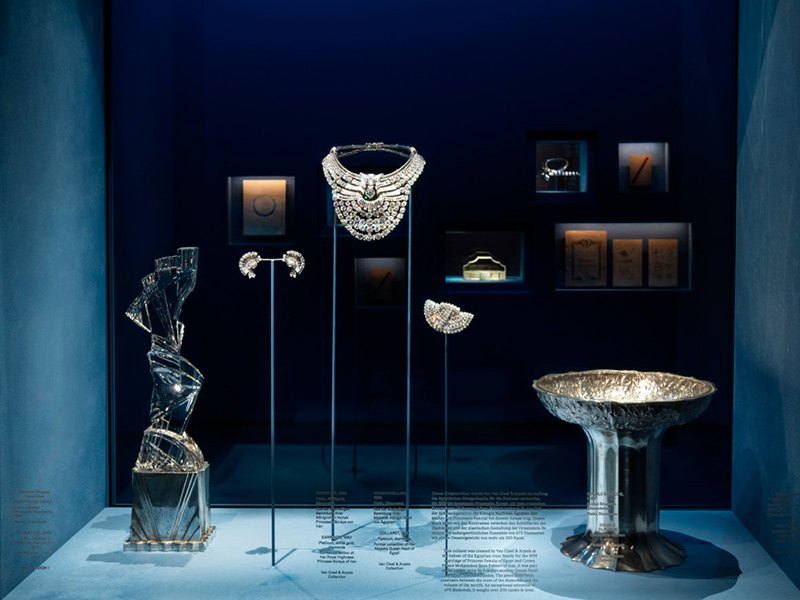
Two men stole, on Thursday August 27 around 2 p.m., one of the centerpieces of “Glanzstücke”, the exhibition that the MAK – Museum of Applied Arts in Vienna is dedicating to Van Cleef & Arpels. The suspects, unmasked, had purchased their tickets as simple visitors. One displayed a weapon, probably real according to the police, while the other hit the armored display case containing the jewelry with a hammer. According to Der Standardaround forty blows were delivered in less than four minutes. The two men then fled on foot towards the Stadtpark neighbor. No injuries were reported.
Queen Nazli’s necklace, made in 1939 by Van Cleef & Arpels.
© Austrian Ministry of the Interior
The necklace in question is not just any piece. Made in 1939 by Van Cleef & Arpels for Queen Nazli of Egypt, on the occasion of the marriage of her daughter Fawzia to Mohammad Reza Pahlavi, future shah of Iran, it is set with 673 diamonds totaling 204 carats: 355 round stones and 318 baguettes, arranged around a central diamond of approximately six carats. Sold for the first time in 1975, it reappeared at Sotheby’s in New York in 2015 and was sold for $4.28 million (3.8 million euros). Van Cleef & Arpels then acquired it for its heritage collection.
The investigation is being conducted by the Landeskriminalamt from Vienna. Police released CCTV footage of the two suspects, described as slim, between 1.70 and 1.75m tall, with dark hair and beard. Cameras from nearby streets and metro stations are also used. Their trace is lost for the moment in the sector of Stadtpark and national and international research is underway. The current value and insured amount of the necklace have not been communicated; Der Standard believes, however, that the insurance could be of the same order as the price paid in 2015.
Lilli Hollein, general director of MAK, affirms that a specific system had been developed with Van Cleef & Arpels and that the windows met the highest standards for this type of presentation. A visitor interviewed by Die Presse claims, however, that no bag checks were carried out at the time of the events. The next day, the museum installed a metal detector; bags and backpacks must now be left and human and video surveillance has been reinforced.