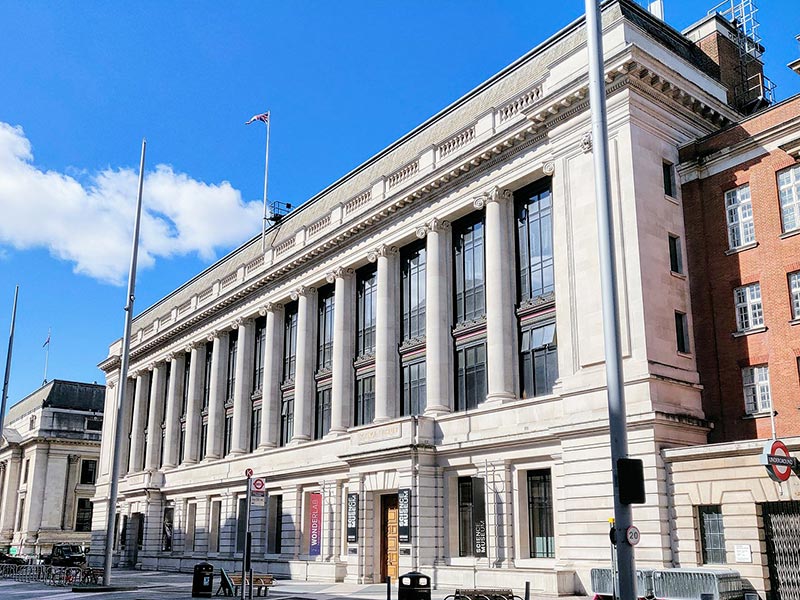
After several decades of partnership, the Science Museum joins the long list of cultural institutions in the United Kingdom to announce that it will not renew its contract with BP, a British oil company, which expired on August 31.
The sponsorship contract more specifically linked the Academy of the Science Museum Group, the museum’s internal structure providing training and resources in science, to the BP company. Although the museum’s general director, Ian Blatchford, did not give a precise reason for this decision, the announcement comes in a context of lasting tensions.
For several years, activists have called for the end of the partnership between the museum and the firm, which they accuse of irresponsibility in terms of environmental impact. Among other things, the oil giant is accused of seeking to improve its image by associating its brand with a scientific institution, as part of a “greenwashing” strategy.
The Culture Unstained collective also suspects that BP exercises influence on the scientific education provided by the institution, in particular through the financing of a research project, for which a daily survey The Guardian had revealed that certain decisions were subject to the agreement of its representatives, which the company denied. Pressure also comes from part of the teaching community, who are calling for a boycott of school visits to the museum, precisely because of the partnership with BP.
While its reputation in the British cultural field was already largely compromised, the oil group found itself at the heart of a new controversy in February 2025, after announcing a sharp increase in its investments in oil and gas and lowering several of its climate objectives. Despite the strong reactions from civil society, the decision was not enough to make the Science Museum or the British Museum give in.
In 2024, the Science Museum ended its partnership with the Norwegian energy company Equinor, after determining that its emissions did not meet the criteria set by the museum, based on Transition Pathway Initiative (TPI) assessments. BP, on the other hand, obtained the maximum level of the TPI index for the quality of its transition management. The Science Museum also estimated that it met its long-term alignment criterion with a trajectory of 1.5°C. This interpretation was contested by Culture Unstained, which pointed out that the TPI assessments did not consider BP to be aligned with this short- to medium-term trajectory.
Over the years, various British cultural institutions have ended their partnership contracts with BP – once one of the sector’s most powerful sponsors – or chosen not to renew them, amid controversies linked to the group’s climate policy. In 2016, BP announced its break with Tate following a long campaign by Liberate Tate activists, officially citing a “extremely difficult economic environment” and denying that the protests were the cause, reported The Guardian. In 2022, it was the turn of the National Portrait Gallery, which after several actions by activists and artists demanding an end to the partnership, ended its contract with BP. The Royal Shakespeare Company is one of the few institutions to have explicitly justified its decision to divest from the company, in 2019, by the reactions of its young audiences.
The break between the Science Museum and BP makes the British Museum the last major British cultural establishment still sponsored by the oil company. In 2023, the museum announced the end of a 27-year partnership with the fossil company, a choice welcomed positively by activists. The satisfaction was short-lived, however, as a new 10-year deal was finally agreed later in the year for £50 million, aimed at funding part of the museum’s renovation programme.