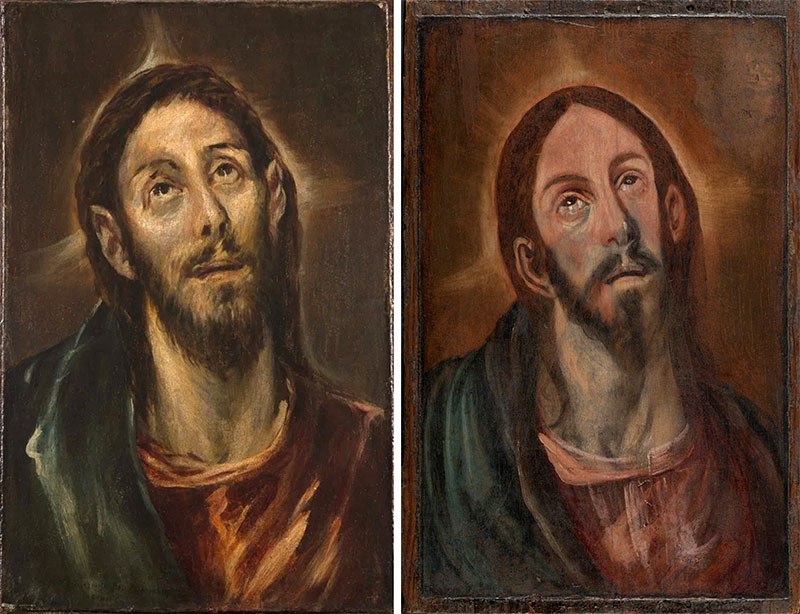
Preserved in the papal apartments, a panel by El Greco, hidden under a painting from the 1960s, has just been rediscovered. He Redentore (1590-1595), 45 x 29 cm, long considered a minor copy, represents a Christ with awkward features. In 1967, José María de Muniáin, professor of aesthetics and devout Catholic, offered the panel to Pope Paul VI. Hanging in the Hall of Ambassadors of the Apostolic Palace, it joins the collections of the Holy See, managed by the Vatican Museums. In 1970, the historian José Camón Aznar put forward the hypothesis of an El Greco. But the crude appearance of Christ discourages research.
The rediscovery comes during a state inspection carried out in 2024. The restorers of the Vatican Museums, under the direction of Paolo Violini, are undertaking a series of analyses: infrared reflectography, X-ray radiography, X fluorescence. The pigments, the binder and the modeling do not correspond to the practices of the end of the 16th century. Pigment analyzes date the repainting to the 1960s. The visible Christ is only a repainting. The El Greco market was then booming; many fakes circulate to meet the demand for spiritual images deemed authentic. An anonymous forger covered the original painting in order to make it “salable” in the Vatican.
The progressive cleaning reveals a slender, frontal Christ, against a dark background, characteristic of El Greco’s Toledo period and intended for private devotion. The images also reveal two earlier compositions, a Virgin and Child, around 1580, linked to a Apparition of the Virgin to Saint Laurentand a Saint Dominic in adoration, around 1590. The whole constitutes a pictorial palimpsest and documents workshop practices, based on the reuse of supports and motifs. Four perforations on the edges suggest a use as a portable altar, extending its devotional function. The work still belongs to the Holy See. Inventoried in the collections of the Vatican Museums, it has not left their legal framework since 1967. Its rediscovery, however, modifies its status.
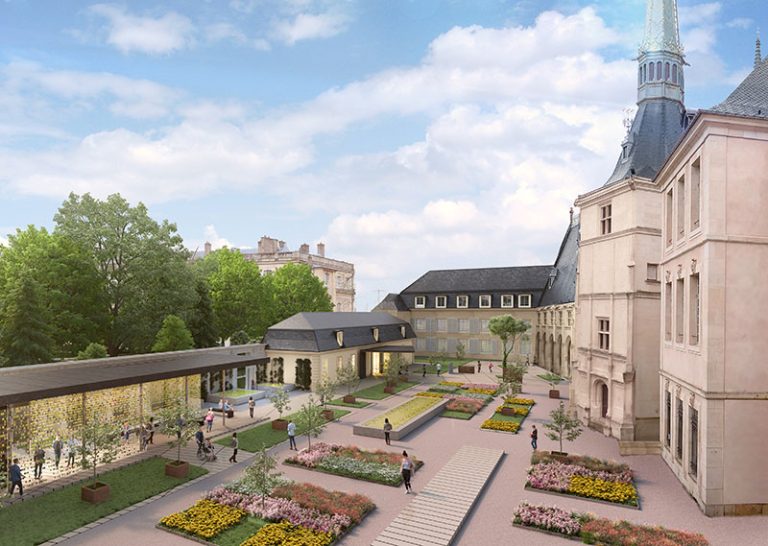
The work has been presented since March 14, 2026 in the exhibition “El Greco allo specchio” (“El Greco in the mirror”), at the Apostolic Palace of Castel Gandolfo. Confronted with a Saint Francis receiving the stigmataan early work, around 1570, on loan from the Pagliara Foundation, it allows us to situate his stylistic evolution, from his Venetian training to his Toledan maturity. The exhibition, visible until June 30, integrates scientific data from the restoration.