
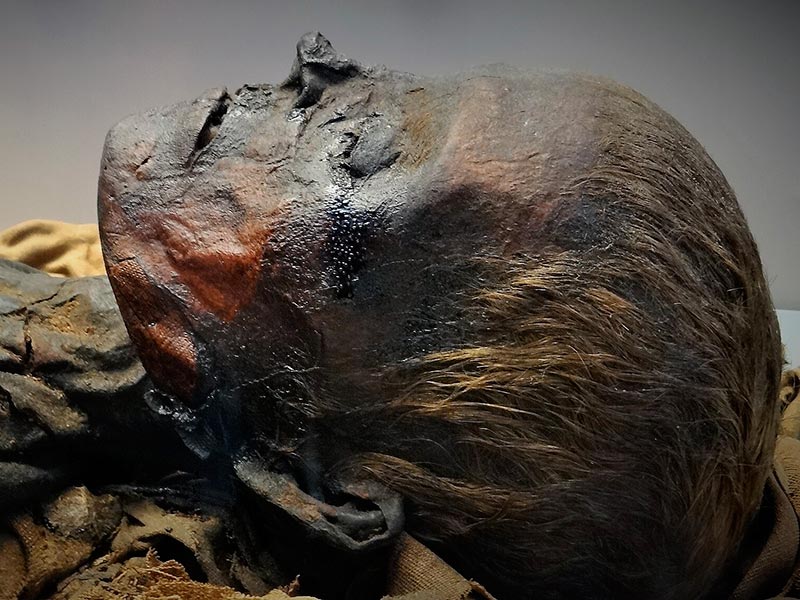
An investigation of Guardianpublished on March 7, provides an initial inventory of human remains preserved in British institutions. Based on information from 289 museums, universities and local authorities, it shows that 241 establishments declare that they hold such sets. In total, more than 263,000 “items” – bones, mummified bodies, skulls, hair, teeth, skins or fragments – have been identified.
This total remains incomplete. Only 100 establishments were able to provide an approximate number of human remains, or 79,334 identifiable people. Around 5,700 remains are not included in any internal database. Private collections are not taken into account. According to the responses obtained, 37,000 human remains have an identified foreign origin, including 28,914 coming from outside Europe. Around 16,000 others remain with no known provenance. Of the 263,000 remains recorded, 166,124 are attributed to the United Kingdom (63%), including 122,747 from archaeological excavations. Around 37% of the total therefore corresponds to non-British remains or those without established origin.
The Natural History Museum (NHM), in London, appears to be the main holding institution. The investigation found 27,864 records of human remains in its databases, corresponding, according to the museum, to approximately 27,500 individuals, more than half of which came from the British Isles. For non-European remains, the establishment keeps a minimum of 11,215 pieces.
The other major center is the Duckworth Laboratory at the University of Cambridge. The investigation reveals 20,110 pieces of human remains, including around 8,740 coming from abroad. A government investigation published in 2003 already indicated that this laboratory housed around 18,000 individuals. According to the Guardian, Cambridge notably holds the largest collection of African remains identified in the United Kingdom, with 6,223 items.
A British government report published in 2003 described various modes of acquisition: purchases, exchanges between institutions, archaeological excavations, but also looting. Several researchers, including historian Dan Hicks of Oxford University, recall that these remains were often collected by colonial officers, military doctors or anthropologists as part of research associated with 19th century racial theories.
The scientific management of these groups has often resulted in the transformation of bodies into inventory objects. The remains are classified in the form of items – skulls, teeth, jaws or bone fragments – identified by numbers and kept in specialized reserves. Work devoted to reserves of human remains describes standardized storage conditions: metal cabinets, plastic bags and sometimes incomplete labels. According to several researchers, this documentary neutrality tends to obscure the historical conditions of collection, often linked to the contexts of colonial conquest or anthropological research of the time.
The management of these collections is mainly based on Human Tissue Act of 2004, supplemented by Guidance for the Care of Human Remains in Museumspublished in 2005 by the Department for Culture, Media and Sport (DCMS). Section 47 of Human Tissue Act authorizes nine national museums – including the British Museum, the Natural History Museum, the Victoria and Albert Museum and the Science Museum – to remove human remains less than 1,000 years old from their collections.
Several specialists are now calling for a review of these guidelines. In 2018, the Honoring the Ancient Dead association contacted the DCMS to request an update of the ethical framework. The question of the trade in human remains is also raised. A report from the All-Party Parliamentary Group for African Reparations (APPG-AR), published in 2025, highlights that it remains legal in the UK to buy and sell certain ancient human remains for decorative or collectible purposes.
However, over the past two decades, several restitution programs have been initiated. Collections from Oceania have been the subject of numerous repatriations. In 2022 then 2024, the Natural History Museum transferred custody of more than 100 then 113 ancestors (111 Moriori and 2 Māori) to the New Zealand National Museum Te Papa and the Hokotehi Moriori Trust.


