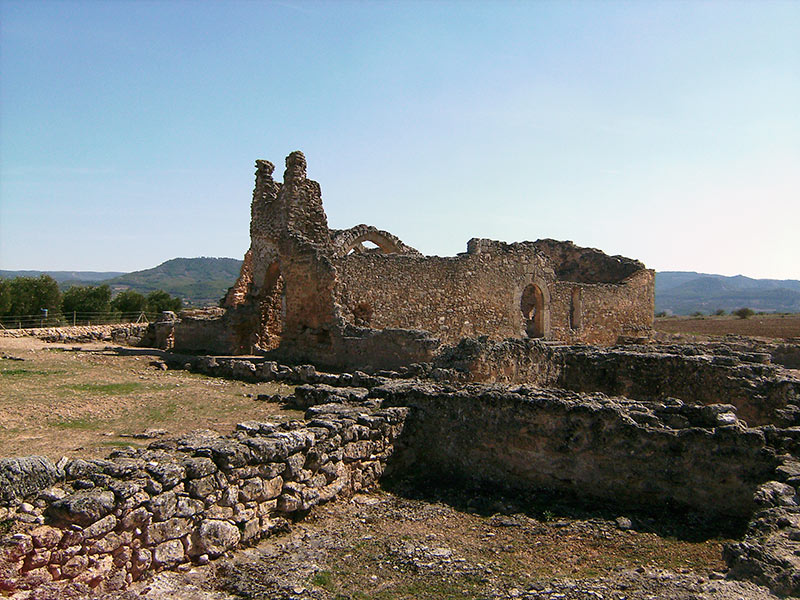
Zorita de los Canes (Castile-La Mancha, Spain). On September 12, 1945, on the second day of excavations on the hill of La Oliva, near the village of Zorita de los Canes, about a hundred kilometers east of Madrid, 90 gold coins emerged from the ground. For Juan Cabré, a respected figure in Spanish archaeology, the find is providential. The most recent pieces date from the reign of Leovigild, the Visigoth king who founded Recópolis in 578. Enough to affirm that this plateau dominating the Tagus is indeed this city known until then only through texts. The deposit quickly established itself as the chronological reference for studies on Hispania from the 6th century. Since then, the site has become a monument of Spanish historiography and an archaeological park open to the public.
Eighty years later, a twenty-page article published in the journal of the Spanish Association of Medieval Archeology cracks this story. Fernando Arce Sainz, historian attached to the Spanish Higher Council for Scientific Research (CSIC), the equivalent of the CNRS in France, maintains that the treasure was “falsely” discovered and that Juan Cabré would have buried it himself to establish his thesis. Its main argument lies in the work of its own excavators, who established that the place where Cabré places his discovery corresponds to levels dated from the 12th and 13th centuries. A 6th century treasure in medieval soil, writes Fernando Arce, is “the smoking gun at the crime scene”. The contents of the treasure also intrigue him. Everything happens as if the pieces had been sorted to confirm Cabré’s theory since none contradicts its dating. As for the currency of the Suevi kingdom, established at the other end of the peninsula, near present-day Galicia, it had little reason to be there.
Gold coins from the Visigoth treasure of Recópolis.
© Museo Arqueológico Nacional
The archaeological community is winding down
The response was immediate. Manuel Castro, site director, contacted by the Arts Journalmakes a simple argument. Many of the coins in the treasure, which combines Visigothic, Byzantine, Merovingian and Suevi coins, had never been seen or described before 1945. No one knew of their existence. Juan Cabré could therefore neither buy them nor have them copied, and the treasure could not be “an accumulation imitated or prepared from known models”. The monograph that Manuel Castro published last March, the first in-depth study of the treasure, also explains that these coins would have been voluntarily buried under the floor of the church at the time of its construction, like a buried religious offering. “to remain there permanently”. A rite of which other examples are known around the Mediterranean.
The Visigothic attribution of the place is not based on these coins alone. The presence of ceramics dated from the 6th to the 8th century, sculptures and Merovingian pieces from Gaul, and twenty-five carbon-14 datings carried out on site point in the same direction. The team also invokes the archives of the excavators and interviews conducted in the past with the workers who unearthed the deposit before alerting Juan Cabré, says Manuel Castro. Lauro Olmo, scientific director, present on site for forty years, judged “scandalous” to question “a respected archaeologist throughout the profession”. In the process, the archaeological community mobilized to defend Cabré, forcing the newspaper El País to nuance its scoop.
Behind the coins a duel of interpretations plays out. Fernando Arce has long defended the idea that the hill of La Oliva is not home to a Visigothic city, but to an Islamic foundation from the 9th century. His article, published without any real evaluation by his peers according to his detractors, contains a weakness that Fernando Arce himself recognizes. Nothing documents how Juan Cabré obtained the parts, this point remaining “impossible to demonstrate by evidence”.
The controversy promises to occupy Spanish archeology all summer. Because if the treasure were to fall, what would be left to prove that Recópolis is indeed Recópolis?