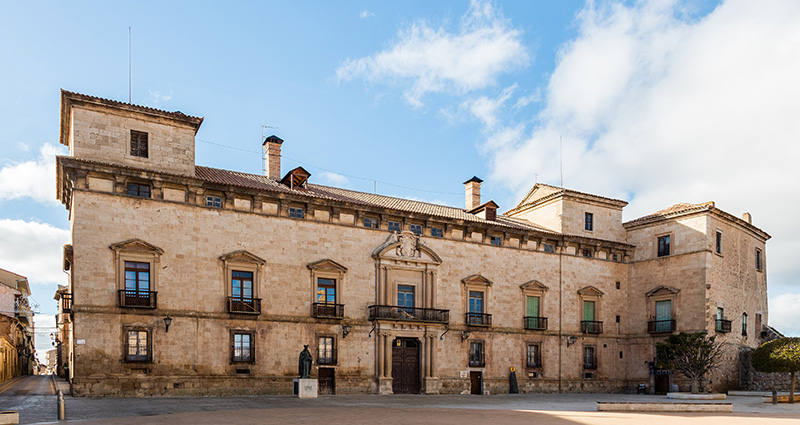
The month of September begins with tumult in Almazán, a town located in the province of Soria in Castile and León. At around 7:50 a.m., local residents were awakened by the sound of the collapse of the facade of the Renaissance palace of Hurtado de Mendoza, classified as an “asset of cultural interest” (Property of Cultural InterestsBIC), which welcomed the Catholic Monarchs in 1496.
The disaster affected a third of the northern facade of the building, overlooking the Duero River. Five of the eleven arches of the upper floor came loose, and the landslide of stones on the road led the municipal services to block traffic. As long as the danger of successive collapses has not been averted, clearing work cannot begin.
The collapsed north facade of the Hurtado Palace in Mendoza.
The mayor of Almazán Jesús Cedazo expressed his frustration in the daily El Paísclaiming that the incident “could have been avoided”. The councilor, who denounced a “institutional inaction”did not fail to recall the multiple complaints addressed by the town hall to the Heritage Department, territorial service of the administration of the Autonomous Community of Castile and León in the province of Soria, competent in matters of cultural heritage and responsible for the monitoring and heritage protection of buildings. Work was carried out on part of the building in 2011, but the restoration of the entire building was lacking.
On September 2, the government of the autonomous community of Castilla y León recalled the conservation obligation incumbent on owners and ruled out any expropriation. She specified that work had been authorized from 2024 and that temporary shoring had been carried out. The town hall of Almazán, a 5% co-owner, must now lead an emergency intervention with technical support from the region.
The flaws highlighted by Mayor Jesús Cedazo echo a structural problem relating to the maintenance of heritage buildings in Spain, as revealed by an investigation byEl País published last May. The experts point out the need to carry out an inventory of monuments on a national scale, in order to determine the state of fortifications in the country and to take the necessary measures to safeguard them, in a context where “more than half are at risk of collapse”.
The situation seems particularly worrying in Castile and León, where several incidents similar to the one affecting the Hurtado Palace in Mendoza have occurred in recent times. In the province of Valladoid, the collapse of two vaults of the Cuenca de Campos convent last April reflected the neglect of heritage located in areas of demographic decline in Spain. Likewise in the village of Muriel de Zapardiel (Soria), the collapse, last January, of a tower of the Our Lady of the Assumption church, a witness to Mudejar architecture, gave rise to criticism accusing the incompetence of the institutions.