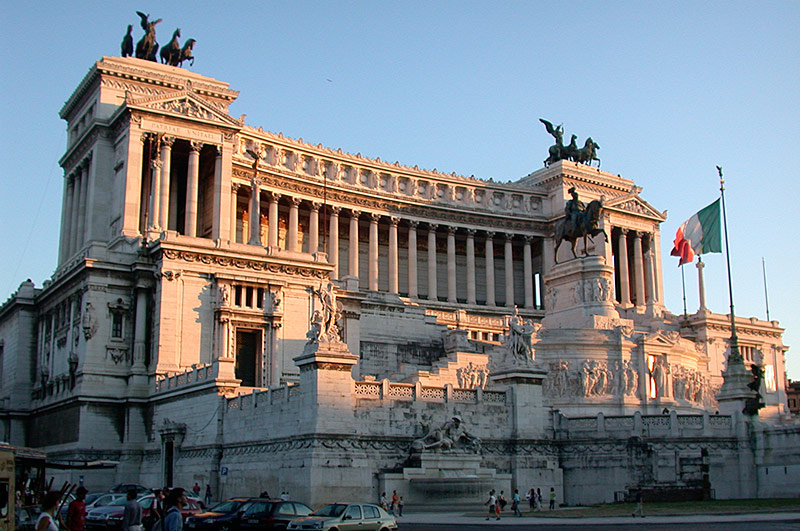
Rome. It is a cruel irony of History, both on a symbolic and purely architectural level. The Vittoriano (or altar of the Fatherland), erected in Rome in 1911 to celebrate 50 years of the unification of the Peninsula, is slowly sinking into the ground. Enough to comfort those who like to emphasize the (too) fragile and recent Italian patriotic feeling. This monument designed to exalt the stability and sustainability of the very young Italian nation turns out to be a colossus of white marble… with feet of clay.
The north-western side of the building located on Place de Venise, in the heart of the capital, is continuously sinking by a few tenths of a millimeter per year. A phenomenon obviously imperceptible to the naked eye but which has not escaped that of satellites. We owe this discovery to a study carried out by the Nhazca company, with the Sapienza University of Rome and the Higher Institute for Environmental Protection and Research (Ispra). Researchers analyzed more than 300 radar images acquired between 2002 and 2019 by the European Envisat and Italian Cosmo-SkyMed satellites.
The monument reacts in a contrasting manner: if its eastern part remains perfectly stable, its northwest side is slowly but surely sinking. Direct consequence on the surrounding wall facing Place de Venise: the difference in height has reached almost 5 millimeters in almost twenty years. A gap which may seem small but which exerts immense pressure distorting the monument. Cracks have already appeared on its west facade. The fault does not lie with an architectural defect, but with Roman geology. The unstable part of the Vittoriano was built on alluvial soil with softer and compressible sediments. The colossal weight of the monument crushes the ground unevenly, causing its asymmetrical subsidence.
“Today, satellites allow us to see a monument move a few tenths of a millimeter per year, to reconstruct its history over twenty years and to understand the causes of the movement without ever touching it,” explains Alessandro Brunetti, general director of Nhazca. Thanks to the countless image archives accumulated by space agencies, experts can analyze the structural past of a site, even if no study had been planned at the time. They thus reconstructed millimetric deformations of the Vittoriano without installing any sensors on the building, preserving its integrity. Finally, the use of satellites allows for better prevention. Traditionally, it was necessary to wait for the appearance of a crack visible to the naked eye to diagnose a structural problem, with intervention often late or at exorbitant costs.
This scientific assistance would have been useful to avoid the collapse in November 2025 of a portion of the facade of the Torre dei Conti (Tower of the Counts) a stone’s throw from the Colosseum. An accident which caused the death of a worker trapped inside the monument whose construction dates back to the 13th century. The Vittoriano is not threatened by this. Stabilizing materials will be injected into its basement to stop differential subsidence, while keeping the building under constant digital surveillance.
The Torre dei Conti (The Tower of the Conti) before and after the partial collapse of its facade on November 3, 2025.