A common metaphor for interiority, a wardrobe can say a lot about its owners. In Pompeii, archaeologists exhumed the contents in the so-called domus of Cornelius Maximus, registered “IX 11.7”, as part of a vast project launched in February 2023 in Regio IX of Pompeii. According to Gabriel Zuchtriegel, director of the Pompeii archaeological park, these remains provide an enlightening testimony to the daily life of the city’s inhabitants before the eruption of Vesuvius in 79.
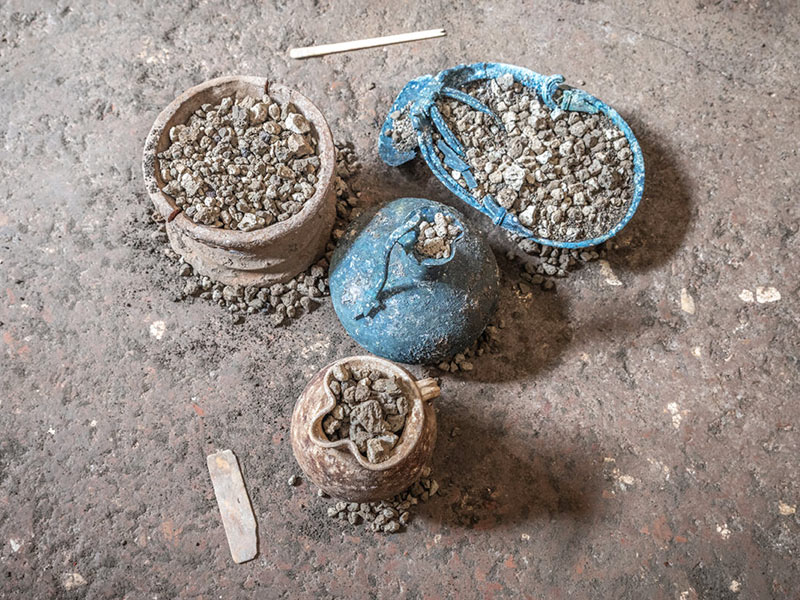
The contents of a large cabinet, the structure of which was reconstructed using the impressions left in the volcanic deposits, allows us to glimpse certain aspects of the daily life of the occupants of the house, notably their washing practices, their domestic and perhaps commercial activities. Makeup utensils, such as tweezers and a small spatula used for mixing pigments, or a glass perfume bottle, give an idea of the personal habits of their owner. Other objects, such as bronze, glass or ceramic kitchen vessels, an oil lamp, or a jug decorated with pine cone scales, evoke activities linked to the maintenance of the house.
A small plant fiber basket containing 38 bronze coins appears in the inventory, which archaeologists estimated was more likely a reserve dedicated to daily expenses than a real treasure. Lead weights were also discovered in a wooden box, which must have been used in a commercial activity.
Crépundia discovered in a cabinet discovered in Pompeii, in the Regio IX sector, insula 11.
© Parco Archeologico di Pompei
Jewelry, formerly kept in a fabric bag, particularly aroused the interest of researchers, who derived hypotheses about intra-family relationships and the place of children in the family. At least 24 small amulets carved in bone, earthenware, glass paste and rock crystal, representing deities including Bes and Mercury, bunches of grapes and other symbolic motifs, have been interpreted as pendants, due to the hole pierced on each of them which must have been used to hang them on a cord. They were thus attributed to crepundia, necklaces with apotropaic functions offered to children, which would allow their movements to be heard thanks to the sound of the pendants clashing. The fact that they were kept in a cabinet has led archaeologists to attribute a certain sentimental value to them.
Partially uncovered during excavations in 1912, the domus had already been attributed to the Roman elite, due to its central location on via dell’Abbondanza, the main commercial and social axis of the ancient city. Its traditional name “house of Cornelius Maximus” refers to inscriptions noted at that time, which have now disappeared. At the time, only its facade had been discovered. Today, the interiors of the house seem to support the theory that the owners belonged to a wealthy social class.
Frescoes of the fourth Pompeian style (ca. 50-79), characterized in particular by illusionism and architectural perspective, testify to the refinement and ornamental taste of the owners. They notably feature panels with a yellow background, a black base and representations of stylized peacocks, birds and dolphins. Archaeologists have compared them to the workshop on Via di Castricio, associated with several decorative groups from Pompeii.