Ciutadella, Menorca,
Hiroshi Kitamura was born in 1955 in Hokkaido and learned watercolor with his mother before forming, then already in sculpture and engraving, at the Academy of Fine Arts of that same Japanese city. After his thirty, he decided to settle in Catalonia (being carried away by his admiration for Picasso, Miró or Gaudí), and since then he began to combine in his creations the materials and Mediterranean references and those of the Japanese culture; For almost fifteen years he lives in the Empordà region, where he is worth fundamentally of wood (trunks and branches) to address the relationships between the human being and the landscape.
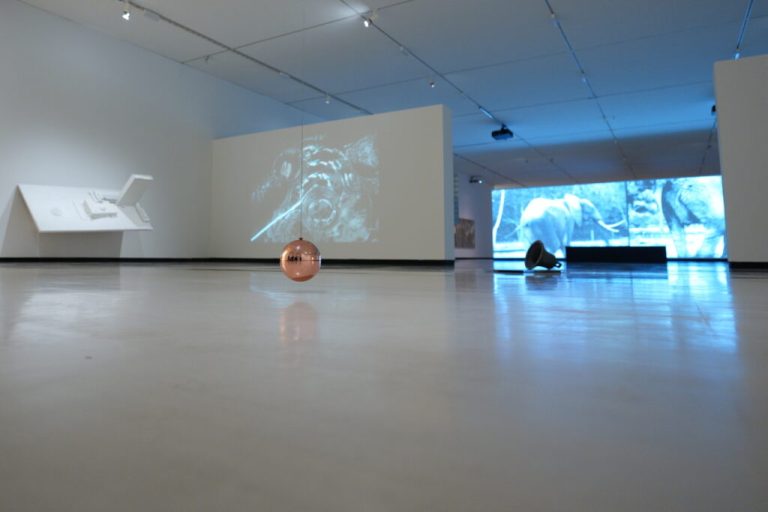
This is the author chosen by the Numa Espais Foundation of Culture to present what is his second exhibition in the port of Ciutadella, in Menorca, after which last year they gave Caspar Berger. Numa is a space founded by Marie Hélène Behale and Joan Pons in order to support artists and favor the development of local culture; In its first twelve months of journey, it has received about 10,000 visitors and in its rooms, bright and wide, both exhibitions and workshops and conferences take place. In its programming, nature plays an important role (also in its architecture, which integrates stone of Marés and Natural Roca), hence this choice of kitamura for its second sample.
They have gathered in Menorca thirty pieces, between inks and sculptures, which establish obvious ties between landscape and culture from notions such as transformation, inheritance, emptiness, ephemeral and primal; All arise from (and underline) the potential of thorough observation and listening to the environment as basic acts to understand both that nature and ourselves as their residents.
Most of the works, twenty -five, are sculptures: they have been produced by Kitamura for seven years and in the most diverse woods previously pruning or talled, from the oak to oak through the beech, the cypress, the cherry tree, the boxwood, the olive tree, the ivy, the apple tree, the laurel, the acacia, the mulberry tree, the lunch, the limestone, strains, sarm. Made in diverse formats, some reach three meters high and propose, ultimately, convergences between human activity and the cyclical of the natural environment that has to escape its control. As for the inks, seven, they offer the same dimensions as the largest sizes (three meters), but wide, and were executed in paper with Chinese, tempera, walnut, caobin and pearl paper that the artist assembled through a traditional technique of his country called Hyouguwhich makes it possible to mount paper and fabric so that the united fragments generate similar pieces to sliding doors, screens, hanging rolls or horizontal rolls.

There are three phases that vertebrate the work processes in Kitamura, which seeks to link in them the work of their hands with that of nature, conceiving itself, rather than as the author of the works, as an assistant in its realization. At first, he walks looking for his raw materials, although he tries to meet him rather than establishing concrete purposes in their findings. Those, necessarily slow, listening and observation actions are essential in these beginnings, in which it also carries out sketches to intuit the final form.
In a second phase, the wood clean, freeing it from its cortex to show its history and memory. And finally, in a third stage, it assembles the pieces respecting their personality, which were their natural shapes and veins. Instead of forcing the union of the fragments, the Japanese tries to find a balance between his intervention and the characteristics of the material, to which he attributes forms of will.

Kitamura assumes, in line with a Japanese tradition from which it has not moved away, that the void is an opportunity for transformation and also an emblem of detachment and the abandonment of the superfluous that must allow creation to sprout in an organic way. He is interested that his art can be integrated into a natural cycle -that his subjects are born -to recognize the life of the materials and let them express themselves by intervening them carefully.
One of its sources of influence was prehistoric art: it has traveled through various Spanish caves, perceiving that the pigments used in cave paintings are those found in the surroundings, and that this is the cause of the subtle differences between one and other shades. He also chose to work with the close and accessible, turning the next habitat into a mine of possibilities and not covering or hiding textures or notches. Only a very slow contemplation could make the viewer appreciate in his pieces the hand of the artist, a companion of the natural and atavistic forms.


Hiroshi Kitamura
Numa Foundation. Spanish culture
Plaça Quintana de Mar
Ciutadella de Menorca
From May 8 to October 31, 2025