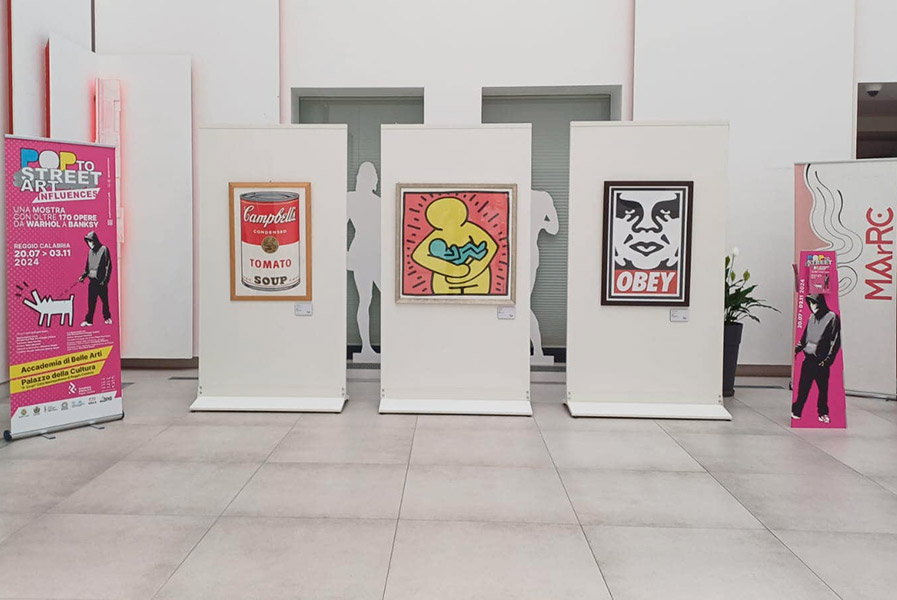
In Reggio Calabria (Italy), a pop art and street art exhibition dedicated to Andy Warhol, Keith Haring and Banksy served as a laundering for fakes. The 143 works, falsely attributed to these artists, were seized by the carabinieri (police) as part of a transnational investigation extending as far as Liège. Among them, 133, mainly attributed to Warhol and Haring, were seized in Reggio. Ten others, associated with Banksy, were identified in Liège. In total, 143 works are at the heart of the investigation. Eleven remain under assessment. Investigators see the hand of a counterfeiting network already identified under the name Operation Caryatid.
The works were presented in the exhibition “Pop to Street Art: Influences”, organized between July 2024 and January 2025 at the Academy of Fine Arts, the Casa della Cultura “P. Crupi” and the National Archeology Museum. The system was based on a loan contract between a Belgian company and the Academy, for an amount of around fifty thousand euros, to which was added revenue linked to ticketing and derivative products. Presented as official loans, the works drew their credibility from the institutional framework.
Investigators speak of “document laundering”. The work, sometimes mediocre, becomes difficult to contest once it is surrounded by certificates, stamps, catalogs and stories of provenance. The 143 works, some attributed to Warhol or Haring, bear falsified identification numbers and foundation references. Those associated with Banksy rely on counterfeit stamps and brands.
The Belgian company, whose name has not been made public, appears to be the center of the system, both supplier of the works and producer of their false provenance. Three Belgian nationals are accused. Two were indicted in Liège, one of whom is presented as the manager of the structure which rented the 143 works. The searches made it possible to seize other documents attributed to Banksy, as well as elements suggesting the organized production of false documents.
The case highlights a common phenomenon. Public institutions, in search of visibility, accept turnkey exhibitions of which they have no control over the origin or the conditions of expertise. In return, private lenders obtain institutional validation which makes their objects presentable, and therefore salable.
Investigations are continuing, particularly in Belgium, where around ten additional works are currently being assessed. The qualifications retained could include counterfeiting, fraud, criminal conspiracy and falsification of documents.
This operation stems from an investigation opened in 2023 by the Pisa public prosecutor’s office, in coordination with Eurojust, the European Union Agency for Judicial Cooperation in Criminal Matters. It uncovered a network of counterfeiters active in Italy, Spain, France and Belgium. The authorities have seized more than 2,100 fake works attributed to Banksy, Warhol, Picasso, Modigliani, Monet or Klimt, for an estimated value of around 200 million euros, with the identification of several production workshops, notably in Tuscany and Venice. Investigators noted the involvement of auction houses that organized catalogs and exhibitions of fake Banksys or fake Warhols, as well as exhibitions in public institutions, used to give apparent legitimacy to the pieces before their resale on the art market.