Chantilly (Oise). “The Monuscripts’ Mona Lisa” According to his almost official nickname, “A book that has no rival” According to the Duke of Aumale, and an inaccessible work – “It is easier to meet the Pope or the President of the United States”, estimates the expert of manuscripts Christopher de Hamel. THE teasingfor this exhibition dedicated by the Château de Chantilly to Very rich hours of the Duke of Berryis intense: but the visit to the course is a patience test before you can meet the “King of hours of hours”. The little sanctuary – How to call it differently? – fitted out to present the pages of the illuminated manuscript calendar, suspended in the dark, is located at the very end of the course. A politeness to the works presented upstream, explains Mathieu Deldicque, director of the Condé museum at the castle and exhibition commissioner: “No book equals the quality of Very rich hours. »» Not even the other five hours of hours ordered by Duke Jean I of Berry (1340-1416), gathered here for the first time.
But reaching the Holy of Saints is not a way of the cross: after a rapid passage on the rediscovery of this prayer book for the use of the Laïcs by the Duke of Aumale (1822-1897), the course evokes the artistic context in which objection this masterpiece, commanded around 1411 and completed in 1485. Then it was by sculpture that the visitor is invited to discover this art of the early 15th century Through the presence of the marble recumbent in the Duke of Berry, exceptionally out of his rest in the cathedral of Bourges, and accompanied by the sculptures of Jean de Cambrai. The portrait of a duke strongly invested in artistic patronage is thus brushed, despite the chaotic context of the Hundred Years War.
The presentation of the sponsor is followed by that of the artists, because The very rich hours form a complex work, on which several hands have intervened. The most important are those of the Paul, Jean and Hermann brothers of Limburg (around 1380-1416), already present in the role of secondary stakeholders for Very beautiful hoursfrom the Royal Library of Belgium, or the Small hourskept by the National Library of France. The first order entirely executed by the brothers, and entitled The beautiful hoursis also exceptionally presented, coming from the New York Cabinet.
Clever staging
The agency Jaams (which now knows the premises well, after the exhibitions Dürer in 2022 and Ingres in 2023) found an elegant scenographic solution to make the dialogue Very rich hours With the other books of hours presented upstream, while maintaining the suspense of the final discovery: two semicircles of picture rails are close to each other, one containing the outcome of the exhibition, the other its prefiguration a few years ago. Thanks to a little day spared in these picture rails, the visitor can even see the long -term leaflets on the calendar, while looking at the High hoursthe work that Jean de Berry wanted to surpass with the order of Very rich hours.
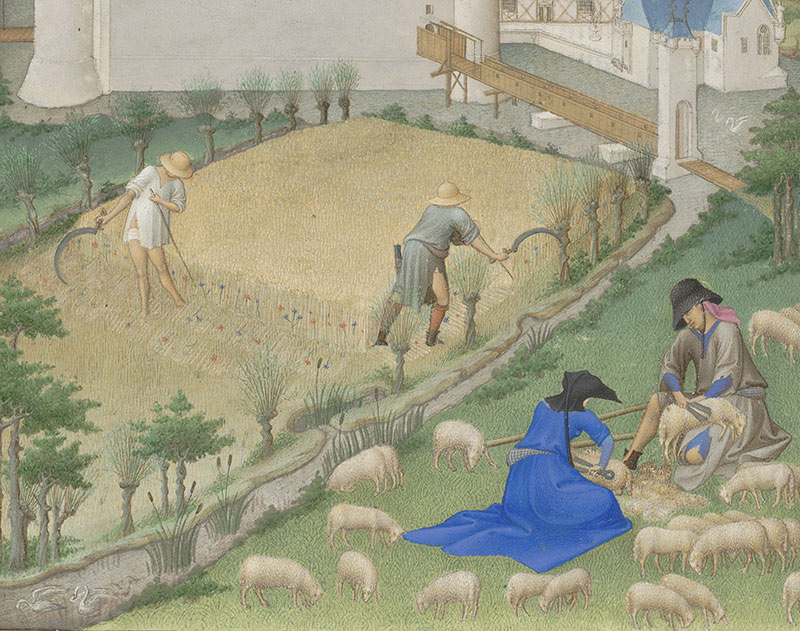
The very rich hours of the Duke of Berry,, “Month of July: harvest and mowing sheep”painting produced by the brothers of Limburg between 1411 and 1416.
© RMN-GP / Michel Urtado
The following section may appear destabilizing since it presents, before the Very rich hours, The fortune and the dissemination of his images in the contemporary decades at the completion of the manuscript, during the 15th century, by Barthélemy d’Eyck (1420-1470) then Jean Colombe (around 1440-1493?), According to the drawings of the brothers of Limburg. But the copies, moreover, of excellent bill, quickly give way to the original. Only the calendar notebook was released to allow each month to be presented as a real painting. While the MET had another preservation bias, by unleasing all of the Beautiful hoursChantilly makes a more prudent choice by guaranteeing the integrity of the object.
Behind this exhibition is an important catering project for this manuscript “A little too consulted in the XXe century, with dirt and cracks that could cause loss of matter ”, As Mathieu Deldicque describes it. This project, which requires derelying the pages of the manuscript, provides the unique opportunity to be able to observe each sheet at each sheet, hung in levitation in a box which allows a very close -up look. Because the exhibition is only a stage of the site: at its end, the precious vellums will regain their binding. The engineers of the C2RMF (Center for Research and Restoration of the Museums of France) and the restorers of the Atelier Coralie Barbe, in charge of catering, will then be the last lucky people to be able to allow themselves this tête-à-tête with the Very rich hours.