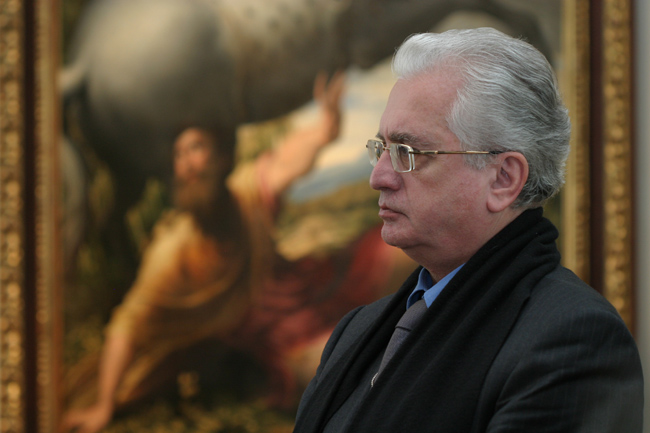
The European Union has adopted its twentieth package of sanctions against Russia. Among the sanctions, it included the name of Mikhail Piotrovsky (81), director of the Hermitage Museum in Saint Petersburg, on the blacklist of people subject to restrictive measures. For three decades, he embodied the cultural face of a Russia then considered acceptable. Brussels now considers him to be complicit in the war of aggression against Ukraine.
Mikhail Piotrovsky was born in 1944 into a family linked to the Hermitage. His father, Boris Piotrovsky, an archaeologist specializing in the ancient Near East, directed the museum from 1964 to 1990. A graduate in Arabic language and literature at the University of Leningrad in 1967, after a stay in Cairo, Mikhail Piotrovsky specialized in medieval Islam and the archeology of the Arabian Peninsula. Appointed general director of the Hermitage in 1992, he inherited a museum with a budget of around €920,000, which he profoundly transformed. At the end of the 2010s, the budget exceeded €69 million and attendance reached 4.5 million annual visitors.
In the early 1990s, he crossed paths with Vladimir Putin, then advisor to the mayor of Saint Petersburg Anatoly Sobchak. In September 2021, Mikhail Piotrovsky leads the list of the United Russia party, Putin’s party, in Saint Petersburg. In December 2024, the Russian president personally presented him with the order “For services rendered to the Fatherland” first class, the highest civilian distinction in Russia. In September 2025, the government renewed its contract at the head of the museum for five years.
The European Implementing Regulation placed Mikhail Piotrovsky on the list of persons subject to restrictive measures, based on three grounds. In an interview with the state daily Rossiyskaya Gazeta in June 2022, he described the Hermitage’s exhibition policy as a “special cultural operation, a powerful cultural offensive”, using the Kremlin’s official vocabulary for the invasion of Ukraine. He added that the war could be seen as a form of national affirmation. The Hermitage supported legislative efforts to incorporate cultural objects from Ukrainian museums in the occupied territories into the Russian State Museum Fund.
Furthermore, under his leadership, the museum conducted unauthorized archaeological excavations in occupied Crimea. Alexandre Boutiaguine, head of the ancient archeology sector of the Black Sea at the Hermitage, has directed since 1999 the excavations of the site of Myrmékion, a Greek colony from the 6th century BC located in the district of Kerch. Authorized by Ukraine until the annexation of March 2014, his work continued between 2014 and 2019. In November 2024, the Ukrainian Prosecutor General’s Office accused him of partial destruction of the site and appropriation of thirty gold coins for damage estimated at 200 million hryvnias (€4.1 million). Arrested in Warsaw in December 2025, his extradition to Ukraine was approved last March, before he was released during a prisoner exchange.
The consequences for Mikhail Piotrovsky are twofold: freezing of all his assets in the European Union and ban on entering or transiting the territory of any Member State. It was cut off from the network of partnerships and exhibitions that made the Hermitage a central player on the international museum scene.
But he is not the only one being pursued. The EU has also sanctioned the entire archaeological looting sector in Ukraine. Andrei Polyakov, director of the Institute for the History of Material Culture, is also on the list for excavations carried out in occupied Crimea between 2014 and 2023. Nikolai Makarov, director of the Institute of Archaeology, has been designated as a central player in Russian archaeological policy in the region. Sergei Obryvalin, Deputy Minister of Culture, was targeted for having authorized these excavations and supervising the reclassification of Ukrainian cultural property. The list also includes Anton Anisimov, for “spreading disinformation”, Igor Solonin for “erasing Ukrainian cultural memory” and singer Timati for his participation in a pro-annexation meeting in March 2022.
Initially scheduled for February 24, the anniversary of the invasion of Ukraine, the twentieth package of sanctions was blocked by a Hungarian veto. The defeat of Viktor Orban in the April legislative elections changed the situation.