Bordeaux (Gironde). An exhibition on several sites, which unfolds its multiple ramifications on both sides of the Garonne. From the CAPC-Museum of Contemporary Art to the Frac Méca (New Aquitaine Regional Contemporary Art Fund), via the Mériadeck library, the Aquitaine Museum and the Bordeaux Métropole Archives, Bordeaux’s cultural spaces are currently the scene of a vast curatorial program set to set a milestone.
There is no doubt that “Blackground” represents a major step in the work of remembrance begun by Bordeaux institutions for almost a decade regarding the role played by the Gironde port and its infrastructures in the development, from the 18th century, of the trade in goods produced in the colonies by populations reduced to slavery. After commissioning significant research into the history of its building, which served in the 19th century as a warehouse for colonial goods, the CAPC is today confronting the slave system and its “survivals”, according to the concept coined by the black American historian Saidiya Hartman. The term refers to “continuities through which colonial slavery continues to organize the material, political and symbolic conditions of the present, well beyond its abolition”, we learn from reading the critical glossary made available to visitors at the entrance to the exhibition.
Bringing together the works of around fifty artists originating, for the most part, from the French overseas territories of the Antilles, the Indian Ocean and the Pacific, the project probes the consequences of slavery on bodies and minds, its imprints in current political and economic models, while highlighting the lines of resistance which are perpetuated in the background – the title of the exhibition, a portmanteau inherited from the black American thinker Fred Moten, makes a direct reference to it.
Weaving a dialogue between the time of the colonies and the present, the two commissioners, Cédric Fauq and S. Mochtari, take an uncompromising look at the social and ecological issues that cross the overseas departments, regions and communities (the high cost of living in the West Indies, the treatment of the ravages of Cyclone Chido in 2024 in Mayotte), and this in an institutional landscape tending to euphemize subjects considered sensitive.
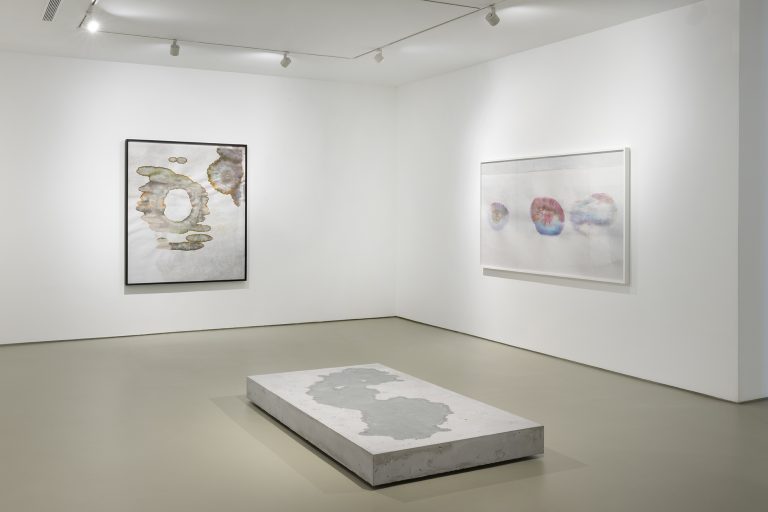
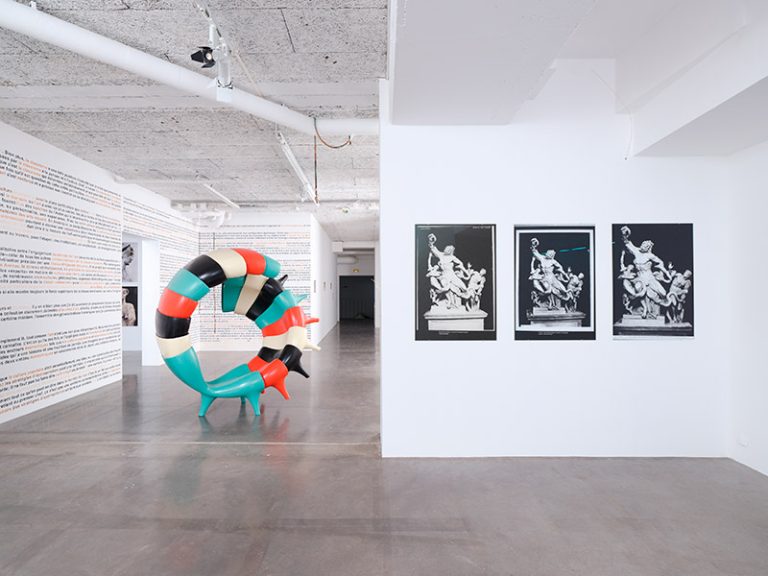
Katrina Palmer, Black Text2026, view of the exhibition “Blackground, murmure des mornes” at the CAPC in Bordeaux.
© Arthur Péquin
© Adagp Paris 2026
A wise choice
For more than two years, the commissioners carried out demanding prospecting work. “We did not want to only exhibit the artists we expect on these issues, explains S. Mochtari. We also wanted to put forward new perspectives. » The primary interest of “Blackground” lies in its ability to promote talented young visual artists who had, until now, never exhibited in mainland France.
If the exhibition offers varied aesthetic positions, with works from a diversity of mediums, the curators thought at length about the image regime that they wished to defend through this project. The body of work thus takes the opposite view of the violence of representations traditionally associated with the history of slavery. “We do not want to recirculate violent images because we think there are other ways to approach this story and to listen to the victims,” justifies S. Mochtari. At the Aquitaine Museum, which hosts around ten contemporary works in its permanent rooms devoted to triangular trade, the curators have decided to place “enigmatic works, which are in a form of formal restraint”. The historical objects and testimonies attesting to the violence of slavery in a frontal manner respond to symbolic and conceptual artistic proposals such as A Semblance of the Barracoon (2023) by Boz Deseo Garden, which transposes the traces of the transatlantic slave trade into a psychoanalytic diagram of Lacan. An ingenious choice that keeps the exhibition away from the banks of sensationalism and miserabilism.
The section of the exhibition presented at the Grand Verre, at the top of the Frac building, clearly illustrates this desire to represent the suffering of black bodies through a fragmentary or metaphorical representation. In this space overlooking the Garonne, the corporeality of trafficking victims is approached through an aesthetics of absence. In its superb organic installation Chorus of Soil (2020), Italian-Senegalese artist Binta Diaw sketches the framework of a slave ship using earth. A silent cemetery, this monumental skeleton carries within itself the seeds of renewal: melon shoots spring from its bowels and grow. With Black Noise 4 (2021), Swedish visual artist Ina Nian deploys a chilling immersive environment, reviving the sound memory of the holds of slave ships, between the creaking of wood and the clash of metal chains.
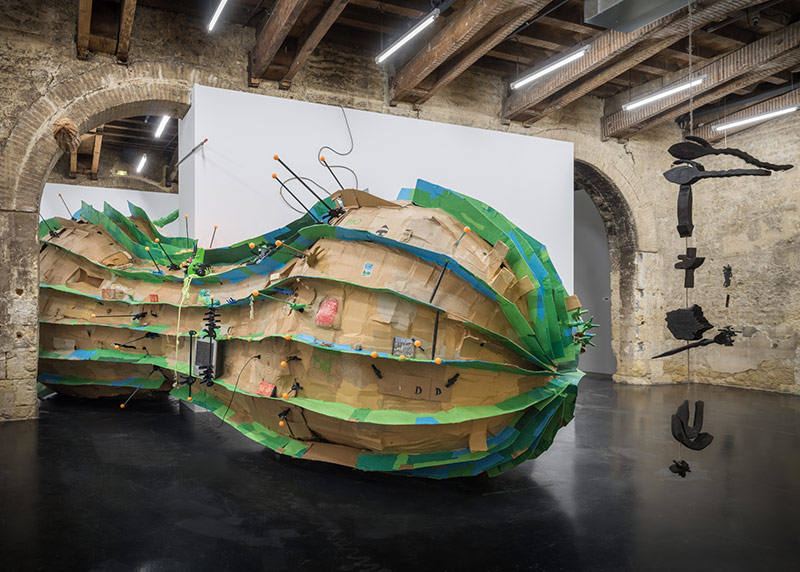
The choice of non-representation of the abused body finds a particularly convincing echo in the scenography of the CAPC galleries. Whispers, laughter, cries, songs: the first sensory data to reach the visitor are always of a sound nature. “We sought to embody the body differently, through the multiplicity and tangle of voices,” says S. Mochtari. Here and there, the voices overlap, respond to each other, blur. This overinvestment in sound material contrasts with the systematic obstruction of vision: the visitor is unable to take in the entire space with his gaze due to the partial occlusion of the building’s historic openings by picture rails. Monumental works are even embedded in the partitions, like Guéter Toubab Bou Noroul (2026, [voir ill.]) by Pap Souleye Fall, who questions the consequences of peanut monoculture in West Africa. To understand the enormous cardboard sculpture in its entirety, there is no other choice than to continue towards the next room.
With its labyrinthine shape and its limited perspectives, the route nods to the side roads that escaped Maroon slaves walked through the hills, these mountainous formations emblematic of tropical islands. This spatial arrangement makes up an intimate exhibition (the numerous picture rails form rooms of modest dimensions in which more than three or four works rarely coexist), sensitive to the powerful outbursts of voices as well as the faintest whispers.