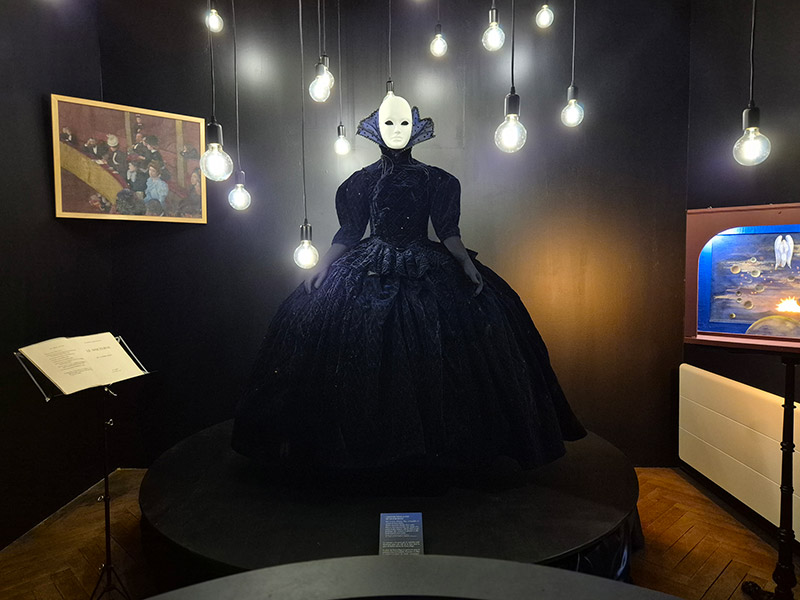
Mills (Cher). “Enter the Night” : on the parquet floor, a sticker invites the public of the Anne-de-Beaujeu Museum to discover the night as, from the end of the 18th century to the beginning of the 20th century, painters and sculptors imagined it. However, the first artist whose work we will see is the scenographer, Cyrille Bretaud. One of the great assets of the exhibition is the universe he created, dark blue of course, leading the visitor into the shadows of enchanted forests, under an enormous moon which floats overhead, and on the luminous traces, on the ground, of eagle owl paws. In the soft or deep darkness, works, objects and stuffed animals reflect the themes chosen by the curator, Guennola Thivolle.
Eager to highlight them, the curator relied on the museum’s collections to construct her argument. This collection constitutes half of the corpus presented. The rest comes from Parisian and regional museums and collectors. The Museum of Youth Illustration, the National Costume and Stage Center and the Pierre-Bassot Fund, all three located in Moulins, also participated.
Except for the print The Sleep of Reason breeds monsters (1806-1807) by Goya, the works lent are not beacons of art. And although Guennola Thivolle called on literature professor and philosopher Alain Montandon for the introduction to the catalog, she does not defend a historical or sociological thesis: the journey is a walk through different aspects of the night according to small or big names in art. If it is not flashy, it arouses emotion and is educational: all the works are commented on and their creator presented.
View of the “Imagining the Night” exhibition at the Anne de Beaujeu Museum.
© Delphine Desmard
The guest stars of “Imagine the Night” are Paul Baudry, Jean Béraud, Auguste Clésinger, Marcellin Desboutin, Eugène Devéria, Gustave Doré, Émile Gallé, Jean Léon Gérôme, Henri Harpignies, Jean-Paul Laurens, Jean Lecomte du Nouy, Luc Olivier Merson and Victor Prouvé. Their exhibited works are never the best known. Of the romantic Devéria, it is the extraordinary Hangman’s Round (nd) which came from Grenoble, a hallucinated vision of a man hanging from a tree trunk, on the side of a mountain and above the void, surrounded by a sabbath of ghost-women while, in the foreground, under a lantern, the rock seems to take human form. Among the supporting roles, we discover Eugène Assezat de Bouteyre, kitsch and charming, the orientalist Georges Duseigneur, Adolphe Faugeron, famous during the Belle Époque, the realist Amédée Guérard, Antoine Rivoulon, history painter and brother-in-law of Alfred Sisley. Around 1855, Armand Queyroy painted Couple fleeing in the moonlight : in the pale light of the star which has here taken the shape of an old man’s head, two peasants, pressed together, run across the fields.
Georges Rochegrosse, very represented
The ominous birds and bare tree branches of this drawing are found on the original border of Autumn wind (nd), a magnificent watercolor by Georges Rochegrosse. This endearing artist, whose museum has the most important collection, is also the most represented in the exhibition. By his illustrations, but also by The Call (1923), large canvas depicting an old man reading at his desk under a lit lamp, frightened by the appearance of Christ. When his wife died, the artist began signing “GM Rochegrosse” – the M being for Marie.
Because the visitor contemplates the works in this nocturnal environment, each of them is a discovery or a rediscovery. For the poster and the cover of the catalog, the curator chose Moonrise over a canal (around 1890-1900, [voir ill.]) by Charles Guilloux, a symbolist landscaper and passionate explorer of the lights of the night and its surroundings. Mysterious and meditative, this painting from the Anne-de-Beaujeu Museum seems made to illustrate the words of Alain Cabantous in the introduction to his History of the night. XVIIe-XVIIIe century (ed. Fayard, 2009): “Space and time, night is all together. »
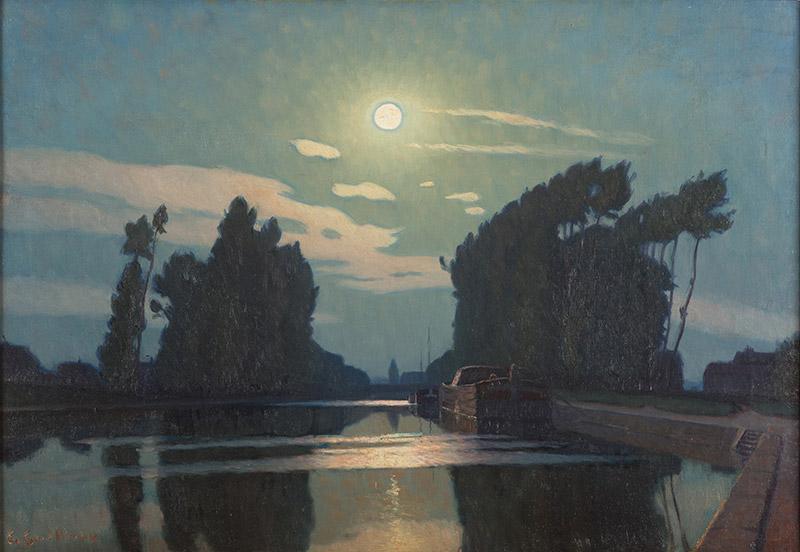
Charles Guilloux (1866-1946), Moonrise over a canal19th century, 26 x 21 cm.
© Anne-de-Beaujeu Museum / Jérôme Mondière