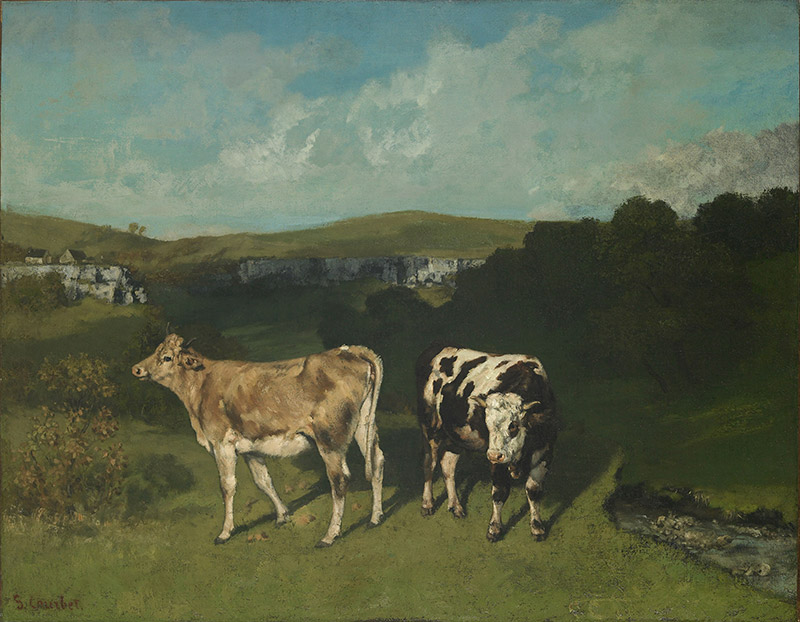
Ornans (Doubs). The representations of wild animals by Gustave Courbet (1819-1877) are well known to the public, whether they are large ungulates (deer, roe deer, wild boar) or Fox trapped (around 1860). For their part, art historians underline the importance of the subject of livestock in the work of this Franche-Comtois so attached to his native land. The Ornans Museum has two masterpieces in this area, Heifer and bull in pasture (around 1850) (see ill.) and, since 2019, The Calf (around 1873). While the first of these paintings was at the Musée d’Orsay during the work on the Musée d’Ornans, in 2020 and 2021, “Isolde Pludermacher, curator, had the bright idea of [le] to present […] between two renowned animal specialists: Rosa Bonheur and Constant Troyon. This unprecedented face-to-face initiated a reflection on the rise of animal representation in the mid-19th century.e century “writes Benjamin Foudral in the preface to the catalog. The exhibition which he curates with Thierry Laugée and Olivier Vayron “retraces the evolution of this art, from its elitist origins to its gradual democratization. Long considered a minor genre, animal art is experiencing meteoric growth […]driven by artistic, political, economic and societal issues. »
The route features a large panel of animal artists, from Paul Potter (1625-1654), to “animal origins of realism” and from which Courbet was directly inspired to Heifer and bull in pastureuntil François Pompon (1855-1933) whose synthetism constitutes a culmination of realism. The first section therefore focuses on the discovery by French painters of the Dutch Potter through his painting The Young Bull (1647), seized by French troops in 1795 to be placed in the Central Museum of Arts. In 1846, the writer Arsène Houssaye took advantage of this still lively craze to encourage a realistic movement among artists. Coming from an agricultural background, the author ofHistory of Flemish and Dutch painting (1846) states: “If they want to achieve realism like Rembrandt or Paul Potter, let them immerse themselves in nature and no longer study in picture galleries. » Potter’s followers were numerous and, at the Salon of 1848, the “Animal Art” section was created, presenting the work of Rosa Bonheur. This genre benefits from significant state investment in the industrialization of livestock farming, reveal the commissioners in the room panel devoted to rural reform. And Rosa Bonheur, of which is exposed Nivernais plowing (1849), was the most important of the artists responsible for making new cattle breeds known. It was therefore political decisions – and not the enthusiasm of art lovers – that sparked the rise of animal painting in the 19th century.
Paulus Potter (1625-1654), Landscape with cattle and milkmaid1643, oil on wood, 35 x 49 cm.
© Frits Lugt Collection, Fondation Custodia, Paris
Committed works
As for the breeders, some of them had their prize-winning animals portrayed as the English did for their exceptional horses. This is perhaps the case for the owner of the calf painted by Courbet.
In 1824, the Society for the Prevention of Cruelty to Animals was born in London and, in 1845, France in turn established the Society for the Protection of Animals (SPA). This is the year that the print appears The Good Comrade (drawing by François-Gabriel Lépaulle, engraving by A. Martinet), showing a little bourgeois boy sleeping near his dog. In the room dedicated to the defense of the animal cause by artists there is also More faithful than happy (1848), a painting by the Belgian Joseph Stevens representing a dog watching over a poor acrobat who died of cold with his little monkey. In the minds of artists, the public and critics, the animal now accompanies social demands when it is not their subject.
The artist, witness to the living
The last part of the course first analyzes the anthropomorphism which is spreading in society and art. It is not that of the fables of Aesop or La Fontaine but of a fundamental movement born from the questions that scientists and intellectuals ask about the animal psyche. At the same time, some animal artists become naturalists: they focus on describing species and their behavior. Here is Rosa Bonheur again, who painted the animals by which she was surrounded, and of which is presented Fox study (undated). Several works by Alfred Méry (1824-1896) reveal the talent of this painter of insects and birds (The Parisian Sparrow1884). However, the commissioners emphasize, the 19th century is the moment when we begin to understand the importance of each species in the balance of life. A room text tells us that“in 1855, the SPA warned of the destruction of passerines by man, which constituted an upheaval of the natural order”. We can only follow Thierry Laugée and Olivier Vayron who, in the catalog, note that “ […] certain concerns of the time resonate with subjects considered specific to our time, and are surprising in terms of their persistence”.