
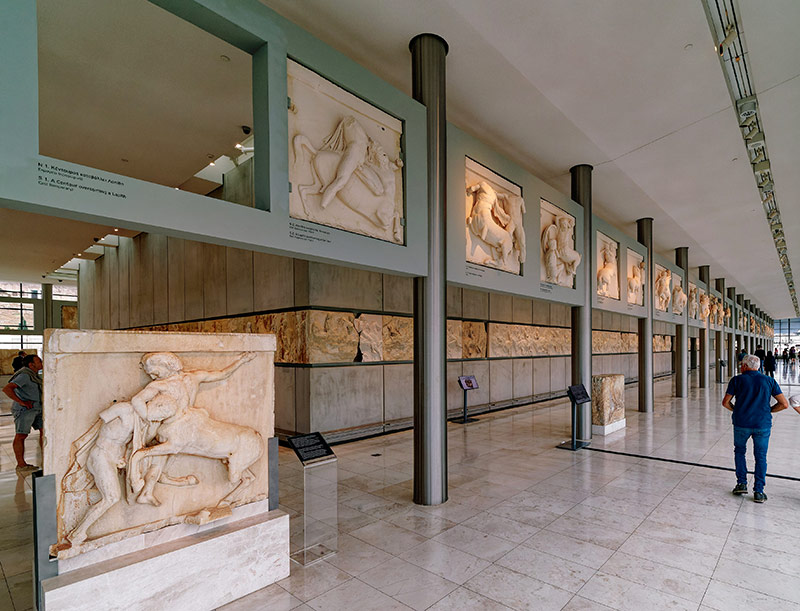
Greece maintains a clear course: the British Museum is not the rightful owner of the Parthenon marbles. And for Athens, this implies that it should not lend fragments that it claims as its own. As a result, the Liebieghaus Museum in Frankfurt had to endure the refusal of the loan of nine authentic fragments of the temple of Athena Parthenos, after the United Kingdom agreed to lend it two, from its collections.
The exhibition “Athena, the stage is yours: the Parthenon puzzle”, which is scheduled to open on November 18 at the Liebieghaus Skulpturensammlung in Frankfurt, will have to do without cooperation from Athens. Fearing that a display bringing together the marbles of the Acropolis Museum and those of the British Museum would be interpreted as a complacent gesture towards what, on the Greek side, remains perceived as a theft, the Greek Central Archaeological Council (KAS) preferred to remove the ambiguity.
The exhibition is to present the work of the research group led by archaeologist Vinzenz Brinkmann on the original composition of the eastern pediment of the Parthenon. Originally, it contained 39 figures representing in particular the birth of Athena from the skull of Zeus. The iconographic method, the tools of archeology and new technologies such as 3D scanning were used to reconstruct the sculpted group. The absence of the nine marbles from the Acropolis Museum in the hanging, whose objective is to offer a clearer understanding of the original appearance of the ancient composition, risks diminishing its interest.
The loan from the British Museum in Frankfurt is part of its policy regarding the Elgin marbles, which aims to demonstrate that their retention in its collections contributes to making them more accessible to the general public. One of the arguments frequently mobilized by the London museum in the context of the conflict with Athens is based precisely on the idea that the presence of marbles in its collections, as one of the most visited museums in the world, guarantees them visibility commensurate with the universality they embody. From the Greek point of view, the British Museum’s loan policy can be seen as a provocation. In 2014, the loan of a fragment of a pediment representing the river god Ilissos to the Hermitage Museum (Saint Petersburg) sparked a very critical reaction in the land of the Hellenes.
During the 25th session of the Intergovernmental Committee for Promoting the Return of Cultural Property to its Country of Origin or its Restitution in Case of Illicit Appropriation (PRBC), held last May at UNESCO headquarters, Greece once again claimed ownership of the Elgin Marbles kept at the British Museum, with the support of 20 states, including Turkey. More recently, on the occasion of the completion of the restoration of the west pediment of the Temple of Athena, on June 18, Greek Minister of Culture Lina Mendoni reaffirmed the State’s desire to recover these fragments. For its part, the United Kingdom continues to defend the legality of the original conditions of the transfer.
Between 1801 and 1805, while Greece was under Ottoman rule, the British ambassador to the Ottoman Empire Lord Elgin orchestrated the removal of almost half of the Parthenon statues, before selling them to the British government, which entrusted them to the British Museum. The dispute between London and Athens concerns the nature and legal scope of the “firman” – written decree issued by a sovereign of the Ottoman Empire – which would have given Lord Elgin authorization to dismantle and export the marbles. The original document has never been found, and only a translation into Italian appears in the archives of the British Museum, the validity of which Athens disputes.


