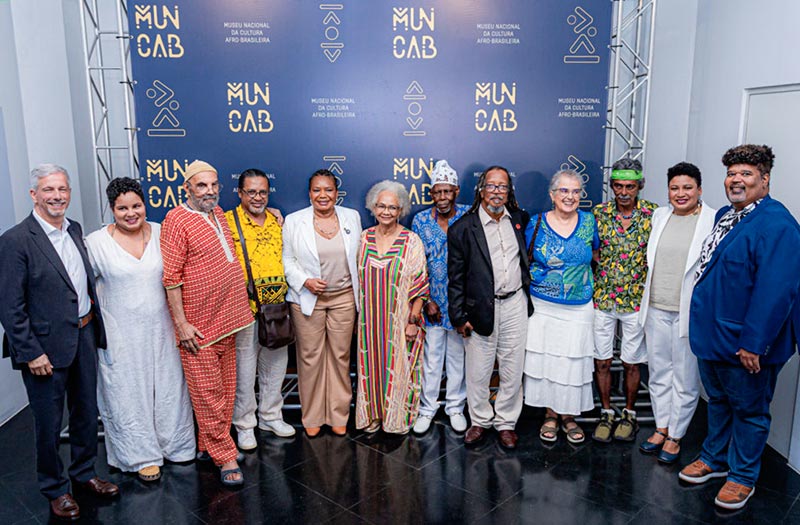
Brazil celebrated the largest donation of works of art in its history. On January 12, 666 pieces created by 135 Afro-Brazilian artists were voluntarily returned from Detroit in the United States to the National Museum of Afro-Brazilian Culture (MUNCAB), in Salvador de Bahia. Built over three decades of artistic production, this collection brings together paintings, sculptures, engravings, photographs, ritual objects and sacred art, representing several generations and regions of Brazil. Among the artists are more or less well-known names in Afro-Brazilian art such as J. Cunha, Babalu, Goya Lopes, Zé Adário, Lena da Bahia, Raimundo Bida, Sol Bahia and Manœl Bonfim.
At the origin of this donation, the artist Barbara Cervenka and the art historian Marion Jackson. For more than thirty years, they collected and preserved these Afro-Brazilian works as part of their Con/Vida project, launched in 1992. Between 1992 and 2012, taking advantage of their university holidays, they traveled every year to Brazil, mainly to Bahia, to meet artists. They acquired their creations, largely with their own money.
Over the years, their collection has grown to nearly 750 works from various states (especially Bahia, but also Pernambuco and Ceará). It notably includes Revolta dos Malês by Sol Bahia and a monumental sculpture in Oxalá wood, 2.1 meters high, by Celestino “Louco Filho” Gama da Silva. Added to this are objects of worship, ceremonial clothing and pearl necklaces linked to the religions of Candomblé and Umbanda.
Their “Con/Vida” project, based in Detroit, benefited from funding from the federal agency National Endowment for the Humanities (NEH) to organize traveling exhibitions disseminating folk art from the Brazilian Northeast in libraries, schools and small museums in the United States. The two University of Michigan retirees took advantage of the university networks in Detroit and Ann Arbor.
MUNCAB, for its part, is preparing to inaugurate a new exhibition devoted to a selection of recently donated works. Scheduled for the beginning of March, it will mark a new stage for the museum, which is continuing at the same time to develop its spaces in order to guarantee optimal conditions for the conservation of the pieces newly integrated into its collections.
Although the Con/Vida collection was constituted by legally acquired acquisitions from artists and communities starting in 1992, its return to Brazil is described as “symbolic reparation”. The stay of these works outside the territory for three decades is perceived as a form of cultural exile. It is also a way of highlighting Afro-Brazilian art in Brazil. Figures like Rubem Valentim (1922-1991) or Heitor dos Prazeres (1898-1966), whose work was the subject of a major retrospective in 1999 at the National Museum of Fine Arts in Rio de Janeiro, have often been classified as popular art or naïve art. Their recognition came late, sometimes posthumously.
However, the term “reparation”, as symbolic as it may be, remains debatable. Here, it is not a question of returning works resulting from looting or spoliation, but rather of a donation relating to contemporary works. Conversely, rather than seeing it as an exclusively reparative gesture, it can be analyzed as a factor of visibility. The exhibition of these works abroad helped to increase the notoriety of Afro-Brazilian artists.