
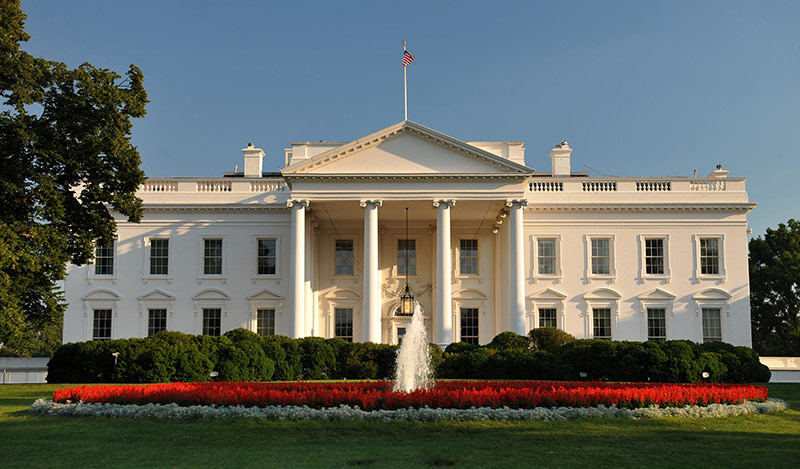
For Donald Trump’s entourage, the White House remains too discreet a palace. Rodney Mims Cook Jr., appointed in January to head the United States Commission of Fine Arts (CFA), suggested replacing the Ionic columns of the north portico with Corinthian columns. The CFA is a federal agency created in 1910 with the mission of advising the President, Congress and federal or District of Columbia authorities on issues of design, aesthetics and heritage interest related to the federal capital. In an interview with Washington Postwho is also the founder of the National Monuments Foundation, a private foundation specializing in major monumental and civic projects, affirms that the Corinthian is the most distinguished order. He is surprised that the main entrance to the presidential residence does not appeal to this “higher order”. However, he indicates that he has not submitted any formal proposal. The White House assures that no project exists.
The suggestion comes at a time when the presidential residence is already undergoing major transformations. The Trump administration has launched construction of a reception hall capable of accommodating more than 1,300 guests in an approximately 8,300 m² wing expansion. The new wing, decorated with Corinthian columns and monumental chandeliers, was to cost $100 million (88 million euros). The estimate now reaches almost 400 million (347 million euros). The White House says the operation will be financed by private donors, while security and maintenance costs will remain the responsibility of the state.
Other projects are circulating: transformation of the “Rose Garden” modeled on Mar-a-Lago (Trump’s property in Florida), installation of giant flag poles, even construction of an additional floor above the west colonnade to correct a symmetry deemed imperfect. The Corinthian columns, omnipresent at Mar-a-Lago as at the Trump Tower, stand out as a recurring motif.
The White House, however, is part of another tradition. Designed in 1792 by the Irish architect James Hoban and inspired by Leinster House, the White House was rebuilt after the fire of Washington caused by British troops in 1814. The current porticoes were added in the 19th century: the southern one in 1824 and the northern one between 1829 and 1830 for the arrival of official carriages. Six fluted Ionic columns approximately five meters high support this portico. Scottish roses and acanthus leaves adorn the capitals. The whole is part of a precise conception of executive power: a measured neoclassical architecture, borrowing from ancient forms without adopting the pageantry of palaces.
Ionic (left) and Corinthian (right) capitals at the Hôtel d’Assézat, Toulouse (1555-1557).
The architectural orders were codified by Vitruvius in the 1st century BC. The Doric, which appeared in the 6th century BC in the Peloponnese, is massive, without a base, with a simple capital. He represents virile strength and austerity. The Ionic, born in Asia Minor, has a slender shaft and ram’s horn volutes. Ancient theorists saw it as feminine grace. The Corinthian, developed in the 4th century in the Greek world and then in Rome, is distinguished by a luxuriant capital of acanthus leaves. He embodies opulence and grandeur.
For architectural historian Steven W. Semes, the Ionic order corresponds to the dignity, grace, and domestic intimacy of a residence. The Corinthian marks a peak of formality and monumentality. Modifying the capitals would, he said, “to surgically lengthen a leg”. Architect Bruce Redman Becker, former member of the Commission of Fine Arts, evokes a departure from the principles of heritage conservation.


