Dunkirk (North). One, art history, constitutes the discursive form of art museums par excellence while the other relates to a field of study not very widespread outside of the University, museology. Under the title “Museums Beyond Borders”, the Frac (Regional Contemporary Art Fund) Grand Large has undertaken a complex exercise: intertwining the history of art and the history of museums – in this case, the Kunstmuseen of Krefeld (Germany), which consists of the Kaiser-Wilhelm Museum (KWM) and two modernist villas designed by Ludwig Mies van der Rohe in 1928-1930.
It is a successful bet for Keren Detton, the director of the Frac and curator of the exhibition, who has managed to retrace more than a century of artistic creation and institutional activity, from the dawn of the 20th century to the present day, by focusing on the acquisition policy, the exhibitions and the personalities who have forged the identity of the Kunstmuseen since their opening in 1897. To deploy her double narrative, the curator has judiciously opted for a chronological route while providing, in each section, contemporary counterpoints to energize the whole. The Frac’s finesse in terms of written mediation also results in an exhibition adapted to different types of audiences: developed, sensitive and musical cartels punctuate the route and enrich the experience of the visit as desired.
At the confluence of art, craft and design
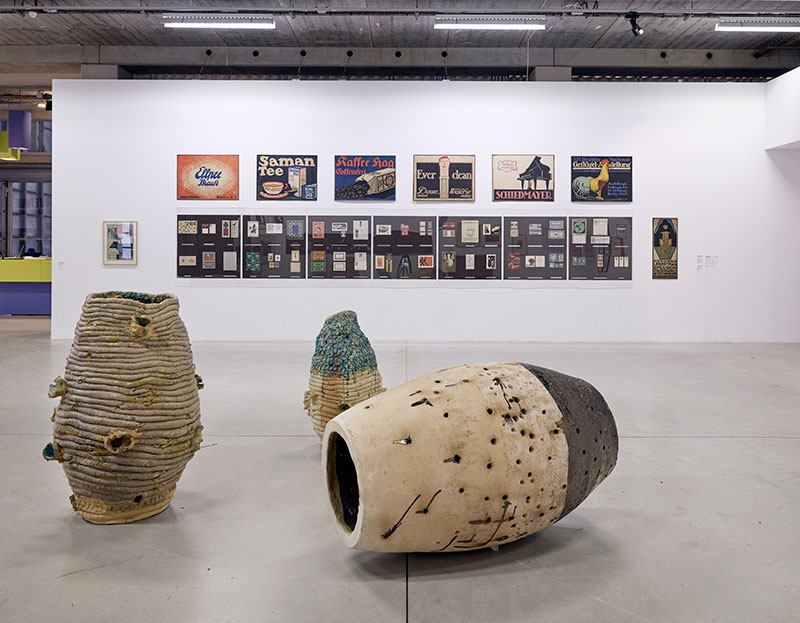
The first section of the tour focuses on the first thirty years of KWM’s existence and the attraction of its first director, Friedrich Deneken, for art forms bringing closer to industry. This room is also a story of the metamorphosis of the curved line into a straight line in the last hours of the Jugendstil.
The choice of the first work in the exhibition crystallizes the ambitions of the curatorial project: the poster designed by Alfred Mohrbutter (1867-1916) promotes the first KWM exhibition while having a certain artistic interest with its lettering typical of Art Nouveau. The exhibition also gives pride of place to industrial design and advertising art from the 1900s through a selection of superb posters from the Deutscher Werkbund and the Wiener Werkstätte, before looking at some figures from the Bauhaus, the quintessence of the union between art and craftsmanship.
Beyond this section, the intersection between art and industry is one of the guiding axes of the history of art written by Keren Detton: the large room presents a compendium of masterpieces from the history of design, with sitze (1988/1989) by Franz West and Stuhltisch mit drei Stuhlen (1968) by Timm Ulrichs.
The Frac also placed emphasis on the opening, at the end of the war, of the Kunstmuseen to the new avant-gardes under the aegis of Paul Wember. Archive photos show installations in situ memorable displays deployed in the two modernist villas from the 1960s. A “room of masterpieces” also presents a set of New Realism pieces from the KWM collection, and emphasizes the determining role that the museum played in the careers of some of its representatives: the Krefeld museum offered Yves Klein his first monographic exhibition in 1961.
Through this artistic-museum history, a history of Franco-German relations emerges, in the context of this year’s commemoration of the 50th anniversary of the twinning of the City of Dunkirk with that of Krefeld, where the first part of this exhibition was presented in 2024, composed of a selection of works from the Frac Grand Large.