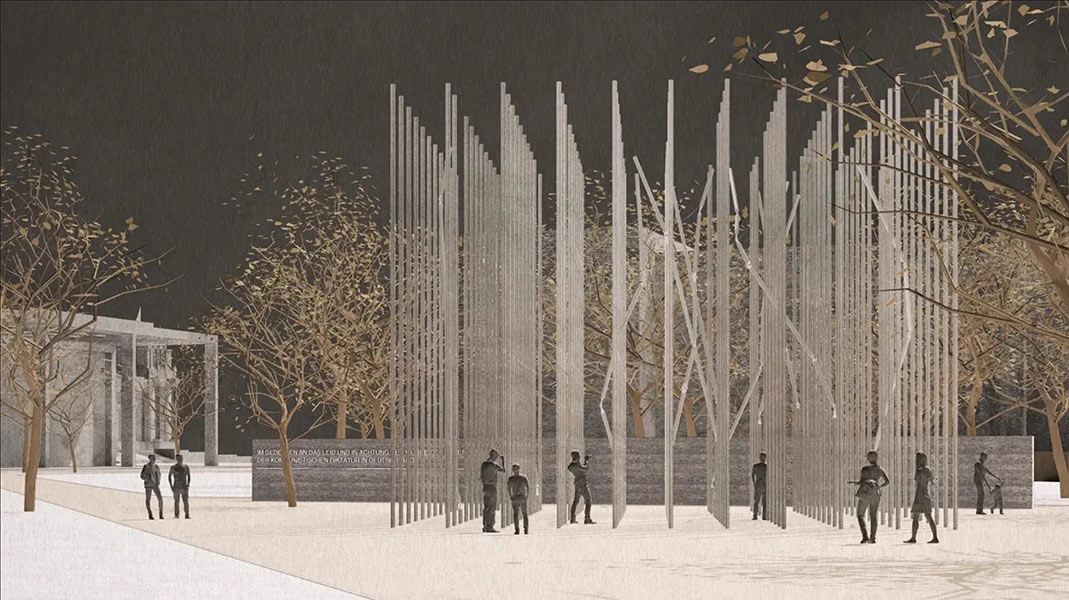
The Minister Delegate for Culture at the German Federal Chancellery, Wolfram Weimer, has just presented the winning project in the design competition for the national memorial dedicated to the victims of the communist dictatorship in Berlin. “Formation und Aufbruch” (“Training and New Momentum”), jointly sponsored by the Leipzig architectural firm ZILA, the Dresden firm Rehwaldt Landschaftsarchitekten and the artists Bea Meyer and Michael Grzesiak, was awarded first prize by an independent jury.
Federal funding of 5 million euros covers the organization of the competition and the creation of the monument. Scheduled to begin in 2027 and to be completed in 2028, the development will take place in Spreebogen Park, a strategic location in the heart of the capital, located between the Chancellery and the Bundestag. Made up of 121 metal pillars approximately 10 meters high, distributed in 11 rows of 11, the installation invites visitors to wander between its structures and interact with them. Through the repetition of its vertical elements arranged in a grid and the stroll that it offers visitors, the project is reminiscent of the memorial to the murdered Jews of Europe, designed by Peter Eisenman and inaugurated in 2005 in Berlin.
The pillars are supposed to represent the rigidity of collective organization imposed by the Socialist Unity Party (SED) regime from 1949 to 1989 in the GDR. Inscriptions corresponding to the different forms of persecution suffered by the victims of the dictatorship will be legible, such as “Ausbürgerung” (loss of nationality), “Familientrennung” (separation of families), or even “Zwangsarbeit” (forced labor). Some pillars will be deformed or twisted to symbolize the resistance of individuals who refused to comply with the regime and suffered the consequences.
Adopted in the Bundestag in 2019 following a proposal from the CDU/CSU (center-right alliance) and SPD (social democratic) parliamentary groups, the project responds to a request made by the Union of Associations of Victims of the Communist Dictatorship for around twenty years. It aims to satisfy the need to make the memory of this period a national issue, and not just specific to East Germany, by providing citizens with a common gathering place.
Other places of memory in Germany are dedicated to the victims of the East German Communist Party, starting with the Berlin Wall Memorial. The capital is also home to the memorial set up in the former Stasi prison, open to the public since 1994, where thousands of political opponents were locked up. In Saxony, the former Bautzen prison has also been converted into a place of memory and welcomes around 80,000 visitors per year. At the old border, the Point-Alpha observatory can also be visited to discover the history of this major location of the Cold War, an outpost of American NATO soldiers.