
Paris. She is evanescent, and yet frozen on the canvas. On the walls of the Louvre, the imprint of Christ’s face emerges from an immaculately white cloth, the one handed to him by Saint Veronica on the way to Calvary. Serving as an introduction, the presentation of the Holy Face (1635) by Zurbarán is particularly eloquent. The work immediately poses a question that has always bothered painters and sculptors of the Spanish Golden Age: how to make the manifestation of the divine in everyday reality perceptible, with as much realism as possible?
A two-part dialogue
Within the Napoleon hall, two exhibitions coexist, thought to be both independent and complementary. On the one hand, a tour devoted to Spanish religious sculpture of the 17th century, revealing the striking naturalism of twenty-three masterpieces in polychrome wood loaned by the Museo Nacional de Escultura de Valladolid and presented in France for the first time. On the other, a rich selection of works by Francisco de Zurbarán (1598-1664), one of the great masters of Spanish painting of the 17th century alongside Diego Velásquez (1599-1660) and Bartolomé Esteban Murillo (1617-1682). “By presenting an exhibition of sculptures at the same time as that on Zurbarán, it was not a question of mixing the two routes. The discourse around his painting unfolds according to its own coherence, especially since Zurbarán did not polychrome sculptures unlike other Spanish painters.specifies Valérie Carpentier-Vanhaverbeke, chief curator at the Department of Sculptures, who designed the exhibition “Sculpting Color” with Alejandro Nuevo Gómez, director of the Valladolid Museum. “But Zurbarán is also an artist whose painting has often been said to be sculptural. We sometimes have the impression of seeing sculptures stand out through his paintings, in the treatment of shadows and light”she adds. In fact, the idea of a double presentation hits the right note. Starting with this panorama of religious sculptures provides a context that is good to have in mind when contemplating the paintings of the Sevillian master. This first part immerses the visitor in the deep religiosity of the Golden Age, a period when the cult of relics and holy intercessors was authoritative. The exhibition brings together human-sized sculptures, half-length figures and small devotional statues, all strikingly realistic in the rendering of skin tones, in their anatomical precision and in the intensity of expressions of bliss and pain.
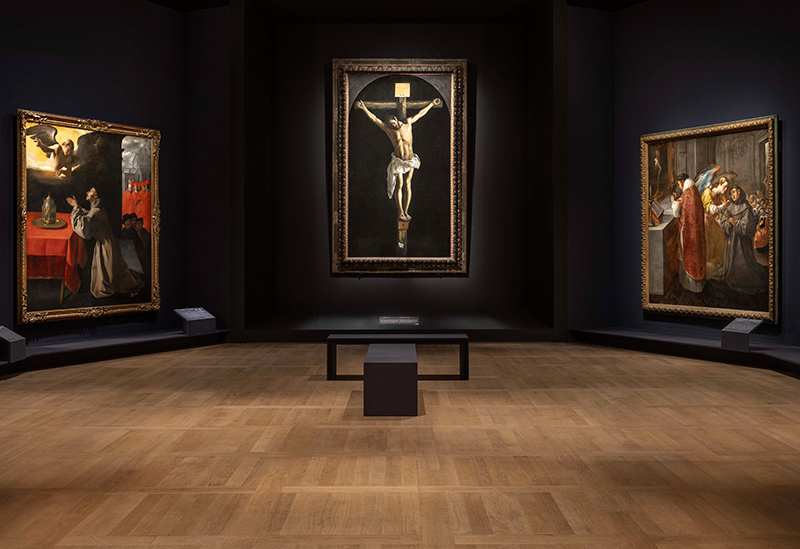
View of the “Sculpting Color” exhibition at the Louvre Museum.
© Louvre Museum / Audrey Viger
Presented in its entirety, the Camino del Calvarioone of the processional groups (pasos) the most famous in Valladolid, recalls here how sculpture then fully participated in the religious experience, beyond the walls of the church. With didacticism, the exhibition clearly details the colors and materials used, the function of these sculptures, their presentation during processions… Enough to better understand the spiritual and symbolic significance of these works. As for the connection that can be established with the work of Zurbarán, this is reinforced by the scenography designed by the Nathalie Crinière agency. Uncluttered, it leaves room for the works while allowing for some well-thought-out visual effects. In the foreground, the eye can, for example, linger on the details of a Saint Nicholas of Tolentino, carved with meticulousness bringing out its veins like those of the wood of his crucifix. Through the gaps in the picture rails, it is a painting of Saint Jerome, hollow stomach and fleshless torso, which is then revealed almost by stealth.
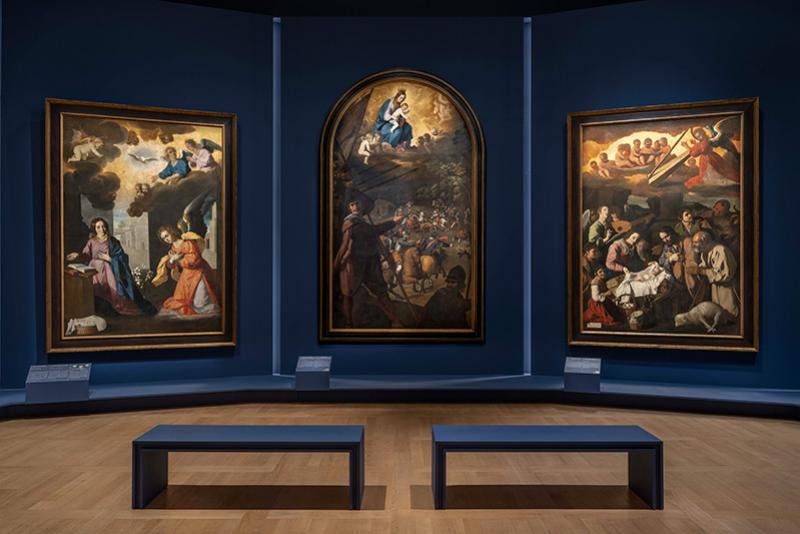
View of the “Zurbaran” exhibition at the Louvre Museum.
© Louvre Museum / Audrey Viger
Rediscover the master
It has been almost forty years, since the major retrospective devoted to him by the Grand Palais in 1988, since such an important group of works by Francisco de Zurbarán had been brought together in Paris. In total, around fifty autograph paintings are brought together, out of the sixty-five in the exhibition. From Zurbarán, we know its essential saints, imbued with solemnity, or its famous Little sheep (“Borreguillo”) of the Prado. These emblematic works are very present, but the exhibition invites us to go beyond this familiar image to reveal the multiple facets of the artist. “The idea was to make known or to rediscover a less austere face of Zurbarán, to show that he was not only the painter of monks, but also a portrait painter, an immense colorist… The plastic power of his painting, its purity, constitute something entirely singular. Once you see his work, you don’t forget it.”insists Charlotte Chastel-Rousseau, chief curator in the Paintings department and co-curator of the exhibition. An impression that the tour confirms by highlighting all the richness of the artist’s painting, between expressive work of light, power of compositions and subtlety of shades of white.
Some works surprise, like his Colossal head painted around 1635, a gigantic male face which would have been produced as part of a series dedicated to Hercules, commissioned by the King of Spain Philip IV. In another pictorial register, the exhibition also reveals a lesser known aspect of his work: still lifes where Zurbarán combines meticulousness of line, sobriety of composition and geometry of forms. It also highlights the production of his last years, also less familiar to the general public, by establishing a judicious parallel with the young Murillo then in full emergence.
Finally, it is impossible to conclude an exhibition on Zurbarán without coming across his representations of Saint Francis of Assisi, of which the painter has multiplied the versions. Rather than bringing together as many as possible, the museum chose to present only two, compared with works by Édouard Manet (1832-1883), Juan Gris (1887-1927) and Pablo Picasso (1881-1973), which bear witness to their posterity. A bias as relevant as it is unexpected, inviting us to reconsider Zurbarán in a new light.


