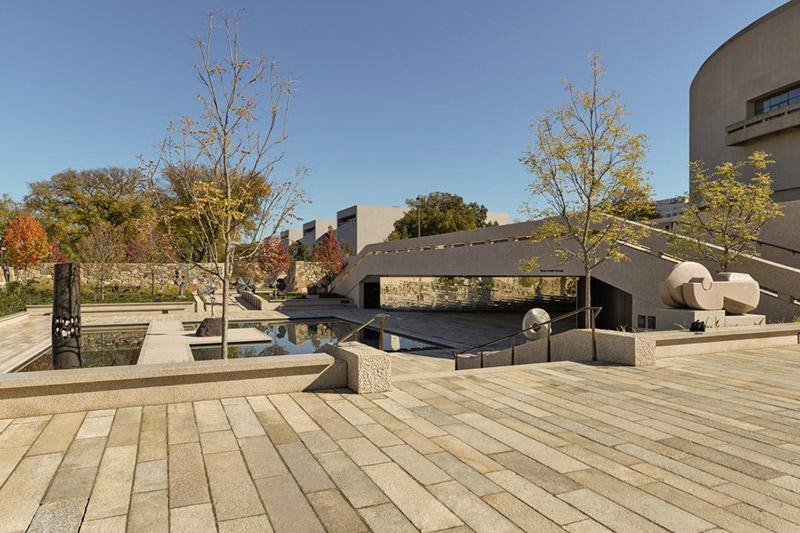
After four years of construction, the Hirshhorn Museum sculpture garden can once again welcome the public. A constitutive element of the identity of the establishment, whose interior spaces had remained accessible throughout the duration of the work, its reopening on October 31 made it possible to restore the experience of the museum as a whole. It completes the most complete redevelopment in the history of the institution, entrusted to the Japanese architect Hiroshi Sugimoto.
Accessibility is one of the main guidelines of the renovation project. The 5,260 m2 garden can now be accessed through five entrances instead of two, notably through the main entrance on the side of the National Mall, a large 3 km long esplanade connecting the Capitol to the Washington Museum, enlarged to reach 18 m high. Closed since the 1980s, the underpass located under Jefferson Drive, connecting the garden to the museum square, has been completely restored. Hiroshi Sugimoto made it a “passage of reflectance”, playing on the term “reflection”, which designates both the physical reflection of light on the large stainless steel walls, and the symbolic meditation of the visitor taking this transitory path.
While preserving the original characteristics of the architecture of Gordon Bunshaft (1909-1990), Hiroshi Sugimoto’s project optimizes the reception capacity, not only of visitors, but also of the works, as well as future events which may take place in the garden. A new space (“West Lawn”) has been designed to accommodate monumental installations and temporary exhibitions. The redevelopment allowed the museum to double its permanent exhibition, from 35 to 60 sculptures, to create a dialogue between works from the museum’s original collection and more recent acquisitions. Finally, the historic water mirror, located in the center of the garden, has been enlarged and enhanced with a performance stage inspired by traditional Japanese theater, intended to host performances.
The sculpture garden at the Hirshhorn Museum in Washington DC.
Courtesy Hirshhorn Museum and Sculpture Garden
Announced in 2019, the project took place in two main stages. The first, from 2020 to 2023, focused on the renovation of the envelope of the museum building. The workers replaced the concrete panels of the facade and the roof, as well as improving the insulation. Only once the first phase was completed did the renovation of the sculpture garden begin, in 2023.
Originally, the Hirshhorn Museum also planned a redevelopment of the lobby and interior spaces of the main building, with the aim of expanding the galleries, modernizing technical equipment, accessibility and security, at a cost of $440 million. But the project had to be scaled back in 2025, following budget cuts from the federal state, and the interior renovation abandoned.
For the 2024 fiscal year, the American Congress reduced the federal envelope for the Smithsonian, by imposing a cut of $54 million in the budget devoted to real estate investments, despite opposition from the Biden administration. The operating budget allocated to the Washington DC establishments, however, remained the same. As a result, the Hirshhorn had to limit its ambitions, and devote the $107 million estimated for the project to the renovation of its outdoor spaces. Just over $45 million came from Smithsonian funds, and federal appropriations had been another major source of the project.
Founded in 1974 following a donation from Joseph H. Hirshhorn, a collector of Latvian art, the Hirshhorn Museum and Sculpture Garden provided the city of Washington with its first museum dedicated to contemporary art. It is based on a collection of 12,000 works, which offers a large place to modern sculpture, but also to post-war painting, contemporary art and new mediums. While strolling through the garden, the visitor comes across masterpieces, such as all of the Burghers of Calais (1884-1889) by Auguste Rodin or the series of Backless (1909-1931) by Henri Matisse, emblematic of the quest for purification pursued by the artist in the repetition of the motif. Gordon Bunshaft’s building expressed from the outset the ambition to create a contrast, through its modernist architecture with brutalist influences, with the neoclassical facades which line the National Mall esplanade.
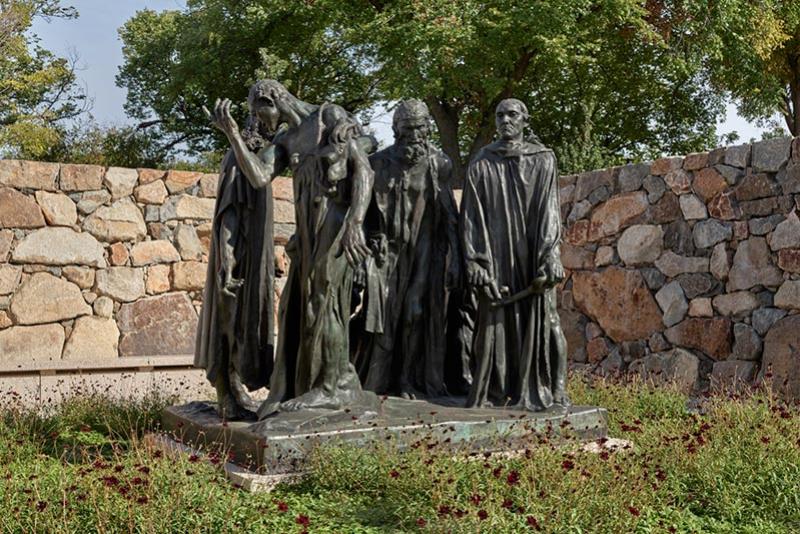
Auguste Rodin (1840-1917), The Burghers of Calais (1884–1889 / cast iron 1953–1959), Hirshhorn Museum and Sculpture Garden.