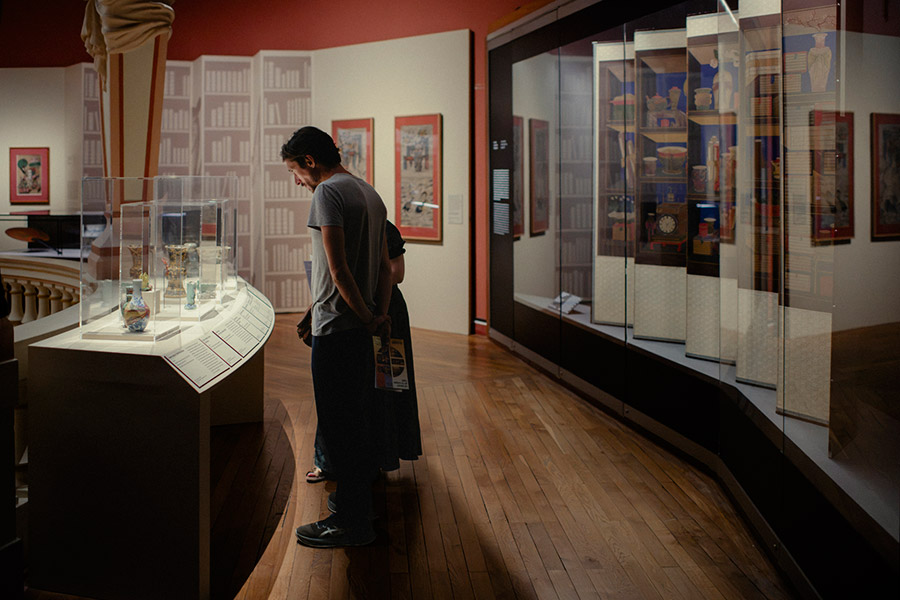
Paris. While it is common in the 21st century to post a library full of fake books on social media, this practice was already underway among Korean elites in the 18th century, but for less frivolous reasons. Under the leadership of King Jeongjo (whose reign lasted from 1776 to 1800) and his interest in books, artistic circles were ordered decorative objects imitating the shelves of a library. “These trompe-l’oeil patterns (chaekgeori in Korean) first illustrated screens intended for the imperial palace, then a long period of peace allowed this movement to spread throughout society.specifies curator Arnaud Bertrand, curator of the Korea and ancient China collections at the Guimet Museum. In addition to books, the screen panels also represent small refined objects, vases of flowers, jade statuettes, inkwells. “Traditionally, there are no shelves full of objects in Korean interiors”explains the commissioner, who adds that these screens show specific objects, “associated with the elevation of the spirit through knowledge and the arts”. The route includes several screens rarely exhibited where flowers, books with bound covers, scrolls of calligraphy are displayed: all motifs that make up “an ideal office” imaginary. Small objects in the shape of animals or plants dot the route to show that the taste for trompe-l’oeil spread to other decorative arts in Korea, sometimes through contact with Europeans.
View of the exhibition “Knowledge in trompe-l’oeil. Korea, 18th-20th centuries” at the Guimet Museum.
© Nicolas Fagot / Guimet Museum
Abstract geometric games
Because Korea in the 18th century was not closed to the world and exchanged ambassadors with its neighbors, notably China. A long painted scroll (5.5 meters) from the Joseon period (late 14th-early 20th century) presents the meeting between a Korean ambassador and the emperor of China, an opportunity for Korean diplomats to discover the baroque art of the Jesuit churches of China where trompe-l’oeil is central. Under the influence of this art and the translation of scientific treatises, Korean artists adopt perspective, and devote themselves to “geometric games” on the screens which take on the appearance of abstract canvases according to the curator, an abstraction echoed by the scenography with accordion panels.
The purpose of the screens is to “to encourage the observer to enrich his knowledge and go to a real library”explains Arnaud Bertrand. But the last section shows how screens and decorative panels reinvent trompe l’oeil to represent “a cabinet of desires” in the 19th century, with images of cigarettes, pairs of glasses, bowls of fruit: these screens give off an impression of strangeness to the eyes of a Western visitor accustomed to seeing objects in an interior and not their representation. The whole exhibition remains a little cold despite the presence of a digital device which allows the creation of a personalized virtual library, from a type of shelf, a selection of books and objects, scientific instruments, world maps… The trompe l’oeil was reserved for the Korean elites and bourgeoisie, and what is perhaps missing here is an audiovisual device to bring these ultimately very intellectual objects to life.
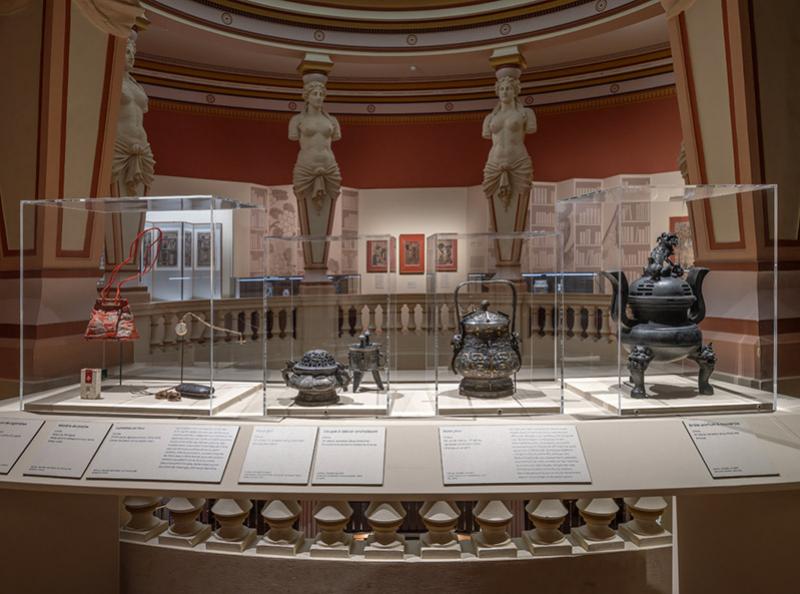
View of the exhibition “Knowledge in trompe-l’oeil. Korea, 18th-20th centuries” at the Guimet Museum.
© Luc Boegly / Guimet Museum